
Overview
How Atomgigs works: sources, catalysts and buyers
Atomgigs does not build machines. It helps makers go to market, advises buyers and delivers work done and data.
- Go-to-market: where, how and to whom
- Gigs: jobs for their machines and talent
Paid by Makers: GTM fees; buyers: per gig
- Advice and investor diligence
- Project bidding and execution
Paid by Catalysts: advice, projects
- Hyperscalers
- Colocation providers
- Neoclouds
- AI labs
- Enterprise and edge
- Automakers
- Other manufacturers
- 3PLs (logistics firms)
- Carriers
- Warehouse operators
- Builders and owners
- Program managers
- Energy and power
- Mining, oil and gas
- Transit and telecom
- Public works
- Police, fire and rescue
- EMS
- Security operators
- Corrections and border
- Military installations
- Defense primes
- Healthcare
- Hospitality
- Real estate, facilities
- Food service
- Retail and agriculture
- Waste and recycling
- Data to train robots
- Real-site task data
- Video and sensor data
- Labs pay for the data
- Buyers get a discount
We offer Advice and work done for buyers; data for physical AI labs. Paid by Buyers: advice, capacity; labs: data
Numbers 01 to 12 are primer numbers: each box has its own detailed primer.
Ten facts that frame the field.
The essentials a decision-maker needs before any conversation about machines.
A fragmented field
About 17,500 police agencies and 29,500 fire departments buy separately.
Volunteers carry fire service
62% of about 1.02M U.S. firefighters are volunteers.
Drones went mainstream
1,000+ agencies are cleared for drone-first-responder flights.
Defense money is large
$839.2B was enacted for FY2026 defense.
Grants steer local buying
About $1.06B in FY2026 homeland security grants.
Drone rules changed
New foreign-made drones are barred from FCC authorization.
Cyber rules reach suppliers
CMMC phase 2 began 10 Nov 2026.
Trust decides adoption
50+ communities canceled police camera contracts in 2026.
Small-business funding reopened
SBIR and STTR were reauthorized in April 2026.
People stay in charge
Humans in the lead, physical AI in the loop.
Sources: BJS, NFPA, NVFC, FAA, House Appropriations, FEMA, FCC, DoD CIO, Stateline. Figures as of Nov 2026.
Your world
Landscape and scale, how you buy, compliance gates, trust, privacy and civil liberties, responsible AI, human in control, vocabulary.
ATOMGIGS
Landscape and scale
Who the primer serves, the numbers, and where machines are proven.
On the following pages
01
Who this primer serves.
9
04
Where machines are proven today.
12
02
Public safety in numbers.
10
03
Defense in numbers.
11
Seven groups share one need.
Who this primer serves.
Police
Municipal, county and state agencies: patrol, investigations, traffic and scene work. Machines add eyes, reach and safer entry.
Fire and rescue
Career, combination and volunteer departments: fire, rescue, hazmat and wildfire. Machines add eyes in smoke, heat and height.
EMS and emergency ops
Ambulance services, 911 centers and emergency operations. Machines add situational awareness and supply delivery.
Security operators
Corporate, campus, venue and critical-infrastructure security. Machines add patrol hours and perimeter coverage.
Corrections
Jails, prisons and detention centers. Machines add rounds, inspection and routine logistics.
Border and customs
Ports of entry, border corridors and customs sites. Machines add wide-area observation and inspection support.
Military sites and primes
Bases, depots, arsenals, shipyards and the firms that serve them. Machines add maintenance, logistics and inspection capacity.
So what. Each group buys differently, so Chapter 6 treats them one by one.
Public safety is large and fragmented.
Public safety in numbers.
~17,500
state and local law enforcement agencies, 2018
1.2M
full-time sworn and civilian law enforcement staff
~29,500
fire departments in the U.S., 2020
62%
of about 1.02M firefighters are volunteers, 2026
What the numbers say
| Level | Examples | Who decides |
|---|---|---|
| Municipal | City police and fire | Chief and city council |
| County | Sheriffs, county fire, jails, EMS | Board of supervisors |
| State | State police, emergency management, corrections | Department procurement |
| Federal | Border, customs and protective services | Agency contracting officers |
| Special districts | Campus, transit, airport and port forces | District board |
- About 17,500 state and local agencies employ 1.2 million full-time sworn and civilian staff.
- Half of local police officers work in jurisdictions of 100,000 residents or more. The rest serve smaller places.
- 82% of fire departments are all or mostly volunteer.
- Recruiting and retention are the shared pressure. Machines extend what each person can cover.
So what. Thousands of separate buyers means many small decisions. Few agencies can build technology capacity alone.
Sources: BJS (2018, 2020); NFPA (2020); NVFC (2026).
Defense money is large and concentrated.
Defense in numbers.
$839.2B
FY2026 defense appropriations enacted
3 Feb 2026
Consolidated Appropriations Act, 2026 signed
1.30M
active-duty end strength funded
764,900
selected reserve end strength funded
How defense money flows
| Buyer | Buys | Entry point |
|---|---|---|
| Military services | Platforms, sustainment, base services | Program offices |
| Installations | Security, facilities, energy, transport | Installation contracting |
| Depots and shipyards | Maintenance, repair, overhaul tooling | Depot commands, teaming |
| Defense agencies | Supply, logistics, IT services | Agency contracting |
| Primes and integrators | Systems and subsystems | Subcontract teaming |
- Congress appropriates by account: personnel, operations and maintenance, procurement, research and military construction.
- Operations and maintenance funds installations, depots and sustainment.
- Procurement and research funds buy new systems and prototypes.
- The department is also styled the Department of War (Executive Order 14347, Sep 2025).
So what. Defense buys through fewer, larger channels. Teaming with primes and depots is often the practical route.
Sources: House Appropriations Committee; CRS; P.L. 119-75.
Machines are proven in some jobs, not all.
Where machines are proven today.
| Use case | Proof level | Evidence today |
|---|---|---|
| Drone as first responder | Commercial | FAA cleared 1,000+ agencies for drone-first-responder flights between Apr 2025 and Feb 2026. The first program began in Chula Vista in 2018. |
| Fire and wildfire detection | Early commercial | Drones and camera networks are used for detection and mapping. Standards and data sharing are still forming. |
| Hazardous-entry and EOD-support robots | Commercial | Tracked and legged robots are fielded by bomb squads and tactical teams as remote eyes and safety tools. |
| Facility patrol and perimeter robots | Early commercial | Wheeled patrol robots work at campuses, parking structures and industrial sites within defined areas. |
| Depot inspection and MRO automation | Pilot | Automated inspection, painting and welding cells are in pilots at depots and shipyards. Each platform needs qualification. |
| Warehouse and sustainment automation | Commercial | Autonomous forklifts and mobile robots are mature in commercial logistics and are entering defense supply sites. |
| Digital twins and simulation | Early commercial | Facility and fleet twins support planning and training, with growing use on installations. |
So what. Start where proof is strongest, then widen. Nothing here is oversold.
ATOMGIGS
How you buy
Funding streams, grants, contract vehicles, local purchasing and small-business paths.
On the following pages
01
Four funding streams.
14
04
State and local purchasing.
17
02
Grants to know.
15
05
Certifications and their requirements.
18
03
Federal contract vehicles.
16
06
SBIR and STTR in 2026.
19
Four streams fund public safety machines.
Four funding streams.
Local and state budgets
- Annual operating and capital budgets
- Approved by council, board or legislature
- Pilots often fit under purchase limits
- Fastest to move, smallest per agency
Federal and state grants
- Homeland Security Grants: about $1.06B in FY2026
- FEMA fire grants (AFG, SAFER)
- DOJ grants such as Byrne JAG and COPS
- Fenced by purpose and deadline
Federal appropriations
- Defense: $839.2B enacted for FY2026
- Homeland security and justice accounts
- Spent through contracts, orders and agreements
- Cycles follow the 1 October fiscal year
Innovation funds
- SBIR and STTR research awards
- Other transaction agreements for prototypes
- Challenges and accelerator programs
- SBIR and STTR reauthorized April 2026
So what. A pilot can start on local funds. Scale usually needs a grant or a contract vehicle.
Grants steer what agencies buy.
Grants to know.
| Program | Run by | Typical use | FY2026 note |
|---|---|---|---|
| State Homeland Security Program (SHSP) | FEMA, through states | Planning, equipment, training and exercises for terrorism and catastrophic-event readiness | About $394M available |
| Urban Area Security Initiative (UASI) | FEMA, through states | High-threat, high-density urban areas | About $584M available |
| Operation Stonegarden (OPSG) | FEMA, through states | Local and federal border security coordination | About $85.5M available |
| Assistance to Firefighters (AFG) and SAFER | FEMA and USFA | Fire equipment, training and staffing | Annual funding rounds |
| Byrne JAG and COPS | Department of Justice | Police equipment, technology and hiring | Annual funding rounds |
So what. Grant funds arrive fenced. Align your project to the program priorities and its deadline.
Source: FEMA FY2026 Homeland Security Grant Program notice.
Contract vehicles turn pilots into orders.
Federal contract vehicles.
| Vehicle | What it is | Why it matters for physical AI |
|---|---|---|
| GSA Multiple Award Schedule | Pre-negotiated catalog contracts that agencies can buy from directly | A fast path to federal buyers once a product is listed |
| IDIQ contract | Indefinite delivery, indefinite quantity: a master contract with orders placed over time | A pilot can become an order without a new competition |
| Blanket purchase agreement | A standing agreement for repeat purchases | Suits recurring services and supplies |
| Other transaction agreement (OTA) | A flexible prototype and production agreement outside standard acquisition rules | Used by DIU and the services to move quickly with new vendors |
| SBIR and STTR | Phased research awards to small businesses (Phase I, Phase II) | Funds early development and first field tests |
| Prime and subcontractor teaming | A smaller firm works under a prime contract | A common route into large defense programs |
Local buying runs on approvals and trust.
State and local purchasing.
1 Need
A chief or commander names a problem such as slow response or staffing gaps.
2 Funding
A budget line, grant or donation. Pilots often sit under local purchase limits.
3 Buying route
Cooperative contract (Sourcewell, NASPO ValuePoint, OMNIA Partners), competitive bid, or justified sole source.
4 Approval
Council or board vote. In 26+ cities a surveillance-technology review comes first.
5 Pilot to scale
A time-boxed pilot, a public report, then an expansion vote.
Operations
Chief, deputy chief, fire chief, commander, dispatch supervisor.
Money and rules
Finance director, procurement officer, city attorney, grants manager.
The public
Council members, oversight board, community groups, local press.
So what. Plan for the approval and community steps from day one. They set the real timeline.
Small-business status opens set-asides.
Certifications and their requirements.
| Program | Administered by | Core requirements | Term |
|---|---|---|---|
| 8(a) Business Development | SBA | Small business, at least 51% owned and controlled by socially and economically disadvantaged U.S. citizens, with potential for success | Nine years |
| HUBZone | SBA | Small business with its principal office in a HUBZone and at least 35% of employees living in a HUBZone | Ongoing; recertify every three years |
| SDVOSB | SBA veteran certification | Small business at least 51% owned and controlled by one or more service-disabled veterans | Ongoing, with periodic review |
| WOSB and EDWOSB | SBA | Small business at least 51% owned and controlled by women. EDWOSB adds economic disadvantage tests | Ongoing, with periodic review |
So what. Certification does not guarantee contracts. Where a contract is set aside, Atomgigs can team with certified small businesses.
SBIR and STTR reopened in April 2026.
SBIR and STTR in 2026.
30 Sep 2025
Authority lapses
13 Apr 2026
Reauthorized
FY2026 to FY2027
Funds roll over
30 Sep 2031
New end date
No new solicitations or awards for six months.
Signed as P.L. 119-83 after the longest lapse in program history.
Unspent FY2026 SBIR and STTR funds can be used in FY2027.
Five-year authority through 2031.
What changed
- New Strategic Breakthrough awards of up to $30M after Phase II
- Stronger screening for foreign influence
- Per-firm proposal caps begin in FY2027
What it means for pilots
- Small makers and integrators can fund development again
- Phase II winners can move to follow-on production contracts
- Agencies restart solicitations one by one
ATOMGIGS
Compliance gates
Airspace, drone supply chain, cyber, export, cloud and clearances.
On the following pages
01
02
The six gates.
Airspace rules.
21
22
04
05
CMMC timeline.
Four more checks for defense work.
24
25
03
Drone supply-chain rules.
23
Six compliance gates sit in front of a pilot.
The six gates.
Airspace | FAA
Where, how and who may fly. Part 107, public safety waivers and Part 108 (final rule pending).
Drone supply chain | FCC, Congress
Foreign-made drones and key parts cannot get new FCC authorization. FY2025 NDAA section 1709.
Cyber | Department of Defense
CMMC levels for suppliers that handle federal contract or controlled information.
Export control | State, Commerce
ITAR for defense articles, EAR for dual-use items. Affects data, parts and foreign staff.
Cloud services | GSA
FedRAMP authorization for cloud services used by federal agencies.
People and sites | DCSA
Personnel and facility clearances for classified work.
So what. Atomgigs screens every pilot against all six gates before a purchase order is raised.
Airspace rules are loosening in steps.
Airspace rules.
Part 107: small drones in sight
Remote pilot certificate. The drone stays within visual line of sight. The baseline for most work.
Public safety waivers: BVLOS
A streamlined Part 91 waiver since April 2025. 1,000+ agencies cleared by Feb 2026, against 976 in 2018 to Apr 2025.
Part 108: routine BVLOS
Proposed Aug 2025. The final rule has been at White House review since 10 Jul 2026 and is not yet in force.
What to plan for
- Waivers are per agency and expire. Track renewal dates.
- Part 108 would replace case-by-case waivers with permits and certificates, and add safety-management and training duties.
- Remote ID is required for most registered drones.
- Temporary flight restrictions apply over wildfires and major events.
New foreign-made drones are barred.
Drone supply-chain rules.
21 Dec 2025
National security determination
22 Dec 2025
FCC Covered List update
Now
Effect
An executive-branch review finds foreign-made drones pose national security risks.
All foreign-produced drones and key parts added, plus DJI and Autel equipment under NDAA section 1709.
No new FCC equipment authorizations. Drones already in use can keep flying.
What it means for your fleet
- Existing drones keep operating; replacement cycles need a plan
- Industry estimates put DJI above 80% of public safety fleets
- Some states, such as Ohio, fund only NDAA-compliant drones
What Atomgigs does
- Specifies compliant U.S.-made and allied platforms by default
- Plans fleet transitions around your replacement cycle
- Stays robot-agnostic so you keep a choice of makers
Cyber rules reach small suppliers in phases.
CMMC timeline.
10 Nov 2025
Phase 1
10 Nov 2026
Phase 2
10 Nov 2027
Phase 3
10 Nov 2028
Phase 4
Level 1 and Level 2 self-assessments appear in selected contracts.
Level 2 third-party certification (C3PAO) appears in selected contracts.
Level 2 certification expands. Level 3 government assessment may appear.
Full implementation in all applicable contracts.
Level 1
Protects federal contract information. 15 basic practices, annual self-assessment.
Level 2
Protects controlled unclassified information (CUI). 110 requirements from NIST SP 800-171.
Level 3
Adds a subset of NIST SP 800-172 requirements. Government-led assessment.
So what. When a subcontract carries controlled information, the requirement flows down to small suppliers too.
Export, cloud and clearance rules.
Four more checks for defense work.
ITAR
State Department (DDTC). Controls defense articles and technical data on the U.S. Munitions List. Needs registration and limits foreign-person access. Non-weapon work here is mostly outside it, but defense data may not be.
EAR
Commerce Department (BIS). Controls dual-use items on the Commerce Control List, such as some thermal imagers and navigation parts. Classify before export or foreign-person access.
FedRAMP
GSA program. Security authorization for cloud services that federal agencies use, at Low, Moderate and High impact levels. Software used in federal pilots must carry it.
Clearances
DCSA. A facility clearance lets a firm do classified work. Personnel clearances apply to individuals. Needed only for classified work; most pilots do not need one.
So what. Public safety pilots rarely touch classified work. Defense work may need one or more of these.
ATOMGIGS
Trust, privacy and civil liberties
Why trust decides adoption and the practices that earn it.
On the following pages
01
Why trust decides adoption.
27
04
The data lifecycle.
30
02
03
What we recommend.
Ten policy questions.
28
29
Trust is a purchase condition.
Why trust decides adoption.
50+
U.S. communities that canceled or switched off police camera contracts in 2026
26+
U.S. cities with community-control laws over police surveillance
1,000+
agencies cleared for drone-first-responder flights
Council votes
now precede surveillance purchases in many cities
| What communities ask | What a good program answers |
|---|---|
| Where do machines fly or patrol, and why? | A written purpose, a defined area and a list of call types. |
| Who sees the video, and for how long? | Named roles, access logs and a fixed retention period. |
| Can data go to other agencies? | Sharing only by written agreement, logged and reportable. |
| Is it used on protests or minor offenses? | Prohibited uses written into the policy. |
| Who checks the program? | Audit logs, an annual public report and a review board. |
So what. Programs with clear rules and public reporting last. Programs without them get stopped.
Sources: Stateline (Aug 2026); ACLU; EFF.
Eight practices that earn community trust.
What we recommend.
Written purpose
Say what the machine is for and what it is never used for.
Minimum data
Collect only what the mission needs. Exclude or blur unrelated areas.
Short, fixed retention
Delete by default. Hold footage longer only with a case number.
No face recognition by default
Biometric matching stays off unless law, policy and the community allow it.
Human review
A trained person reviews every output that could affect someone's rights.
Open audit trail
Every flight, search and export is logged and open to oversight.
Public reporting
Publish flights, uses and outcomes on a set schedule.
Community input
Hold hearings before launch and a review after 90 days.
Ten questions every policy should answer.
Ten policy questions.
Purpose
Why does the program exist, and what is it not for?
Allowed uses
Which calls and tasks may use a machine?
Authorization
Who approves each deployment, and who can stop it?
Data collected
What is captured, and what is excluded?
Retention
How long is data kept, and who can extend it?
Access and sharing
Who may view, search, export or receive data?
Audit
How is use logged and reviewed, and by whom?
Public notice
How does the public learn what is deployed and where?
Complaints
How can a resident ask a question or challenge a use?
Review date
When does the policy sunset or come up for renewal?
Protect data at every step of its life.
The data lifecycle.
1 Capture
Sensors record only inside the mission area.
2 Minimize
Blur, crop or discard unrelated data at the edge.
3 Store and protect
Encrypt in transit and at rest. Keep data in the agency's own cloud tenant.
4 Access and audit
Role-based access. Every view is logged and sampled for audit.
5 Delete and report
Auto-delete on schedule. Publish counts in an annual report.
So what. Controls at each step cost little at design time and a great deal to add later.
ATOMGIGS
Responsible AI, human in control
Autonomy levels, shared frameworks and who is accountable.
On the following pages
01
02
Autonomy levels.
Frameworks to know.
32
33
03
Who is accountable.
34
Four levels of autonomy, people in charge.
Autonomy levels.
Level
What the machine does
What the person does
Example
L1
Remote operated
Moves only as commanded
Controls every movement
Hazardous-entry robot opening a door
| L2 | Assisted | Stabilizes, avoids obstacles, holds position | Chooses destination and actions | Camera drone over a scene |
|---|---|---|---|---|
| L3 | Supervised autonomy | Runs an approved route or task | Monitors, approves and can take over at once | Drone launched to a 911 call; depot inspection route |
| L4 | Routine autonomy | Repeats a defined task in a fenced area | Reviews results and exceptions | Warehouse forklift in a fenced aisle |
So what. Consequential decisions stay with people at every level.
Shared frameworks give a common test.
Frameworks to know.
| Framework | Issued by | What it gives you |
|---|---|---|
| NIST AI Risk Management Framework | NIST | Four functions (govern, map, measure, manage) for finding and handling AI risk |
| DoD AI Ethical Principles | Department of Defense | Five principles: responsible, equitable, traceable, reliable, governable |
| DoD Responsible AI Toolkit | DoD Chief Digital and AI Office | A process and tools to check projects against the principles (released 2023) |
| IEEE 7000 | IEEE | A model process for addressing ethical concerns during system design |
| Local surveillance-technology ordinances | Cities and counties | Approval, impact reports and annual audits before police technology is used |
So what. Atomgigs maps every pilot to these frameworks and hands you the evidence pack.
Every machine has a named person in charge.
Who is accountable.
Agency sponsor (you)
Owns the mission, the policy and the final say.
Rules we apply
- Every machine has a designated human manager
- A manager oversees only as many machines as can be watched safely
- Any person on site can stop any machine
- Remote pilots hold the required FAA certificate and local credentials
- Every incident is logged and reviewed in a debrief
- Changes to tasks or areas need sponsor approval
Atomgigs site pod lead
Runs the site, the safety case and the crew.
Machine managers
Each machine has a named human manager. One person may oversee several machines.
Machines
Operate inside the approved area, task and autonomy level.
ATOMGIGS
Vocabulary
Operations, buying and compliance terms in plain words.
On the following pages
01
Operations terms in plain words.
36
02
Buying terms in plain words.
37
03
Compliance terms in plain words.
38
Operations terms in plain words.
Vocabulary, part 1 of 3.
| Term | Meaning |
|---|---|
| Drone as first responder (DFR) | A drone launched to an emergency call, often before officers arrive. |
| BVLOS | Beyond visual line of sight: flying where the pilot cannot see the drone. |
| Remote ID | A broadcast signal that identifies a drone in flight. |
| Physical AI | Machines that sense, decide and act in the physical world. |
| Autonomy level | How much the machine decides alone, from remote control to routine autonomy. |
| Humans in the lead | People set goals, approve actions and can stop any machine. |
| Pod | A small Atomgigs site team: a lead, machine managers and technicians. |
| Term | Meaning |
|---|---|
| Digital twin | A virtual model of a site or asset used for planning and training. |
| EOD | Explosive ordnance disposal. Robots here act as remote eyes and tools. |
| Situational awareness | A shared, current picture of what is happening at a scene. |
| Real-time crime center | A hub that merges cameras, sensors and dispatch data. |
| Computer-aided dispatch (CAD) | Software that logs calls and assigns units. |
| Perimeter | The boundary of a site that sensors and patrols watch. |
| MRO | Maintenance, repair and overhaul of equipment. |
Buying terms in plain words.
Vocabulary, part 2 of 3.
| Term | Meaning |
|---|---|
| Appropriation | Money Congress or a legislature sets aside for a purpose. |
| IDIQ | Indefinite delivery, indefinite quantity: a master contract with orders over time. |
| OTA | Other transaction agreement: a flexible prototype or production deal. |
| SBIR and STTR | Phased research awards to small businesses. |
| GSA schedule | Pre-negotiated federal catalog contracts. |
| Cooperative contract | A contract one agency competes that others may use. |
| Sole source | A purchase from one vendor with written justification. |
| Term | Meaning |
|---|---|
| RFP and RFQ | Request for proposals and request for quotes. |
| NOFO | Notice of funding opportunity: the call for grant applications. |
| Prime and sub | The prime holds the contract. A subcontractor works under it. |
| Teaming agreement | A written plan for firms to bid together. |
| Set-aside | A contract reserved for a class of small business. |
| Pilot | A time-boxed field test with set goals and reporting. |
| Pay for capacity | Pay for work delivered, not for machine ownership. |
Compliance terms in plain words.
Vocabulary, part 3 of 3.
| Term | Meaning |
|---|---|
| Part 107 | FAA rules for small commercial drones. |
| Part 108 | FAA rule for routine BVLOS flight. Final rule pending, not yet in force. |
| Waiver | FAA permission to depart from a flight rule. |
| NDAA | National Defense Authorization Act, the annual defense policy law. |
| FCC Covered List | Equipment barred from new FCC authorization on security grounds. |
| CMMC | Cybersecurity Maturity Model Certification for defense suppliers. |
| FCI and CUI | Federal contract information and controlled unclassified information. |
| Term | Meaning |
|---|---|
| NIST SP 800-171 | The 110 requirements that protect CUI. |
| ITAR | Export rules for defense articles and technical data. |
| EAR | Export rules for dual-use items. |
| FedRAMP | Security authorization for cloud services used by agencies. |
| Facility clearance | Government approval for a firm to handle classified work. |
| NIST AI RMF | A framework to govern, map, measure and manage AI risk. |
| Retention period | How long data is kept before deletion. |
ATOMGIGS
What Atomgigs does and does not do
Scope, limits and the ways to work with Atomgigs.
On the following pages
01
02
Scope and limits.
Engagement path and routes.
40
41
What Atomgigs does and does not do.
Scope and limits.
What Atomgigs does
- Advises agencies and defense sites on where machines help
- Runs pilots for logistics, inspection, observation and recovery work
- Staffs and trains site pods of managers, pilots and technicians
- Brings robots and software from many makers, with no capital outlay for you
- Documents safety, privacy and compliance for each deployment
What Atomgigs does not do
- Build, sell or integrate weapons or weapon systems
- Provide lethal autonomy or counter-weapon systems
- Replace human decisions on force, arrest or detention
- Use face recognition by default
- Build machines or ask clients to buy them
A note on vendors
Vendors named in this primer may also make weapons-related products. Those are not listed here.
Scope. Humans in the lead, physical AI in the loop. Machines extend your people and never replace their judgment.
Three ways to work with Atomgigs.
Engagement path and routes.
1 Consulting engagement
Map your operation, rank use cases, and write the safety and privacy case.
2 Pilot
A time-boxed field test with an Atomgigs site pod and public reporting: usually 4 to 8 weeks, 60 to 90 days in public safety.
3 Production
Scale to more sites with managed capacity and no machine capital outlay.
Directly with your agency
Pay for capacity and outcomes. No capital outlay for machines. No long-term headcount.
Through a prime or channel partner
Atomgigs joins a prime, integrator or OEM team as a delivery partner on a contract.
Through a grant-funded purchase
Atomgigs helps align a project to a grant program, then delivers the funded scope.
So what. The first step is a conversation about your hardest staffing or safety problem.
Public safety
Police, fire and rescue, EMS and emergency management, security and venues, corrections and border.
ATOMGIGS
Police
Drones as first responders, hazardous-entry robots, scene mapping and the trust questions.
On the following pages
01
Police use cases.
44
04
Ground robots for police.
47
02
Drone as first responder (DFR).
45
05
What happened in 2026.
49
03
DFR vendors and proof level.
46
06
Cost signals for police programs.
50
Eight jobs machines do for police.
Police use cases.
Drone as first responder
A drone launched from a rooftop dock to a 911 call. Eyes on scene before officers arrive.
Hazardous entry
Robots enter rooms, vehicles and buildings first, so officers do not have to.
Explosive ordnance disposal support
Remote robots inspect suspicious items. People keep control of every decision.
Scene mapping
Drones and scanners capture crash and crime scenes in minutes for later reconstruction.
Traffic and crash response
Aerial views clear roads faster and cut time officers stand in live lanes.
Search for missing people
Thermal cameras scan wide areas at night and in rough terrain.
Event and perimeter overwatch
Aerial and ground cameras add coverage at large events and fixed sites.
Welfare checks and negotiation
A robot carries a phone or camera into a standoff to keep people at a distance.
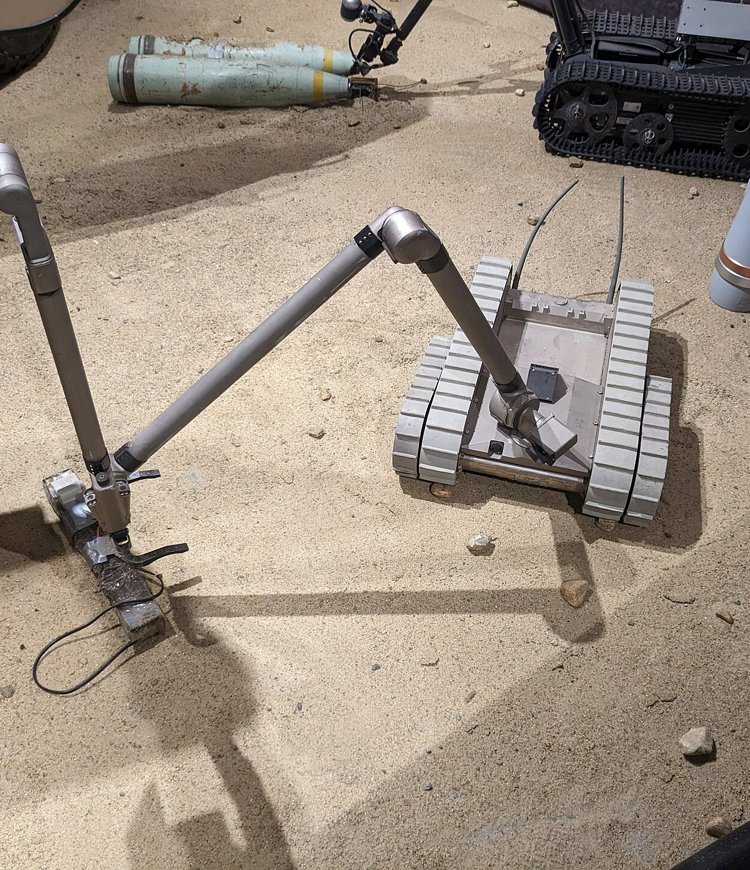
Tracked robot with arm (PackBot)
Photo: Joshbaumgartner, CC BY-SA 4.0, Wikimedia Commons
So what. Each use starts with a written purpose, a defined area and human review.
Drone first response went mainstream fast.
Drone as first responder (DFR).
Chula Vista flew the first drone-as-first-responder program
2018
25,000+
1,000+
10M+
- A dispatcher takes the 911 call and launches the nearest docked drone
- The drone flies to the address and streams live video to dispatch and officers
- Officers arrive briefed, or the call is cleared without a response
- The drone returns to its dock, swaps batteries and is ready again
- Every flight is logged for audit and public reporting
- Time to scene falls from minutes to seconds
- Fewer unneeded responses and fewer risky approaches
- Officers spend time where people are needed
- Programs need pilots or remote supervisors, docks and cloud video
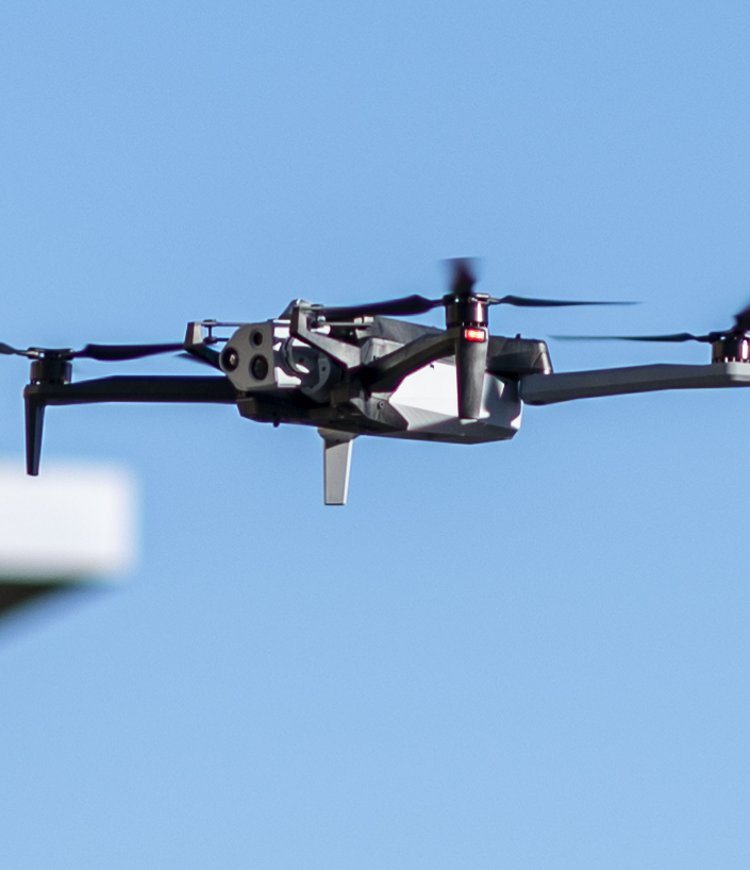
Skydio X10 public safety drone
Photo: Alexander Kubitza, Public domain, Wikimedia Commons
So what. Speed is the benefit. Clear rules on use and data are the condition.
Sources: DroneXL; EFF (FAA waiver records).
Five makers lead the DFR market.
DFR vendors and proof level.
Maker
Non-weapon offering
Proof
Public evidence
Skydio
X10 aircraft, Dock, DFR Command software. Sold with Axon.
Commercial
Integrates into CentralSquare dispatch software (Aug 2026). FAA approval for one pilot to fly four drones; 12 departments reported in.
Responder and Guardian aircraft, stations, LiveOps software. Sold with Motorola Solutions.
Commercial
Motorola led a reported $125M round (Jul 2026). Boston Police pilot announced 28 Aug 2026.
Flock Safety
Alpha drone and Aerodome software, linked to its camera network.
Commercial
Says it has 200+ DFR customers. First NDAA-compliant U.S.-assembled Flock drone shown Oct 2025.
Paladin
Drone hardware and software for DFR programs.
Commercial
Named with Skydio, BRINC and Flock as one of four main DFR suppliers in 2026 market reviews.
Axon
Axon Air programs with Skydio. Body cameras and evidence software.
Commercial
Axon and Skydio announced a joint public safety drone offering.
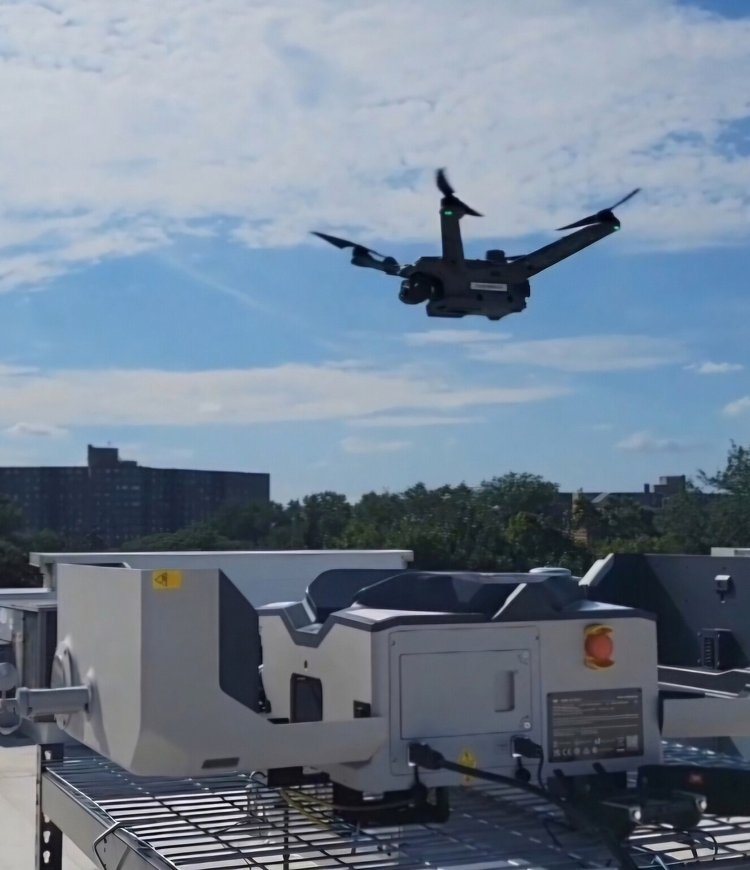
Drone launching from a rooftop
Photo: Chiam Naiditch, CC BY 4.0, Wikimedia Commons
So what. Pilots are often free or low cost in year one. Compare vendors on your own call load.
Ground robots work best in hazardous entry.
Ground robots for police.
Maker
Non-weapon offering
Proof
Public evidence
Boston Dynamics
Spot legged robot for hazardous entry, with arm and sensor payloads.
Commercial
60+ bomb squads and SWAT teams in the U.S. and Canada; about 2,000 Spot units worldwide (Bloomberg, Nov 2025). Requires a stated use plan before shipping.
Teledyne FLIR
Tracked response robots such as PackBot (from iRobot Defense) and thermal cameras.
Commercial
Tracked robots have served bomb squads since the 1980s; PackBot is used by larger police forces.
Remotec
Andros F6A tracked robot.
Commercial
In use at county bomb squads such as Montgomery County, Pennsylvania, alongside Spot.
Knightscope
K5 autonomous security robot for campuses, lots and facilities.
Early commercial
AFWERX Phase I SBIR (Jan 2025) to assess Air Force installation security.
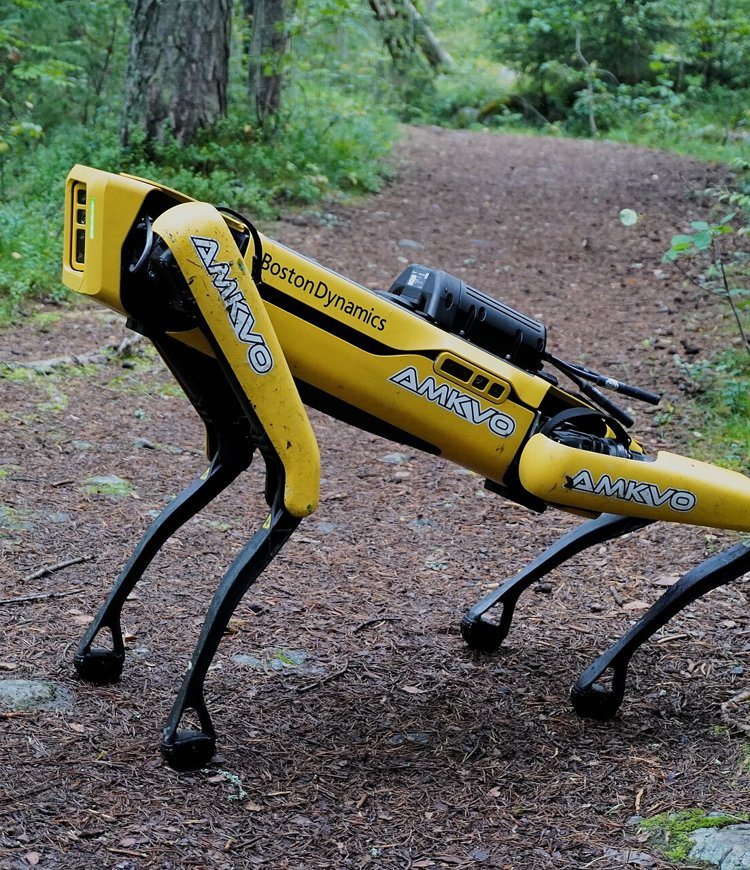
Spot legged robot on a trail
Photo: Jonte, CC BY-SA 4.0, Wikimedia Commons
So what. Agencies add robots one mission at a time, starting with bomb squads and tactical teams.
Sources: Bloomberg (Nov 2025); Boston Dynamics.
A bomb squad robot works so people do not have to.
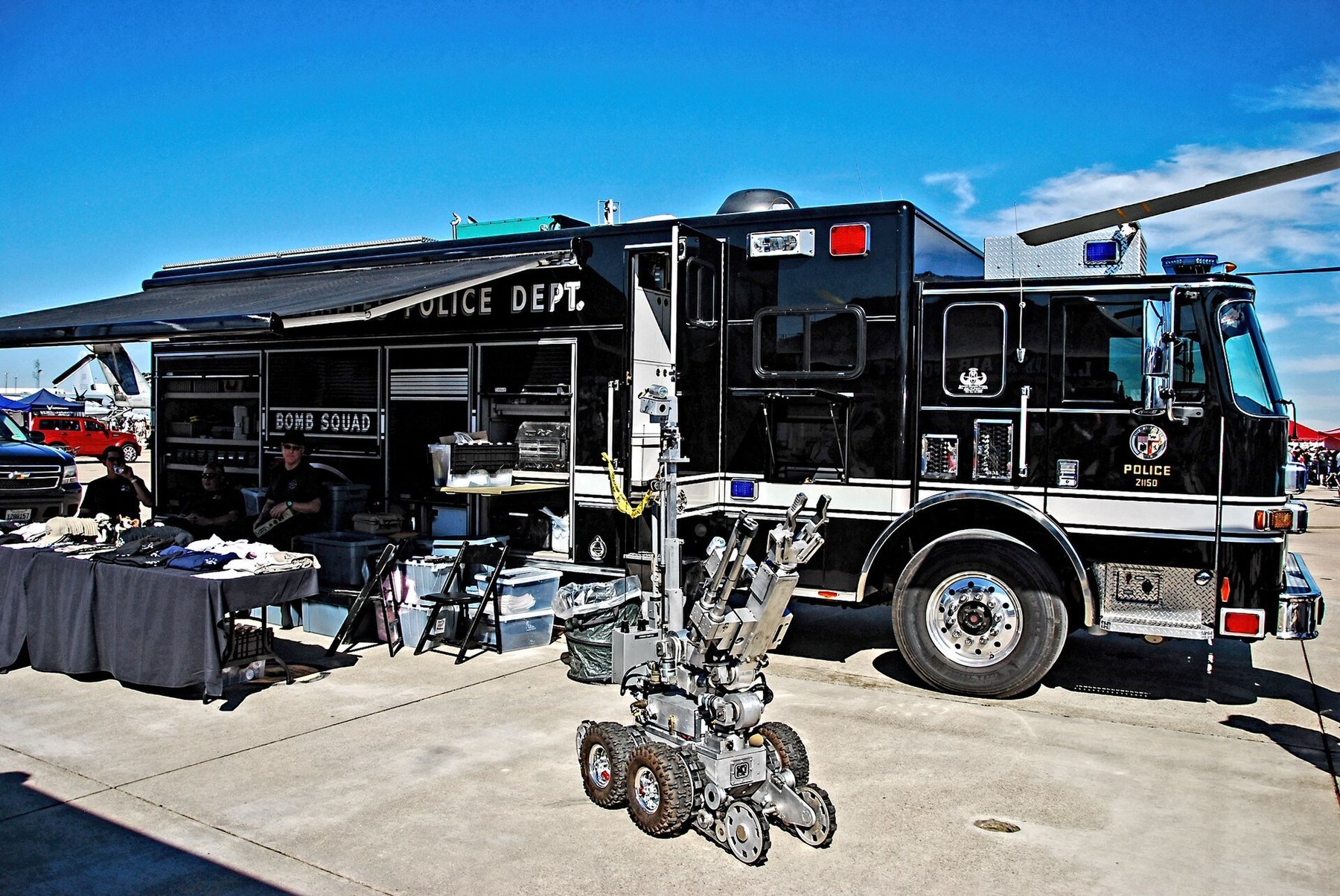
- A tracked bomb-squad robot in front of a Los Angeles Police Department bomb squad truck
- Its arm, gripper and cameras let technicians inspect a suspicious item from a safe distance
- Robots like this have served U.S. bomb squads since the 1980s
- A technician controls every move; the robot makes no decisions
Photo: Tomás Del Coro, CC BY-SA 2.0, Wikimedia Commons
Adoption is contested, city by city.
What happened in 2026.
| When | Where | What happened |
|---|---|---|
| Jan 2026 | Bridgeport, Connecticut | Council committees rejected a Flock drone program five days after it launched. |
| Mar 2026 | Wichita, Kansas | Police asked council for $650,000 for two robot dogs, one for SWAT and one for the bomb squad. |
| Mar 2026 | Stockton, California | Council approved a $3.15M Flock drone program 7-0 despite public opposition. |
| 2 Sep 2026 | Chula Vista, California | Paused a proposal to use Flock drones, though it flew the first DFR program in 2018. |
| 17 Sep 2026 | Murfreesboro, Tennessee | Police dropped a Flock integration after public backlash. |
| Oct 2026 | San Francisco, California | City weighed DFR rules as Flock pressed to sell drones. |
So what. Programs with written limits and public reporting get approved. Programs without them get paused.
Cost is more than the aircraft.
Cost signals for police programs.
What 2026 programs cost
- Skydio X10 DFR in Conroe, Texas: bought with asset-forfeiture funds
- Spot-class robot: about $325,000 per unit with arm and sensors, as priced in the Wichita request
- Typical bomb-squad-ready robot dog: $150,000 to $400,000 per unit, one review estimates
- Some vendors offer no-cost first-year DFR pilots, such as South Bend with Flock
What drives total cost
- Aircraft and docks, per site
- Software, video storage and dispatch integration
- Remote pilots or supervisors
- Training, insurance and FAA paperwork
- Public reporting and audit time
How Atomgigs helps
- Compares makers on your call load and your rules
- Sizes the program to your budget lines and grants
- Staffs pilots and supervisors by contract
- Runs the pilot and the public report
So what. Plan on the whole program cost, not the aircraft price.
Typical ballpark values from public sources, not quotes. Sources: DroneXL; Wichita Eagle.
ATOMGIGS
Fire and rescue
Size-up from the air, hazmat and rescue entries, standards and how departments start.
On the following pages
01
Fire and rescue use cases.
52
04
How a department starts.
56
02
Fire and rescue vendors.
53
03
NFPA 2400 and test methods.
55
Eight jobs machines do for the fire service.
Fire and rescue use cases.
Fireground size-up
Thermal drones show fire spread, roof conditions and hot spots from above in minutes.
Hazardous materials
Robots and drones sample and observe a release without sending people into the zone.
Structural collapse and rescue
Ground robots and small drones search voids and rubble for survivors.
High-rise and tall structures
Drones inspect facades and rooftops that crews cannot see from the street.
Water and swift-water rescue
Drones locate people and drop flotation. Crews stay on shore.
Firefighting robots
Remote tracked machines move hose and water into heat that crews cannot enter.
Fire investigation
Aerial mapping records the scene before it changes.
Pre-incident planning
Digital twins of large buildings help crews plan before a call.
So what. Machines add sensing and reach. Crews decide tactics.
Fire departments already fly many drones.
Fire and rescue vendors.
Maker
Non-weapon offering
Proof
Public evidence
Skydio
X10 drones with thermal cameras and docks for fireground and DFR use.
Commercial
Used by public safety agencies for aerial response.
| Teledyne FLIR | Thermal imaging cameras and drone payloads for fire and rescue. | Commercial | Long-standing thermal imaging supplier to fire departments. |
|---|---|---|---|
| Howe & Howe (Textron) | Thermite remote-controlled firefighting robot. | Commercial | Fielded by fire departments for high-heat and collapse-risk fires. |
| Boston Dynamics | Spot legged robot for hazmat and structure inspection. | Commercial | Used by bomb squads and hazmat teams as a remote observer. |
| DJI | Widely used thermal drones in existing fleets. | Commercial | Industry estimates put DJI above 80% of public safety fleets. New FCC authorizations are barred since Dec 2025. |
So what. Check NDAA and FCC status before you buy or replace a drone.
A firefighting robot takes water into the heat.
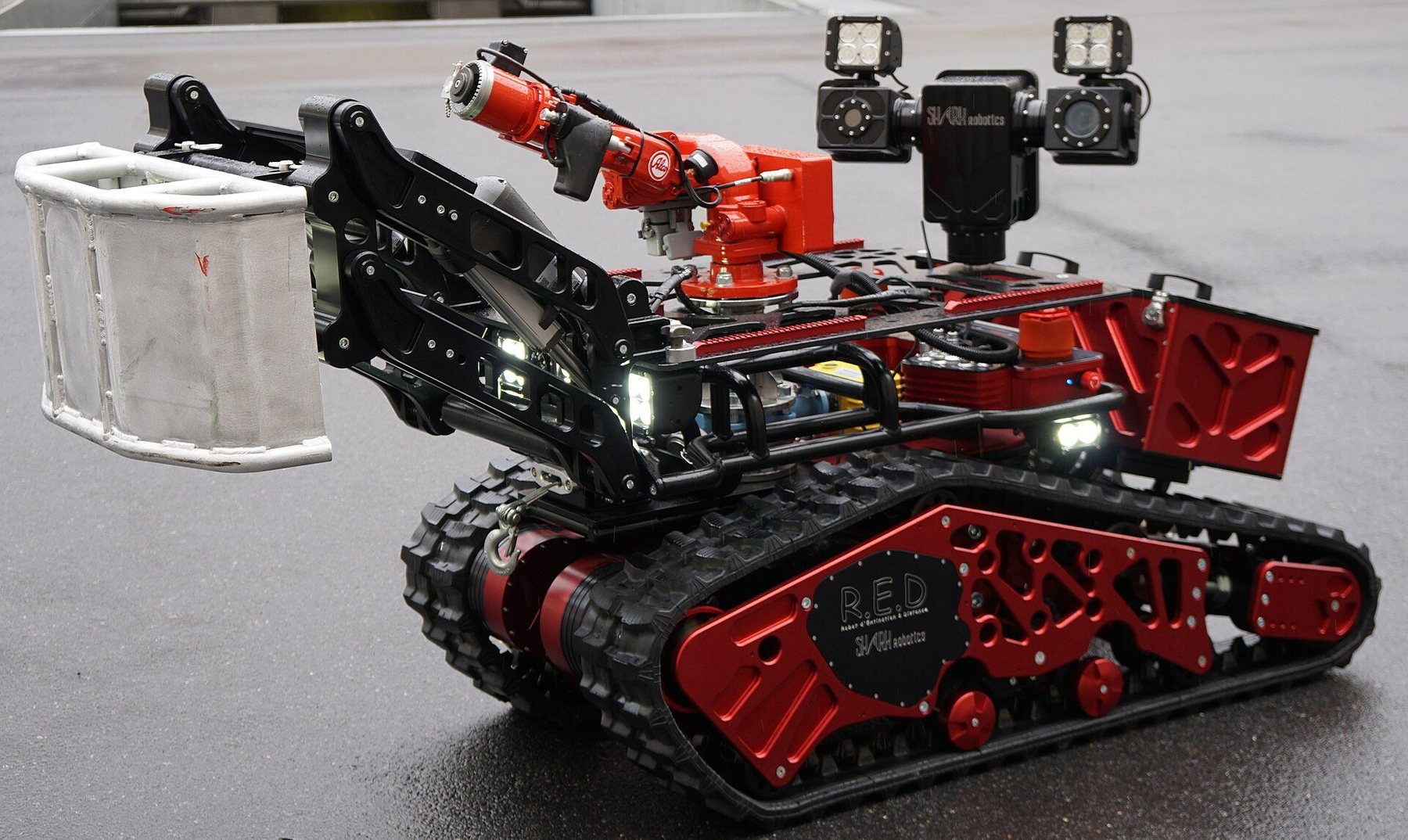
- A remote-controlled tracked firefighting robot made by Shark Robotics of France
- The red water monitor on top sprays water or foam; cameras and lights show the operator the scene
- The front arm moves debris and obstacles
- Crews drive it from a safe distance. Howe & Howe's Thermite does the same job in U.S. departments such as the LAFD
Photo: Shark Robotics, CC BY-SA 4.0, Wikimedia Commons
One standard now guides fire drone programs.
NFPA 2400 and test methods.
NFPA 2400 first issued, the standard for public safety drones
2019
2024
Free
- Organization and program criteria
- Professional qualifications for safety personnel
- Maintenance of aircraft and equipment
- Use cases, incident command and risk review
- NIST developed standard test methods for response robots
- NFPA 2400 refers to them to measure remote pilot skill
- ASTM committee E54.09 is standardizing more than 20 aerial tests
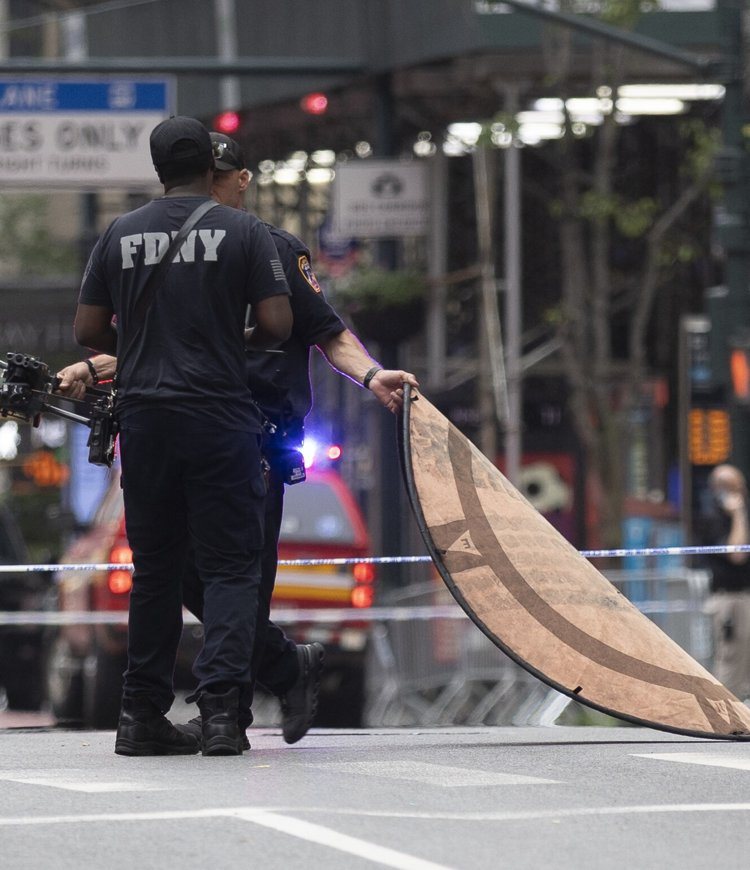
Fire department drone operation, New York
Photo: Tessa Bury, CC BY 4.0, Wikimedia Commons
So what. Voluntary standards give departments a shared bar for training and safety.
A fire drone program starts with five steps.
How a department starts.
1 Name a coordinator
Appoint a drone program coordinator, as NFPA 2400 advises.
2 Write the policy
Purpose, allowed uses, data rules and public notice.
3 Train and certify
Remote pilot certificates and local flight drills.
4 Get airspace cover
Part 107 or a public aircraft declaration; waivers for BVLOS.
5 Run a pilot
A few months, a few call types, and a report to the chief and council.
So what. The slow steps are policy and training, not the aircraft.
ATOMGIGS
EMS and emergency management
Life-saving deliveries, medical logistics, disaster response and emergency operations centers.
On the following pages
01
EMS and AED delivery.
58
04
EMS and disaster vendors.
61
02
03
Medical logistics.
Emergency management use cases.
59
60
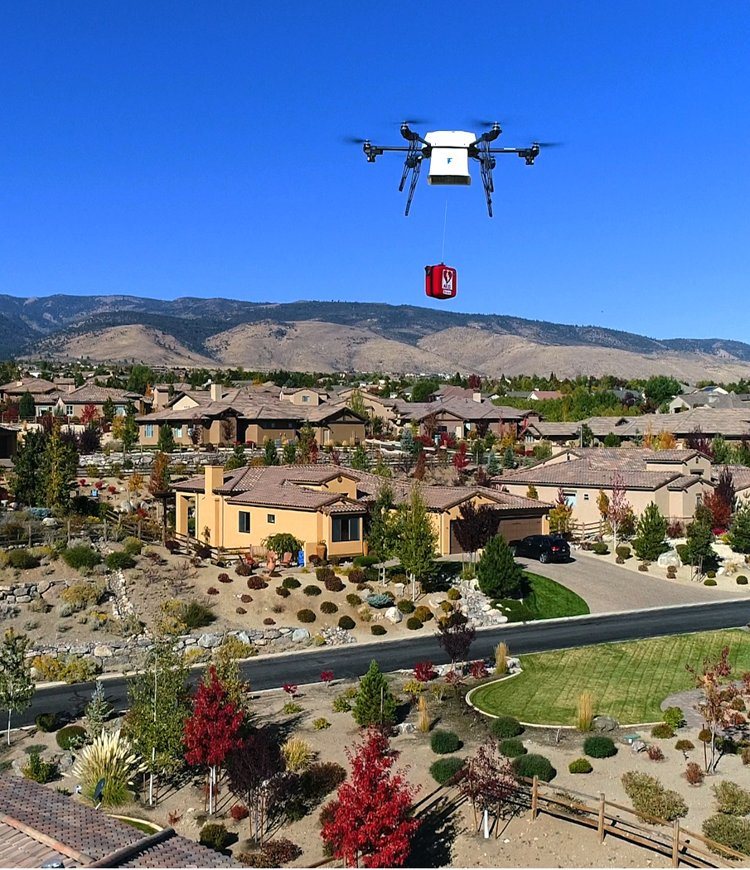
Drones can bring an AED before the ambulance.
EMS and AED delivery.
2 to 3 min
window to apply an AED for survival near 70%
8 to 10 min
typical EMS arrival time
about 4 min
estimated median drone AED delivery in the Duke study
study sites: Clemmons, NC and James City County, VA
1 Dispatcher
Takes the cardiac arrest call and starts the drone.
2 Drone launch
An AED drone flies to the address while EMS responds as usual.
3 Bystander
Opens the AED. The dispatcher talks them through it.
4 EMS arrives
Crews take over care. The drone returns to base.
Drone carrying an AED toward a home
Photo: Mollyrose89, CC BY-SA 4.0, Wikimedia Commons
So what. Drones add a layer. They do not replace EMS.
Sources: Duke Health; DroneLife.
Medical drone networks are taking shape.
Medical logistics.
Prehospital whole blood
Tampa General Hospital is preparing the first EMS-driven drone program for prehospital whole blood (Aug 2026).
Healthcare logistics network
CVS Health described CVS Air Response with SkyfireAI and Thales at XPONENTIAL 2026 (May 2026): medical supply links, disaster response and AED delivery.
Layered state systems
A May 2026 SAE paper modeled a statewide layered medical drone network in Florida for blood, AEDs and critical devices.
Drone-based EMS abroad
Everdrone raised SEK 36 million in Mar 2026 and launched a drone-based emergency medical service in France in Dec 2025.
So what. Medical delivery is early. Pilots and studies come before wide rollout.
Disasters need a fast, shared picture.
Emergency management use cases.
Damage assessment
Drones map roads, bridges and buildings after storms and quakes within hours.
Search and rescue
Thermal drones and ground robots search flooded and collapsed areas.
Flood and levee watch
Drones and cameras watch rising water without sending crews to risky banks.
Communications relay
Drones carry radios or cellular relays when towers fail.
Supply delivery
Small cargo drones move medicine and water to cut-off areas.
Emergency operations center views
A shared map joins drone video, cameras and sensors for decision-makers.
So what. Machines give a common picture fast. The emergency manager decides the response.
A few makers lead medical drone delivery.
EMS and disaster vendors.
Maker
Non-weapon offering
Proof
Public evidence
Skydio
Drones and docks for response, mapping and DFR.
Commercial
Used in public safety DFR programs.
| SkyfireAI | Public safety drone programs and medical delivery partnerships. | Early commercial | Named with CVS Health and Thales for CVS Air Response (May 2026). |
|---|---|---|---|
| Everdrone | AED delivery and drone-based EMS in Sweden and France. | Early commercial | Lancet Digital Health study (2023); France launch (Dec 2025). |
| Arc Aero | Drone used in the Virginia AED delivery study. | Pilot | James City County, Virginia study (DroneLife, Aug 2026). |
So what. Atomgigs treats these as pilots to be proven in your area.
ATOMGIGS
Security and venues
Patrol robots, drone docks, remote guarding and critical-site protection.
On the following pages
01
Security use cases.
63
02
03
Security vendors.
Division of work.
64
66
Six security jobs for machines.
Security use cases.
Campus and parking patrol
Wheeled robots patrol lots and structures with cameras and a speaker.
Perimeter patrol
Drones on docks fly set routes around fences, yards and fuel sites.
Remote guarding
Guards watch many sites from one control center and dispatch when needed.
Venue and event overwatch
Aerial and ground cameras add coverage and crowd flow data.
Critical infrastructure
Substations, ports, rail yards and data centers add layered patrol.
Access and gate support
Cameras read badges and plates and call a guard for exceptions.
So what. Robots patrol and report. Guards verify and respond.
Security robots are early but real.
Security vendors.
Maker
Non-weapon offering
Proof
Public evidence
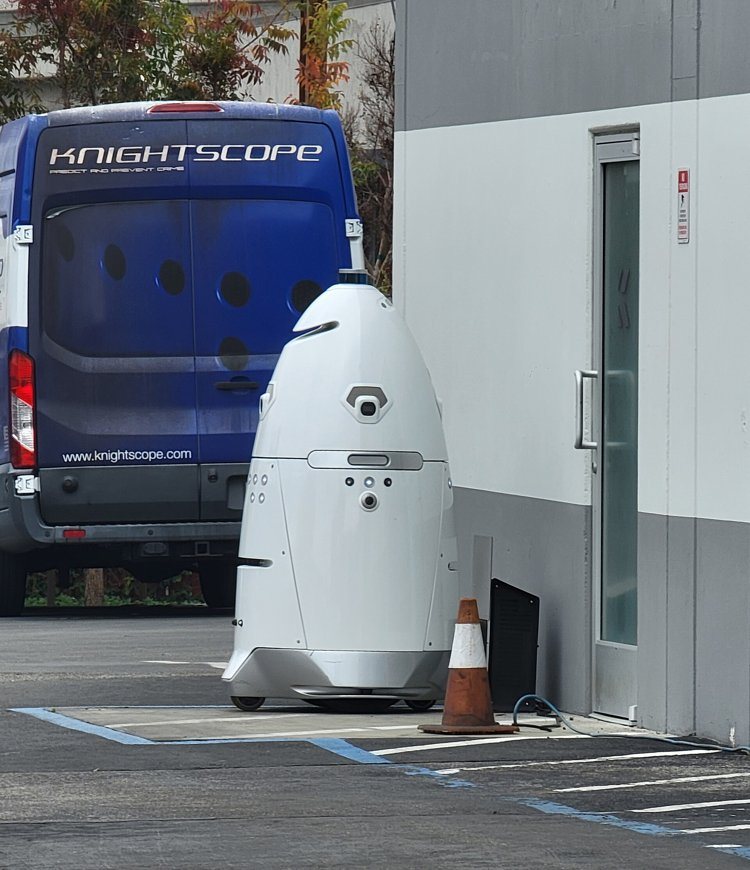
Knightscope
K5 autonomous security robot and related software.
Early commercial
AFWERX Phase I SBIR (Jan 2025). Patrols campuses, lots and logistics hubs.
Asylon
Drone-in-a-box and ground robots with a 24/7 remote operations center.
Early commercial
Reports 350,000+ autonomous missions. Nine AFWERX awards.
Cobalt Robotics
Indoor security robots for offices and warehouses.
Early commercial
Used in corporate buildings.
Boston Dynamics
Spot for site inspection and patrol rounds.
Commercial
Used for industrial inspection and public safety.
Skydio
Dock and X10 for fixed-site patrol.
Commercial
USAFCENT order above $9M for air base security (Apr 2026).
Knightscope K5 security patrol robot
Photo: Votpuske, CC BY-SA 4.0, Wikimedia Commons
So what. Public detail is thin. Many security deployments run under NDA.
A security robot on a night patrol.
- A Knightscope K5 security robot patrolling a gas station forecourt in San Francisco
- Cameras, lights and sensors record the site and flag events to a remote operator
- The robot observes and reports. Guards and police decide and respond
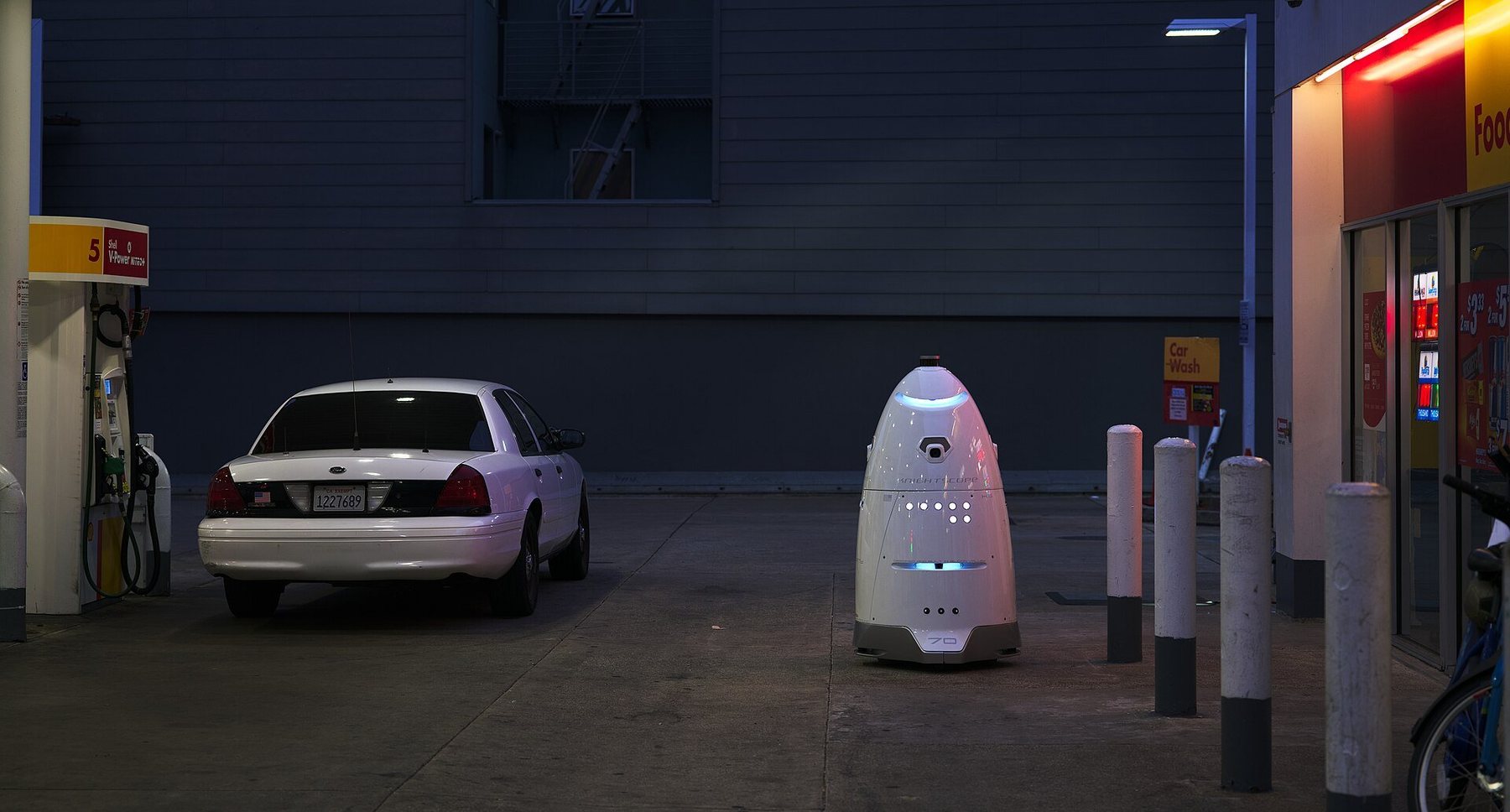
Photo: Dllu, CC BY-SA 4.0, Wikimedia Commons
Robots patrol and humans decide.
Division of work.
What robots do well
- Cover long routes the same way every time
- Never tire on night shifts
- Record video and sensor readings
- Flag anomalies for a person to check
What stays with people
- Judging a threat
- Speaking with the public
- Entering a scene and making a stop
- Deciding to call police
How the guard job changes
- From walking routes to watching robot feeds
- From logging to responding to flagged events
- New skills: remote operations, data and fleet care
So what. Robots change what guards do. They do not remove the need for them.
ATOMGIGS
Corrections and border
Facility rounds, perimeter watch, border towers, scale of funding and the scrutiny it draws.
On the following pages
01
Corrections use cases.
68
02
Border and customs.
69
03
Scrutiny and safeguards.
70
Corrections can use machines for rounds and logistics.
Corrections use cases.
Perimeter and yard watch
Drones and fixed cameras cover fences and yards around the clock.
Inspection rounds
Robots check doors, locks and utilities and log readings.
Facility logistics
Mobile robots move laundry, food and supplies inside secure zones.
Contraband interdiction at the perimeter
Aerial and thermal views spot packages dropped near fences.
Emergency response support
Robots carry cameras into incidents so staff stay at a safe distance.
Training and digital twins
A model of the facility helps plan staffing and drills.
So what. Policies must protect people in custody, staff and the public.
Border technology funding is at a record.
Border and customs.
$46.5B
OBBBA (One Big Beautiful Bill Act) funds for border wall system and technology
$6.2B
border security technology and screening
890
autonomous towers planned in the FY2027 request
$71M
GDIT task order for autonomous towers
Item
What it is
Pace
Autonomous surveillance towers
Fixed and mobile towers with cameras, radar and AI that alert agents.
CBP is buying autonomous towers only, per the law
| Integrated fixed towers | Older tower network with cameras and sensors. | Being consolidated and upgraded |
|---|---|---|
| Ground sensors and trail cameras | Detect traffic on routes without a wall. | Used on about 535 miles with no wall planned |
So what. Large funding, but also public scrutiny. Systems need clear limits.
Sources: CT Strategies; FedScoop; AP.
Border technology draws scrutiny.
Scrutiny and safeguards.
What critics raise
- Wide surveillance reaches border residents
- Sensors on private land without notice
- AI decisions that may carry bias
- Cost and delays on past programs
What agencies commit to
- Alerts to a person, who makes the decision
- Written limits on data use
- Oversight and audits
Where Atomgigs stays
- Observation, inspection and logistics only
- No weapons and no lethal systems
- Public reporting on every pilot
So what. The right path is limits, transparency and human decisions.
Wildfire
Detect, respond, evacuation and recovery.
ATOMGIGS
Detect
Cameras, AI and people that find a fire before the first 911 call.
On the following pages
01
Why early detection matters.
73
02
How detection works.
74
03
Detection programs.
75
Seconds saved at detection save acres.
Why early detection matters.
1,200+
AI-enabled ALERTCalifornia cameras
38%
of California fires seen by camera before any 911 call, one analysis says
725
fires detected in the U.S. by Pano AI in the 2025 season
10 acres
Cal Fire goal: hold 95% of fires at or below this size
Why early detection matters
- A fire can double in size every 10 to 15 minutes in moderate conditions
- Only one in 20 wildfire-area 911 calls is a real wildfire, Pano AI says
- Cameras scan 360 degrees about every two minutes
- Detection helps most in remote areas with few witnesses
What limits it
- Cameras cover only where they are installed
- Fog, dust and clouds can look like smoke
- Valleys and canyons have gaps
- Every alert still needs human verification
So what. AI finds the smoke. A person confirms it, and crews decide how to fight it.
Sources: AP; NPR; Fast Company.
Detection is AI first, human second.
How detection works.
1 Scan
Tower cameras and sensors scan terrain around the clock.
2 Flag
AI marks possible smoke and scores the likelihood.
3 Verify
A trained person reviews the time-lapse and confirms.
4 Alert
Dispatch, fire agencies and utilities get a location and view.
5 Confirm
A drone or ground unit checks the site and feeds the incident plan.
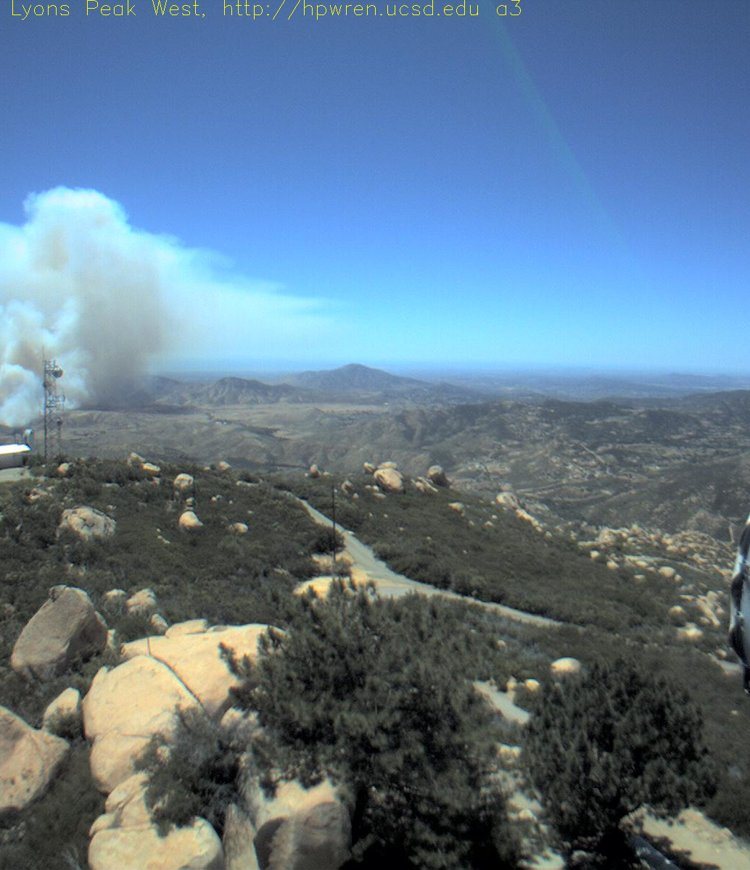
Smoke seen from a wildfire camera
Photo: HPWREN camera network, Public domain, Wikimedia Commons
So what. The human check keeps false alarms from overloading dispatch.
AI camera networks are spreading west and east.
Detection programs.
Program or maker
What it offers
Proof
Public evidence
ALERTCalifornia
AI camera network run by UC San Diego with Cal Fire.
Commercial
1,200+ cameras; Cal Fire uses AI to flag smoke across the state.
| Pano AI | Tower cameras, satellite data and a 24/7 human intelligence center. | Commercial | About $50,000 per camera per year. Customers include utilities, fire agencies and Douglas County, Colorado. |
|---|---|---|---|
| Arizona Public Service | Utility running AI smoke cameras. | Commercial | About 40 active; plans for 71 by summer 2026; Arizona state fire agency has seven of its own. |
| BRINC | Free wildfire map layers using NOAA data. | Early commercial | Announced Aug 2026 with notes on the data limits. |
| Other states | Oregon, Washington, Montana, Idaho, Nevada, Colorado. | Pilot | Deploying or procuring AI cameras, AP reported in May 2026. |
So what. Cameras are proven. The open work is coverage, integration and funding.
Typical ballpark values from public sources, not quotes. Sources: AP; NPR; Fast Company.
ATOMGIGS
Respond
Mapping, thermal views and logistics that help crews fight fires safely.
On the following pages
01
Wildfire response use cases.
77
02
Airspace and standards.
78
Mapping and thermal views lead the way.
Wildfire response use cases.
| Use | What machines do | Proof | Notes |
|---|---|---|---|
| Perimeter and hot-spot mapping | Thermal drones map the fire edge and find hot spots at night. | Commercial | Used by agencies each season. |
| Situational awareness | Live video from above for the incident commander. | Commercial | Needs airspace coordination. |
| Structure protection planning | Aerial views show defensible space and access routes. | Commercial | |
| Communications relay | Drones carry radios over ridges. | Early commercial | Needs approval and range testing. |
| Supply and equipment delivery | Cargo drones move small loads to crews. | Pilot | Weight and weather limits. |
| Autonomous water or retardant aircraft | Uncrewed aircraft drop on a fire. | Concept | Atomgigs does not offer this. |
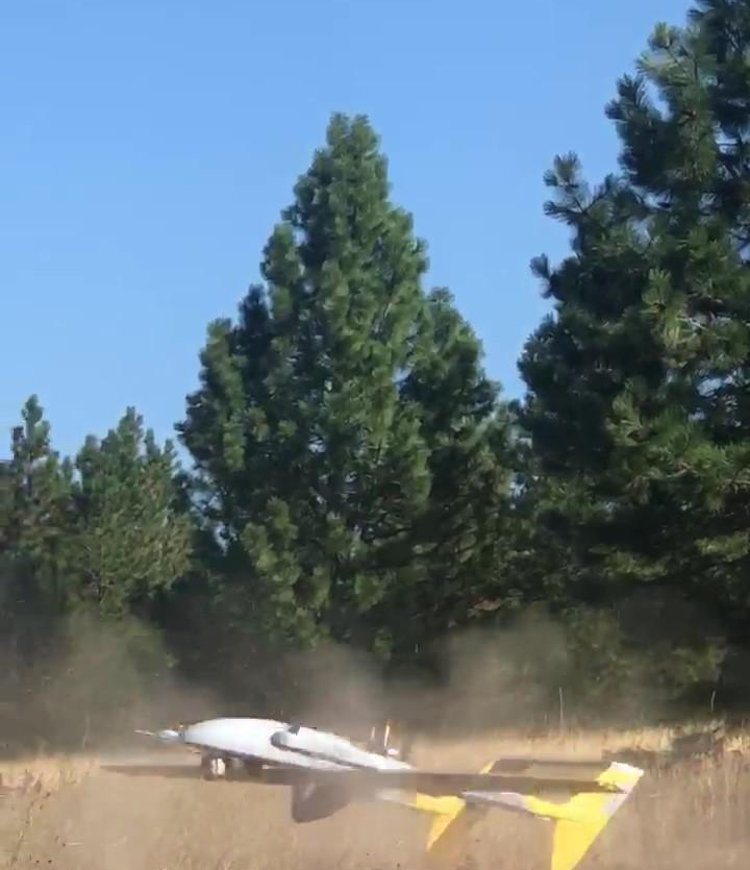
Drone taking off at the Cinnabar Fire
Photo: Forest Service - Northern Region, Public domain, Wikimedia Commons
So what. Start with mapping and awareness. They are proven and low risk.
Drones follow incident command.
Airspace and standards.
Airspace and safety
- Fires create temporary flight restrictions
- Uncoordinated drones can ground firefighting aircraft
- Flights run only under incident command approval
- Remote ID and logs show who flew where
Standards and guides
- NFPA 2400 for public safety drone programs
- NWCG guidance for wildland drone use
- FAA Part 107, waivers and Part 108 once final
How Atomgigs helps
- Trained pilots on contract for fire seasons
- Pre-approved flight plans with local units
- Mapping products delivered to the incident team
So what. Drones help when they are part of the plan. Unplanned drones cost lives.
ATOMGIGS
Evacuation and recovery
Helping people leave safely and helping places rebuild.
On the following pages
01
Evacuation and recovery.
80
02
Who pays.
81
Machines help people leave and rebuild.
Evacuation and recovery.
Evacuation routes
Cameras and drones show traffic, blocked roads and fire advance for planners.
Alerts and warnings
Detection data feeds public alert systems quickly.
Shelters and supply
Mapped needs and supply routes keep shelters stocked.
Damage assessment
Drones count and grade damaged buildings within days.
Debris and slope hazards
Aerial mapping guides debris removal and flood-risk work.
Rebuild and reforestation
Surveys and digital twins guide permits and planting.
So what. Recovery data helps people return sooner and helps insurers and agencies.
Wildfire programs have several funders.
Who pays.
Funder
What it pays for
Notes
Utilities
Detection cameras, vegetation checks and line inspection
Driven by wildfire liability; file state mitigation plans
| State fire and emergency agencies | Camera networks, aircraft and drone programs | California, Arizona, Colorado and others |
|---|---|---|
| Local and county governments | Cameras and drones for county fire and emergency management | Often use grants |
| FEMA | Fire management assistance and hazard mitigation grants | Rules vary by program and year |
| Federal land agencies | Detection, mapping and response on federal lands | Contract through agency offices |
So what. Wildfire work is funded by utilities and governments. Atomgigs engages with both.
Defense support
Installations, depots and the industrial base, training and digital twins, how to enter defense.
ATOMGIGS
Installations
Security, logistics and facility operations on bases, posts and stations.
On the following pages
01
Installation use cases.
84
02
Installation security vendors.
85
03
Logistics and sustainment.
86
Installations run like small cities.
Installation use cases.
Perimeter and gate security
Drone docks, patrol robots and cameras extend security forces.
Facility operations
Inspection robots check roofs, utilities, tanks and energy plants.
Installation logistics
Autonomous vehicles and tugs move cargo and supplies on the base.
Fleet and vehicle care
Predictive maintenance for the non-tactical vehicle fleet.
Emergency response
Fire, rescue and hazmat teams use the same tools as civilian agencies.
Energy and resilience
Digital twins plan microgrids and backup power.
So what. These are the same jobs as civilian sites, with added security rules.
Base security robots are moving from pilot to order.
Installation security vendors.
Maker
Non-weapon offering
Proof
Public evidence
Skydio
Dock and X10 drones for base perimeter patrol.
Commercial
USAFCENT order above $9M for Middle East air bases (8 Apr 2026). Docks launch in under 20 seconds.
| Asylon | Drone-in-a-box and ground robots for base security. | Early commercial | Phase III SBIR contract with Warner Robins Air Logistics Complex for robotic aircraft inspection (Jul 2026). |
|---|---|---|---|
| Knightscope | K5 security robots for bases and logistics hubs. | Pilot | AFWERX Phase I SBIR (Jan 2025). |
So what. Verified operational deployments are few. Most programs are pilots.
Installations are buying autonomous logistics.
Logistics and sustainment.
150,000+
non-tactical vehicles in the department fleet
Jun 2026
DIU ROADS challenge responses closed
Phase 3
initial on-installation pilot, multiple vendors
Flagship
Army logistics modernization with FedEx Dataworks
ROADS challenge
- DIU seeks autonomous vehicles for logistics on roads inside installations
- Road-capable on paved and well-kept unpaved roads, no off-road needed yet
- Winners move to a pilot on an installation
Strategic Capital Initiative
- The Army will use private capital to modernize logistics and industrial sites
- First flagship deal covers domestic non-tactical logistics networks
- Automation and data are the core of the plan
So what. Installation logistics is open to commercial machines with clear safety cases.
ATOMGIGS
Depots and the industrial base
Maintenance, repair, overhaul and manufacturing at depots, arsenals and plants.
On the following pages
01
Army organic industrial base.
88
04
Cross-references.
92
02
Other depots and suppliers.
89
03
MRO automation.
91
The Army is rebuilding its depots.
Army organic industrial base.
Army industrial base sites: depots, arsenals and plants
$1B+
OIB investments in fiscal 2025
Apr 2026
Army signed the OIB Transformation Strategy
Mar 2026
automation contract awarded at Red River
| Site | What is changing |
|---|---|
| Anniston Army Depot, Alabama | Robotic welding and Industry 4.0 work on engine and transmission repair |
| Tobyhanna Army Depot, Pennsylvania | Advanced manufacturing for electronics and motors; AS9100 quality recertification |
| Red River Army Depot, Texas | Hadrian Automation advanced manufacturing facility; track and wheel component work |
| Rock Island Arsenal, Illinois | Advanced Manufacturing Center of Excellence and joint manufacturing center |
| Corpus Christi Army Depot, Texas | Overhaul and repair of helicopters, engines and components: the Army's main rotary-wing MRO site |
| So what. The Army is opening depots to commercial automation. Teaming is the usual route. | |
Source: Army.mil.
Air Force and Navy depots are next.
Other depots and suppliers.
Air Force air logistics complexes
Ogden, Oklahoma City and Warner Robins maintain aircraft and engines. Asylon won a Phase III SBIR contract (Jul 2026) to inspect C-5 and C-130 cargo aircraft with a drone and a ground robot.
Defense Logistics Agency
DLA is moving to a digital backbone and supply chain modernization in FY2027 guidance.
Marine Corps and Navy depots
Marine Corps Logistics Bases and Fleet Readiness Centers do repair and overhaul.
Tier 2 and 3 suppliers
Hundreds of small machine shops feed the primes. Automation lowers their cost.
So what. Each depot buys on its own cycle. Teaming with existing suppliers speeds entry.
Depot maintenance is heavy, skilled, repeated work.
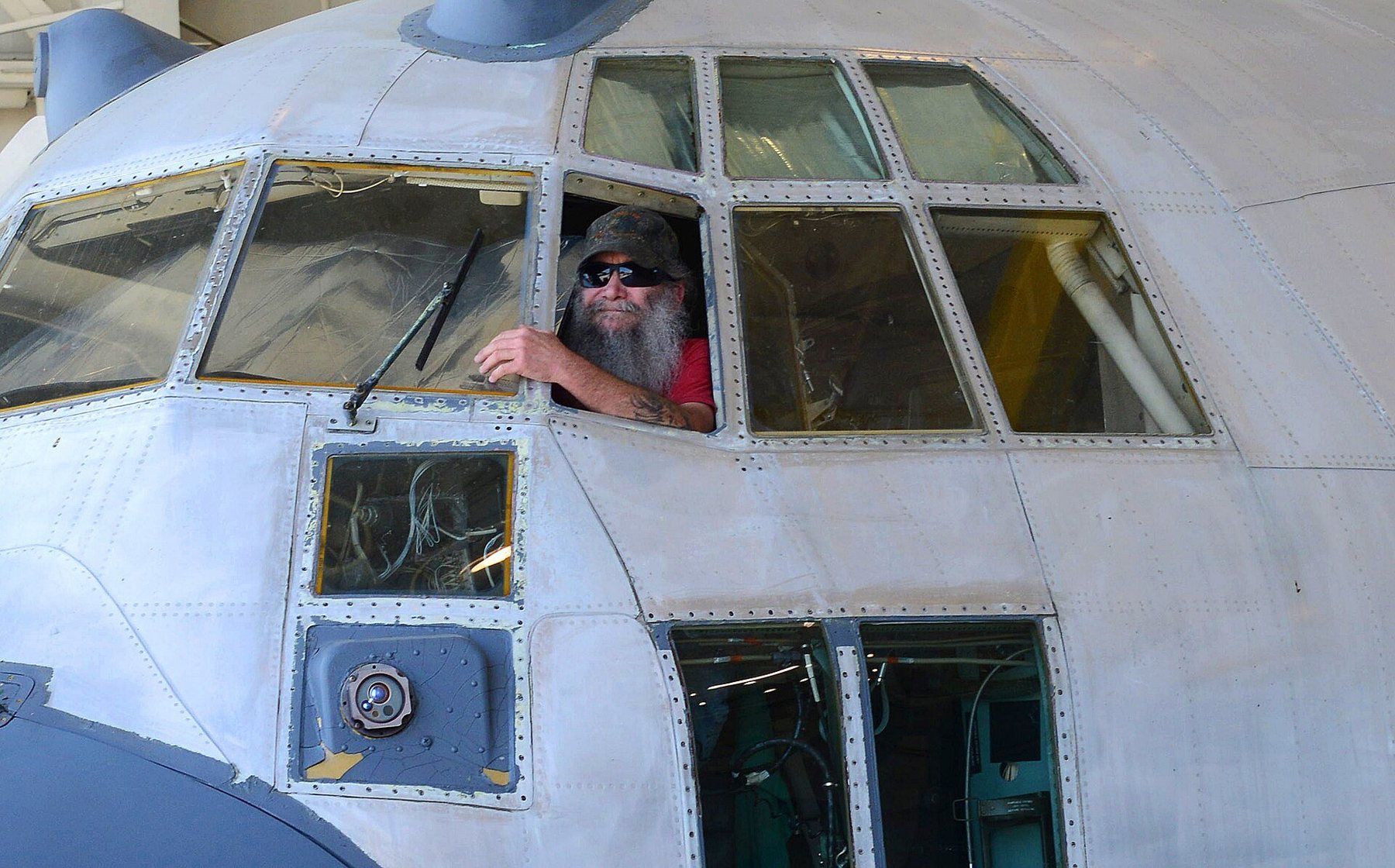
- A C-130 cargo aircraft, stripped to bare metal, moved between work stations during depot maintenance at Warner Robins, Georgia
- Each aircraft is taken apart, inspected, repaired and repainted on a fixed cycle
- Inspection, coating removal and painting are where robots and drones are being tested
- A work lead stays in charge of every move
Photo: Tommie Horton, U.S. Air Force (public domain)
Depot automation starts with inspection.
MRO automation.
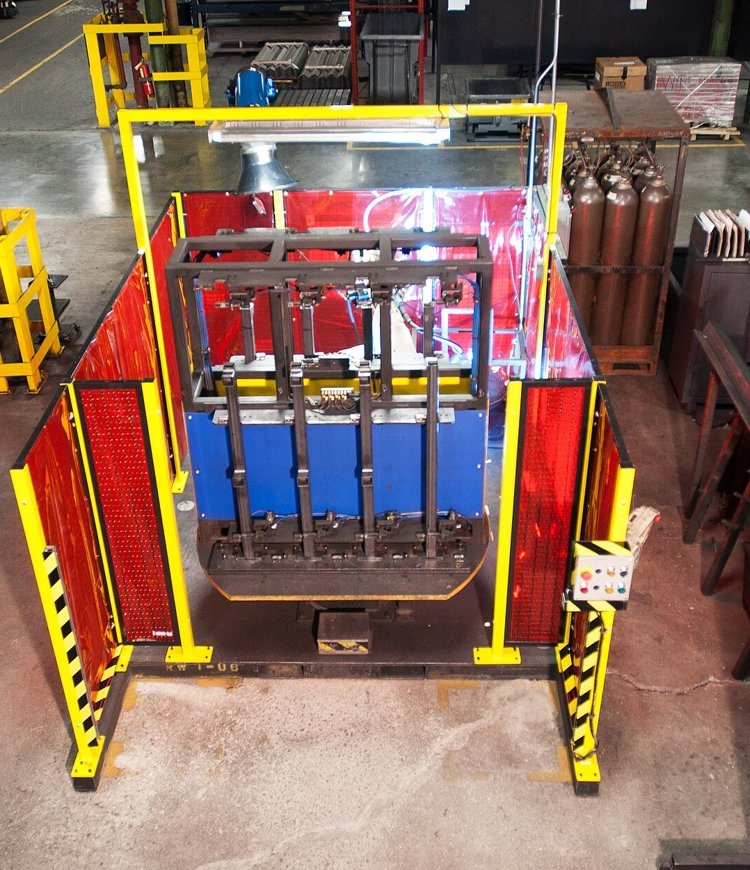
| Use case | What machines do | Proof | Qualification path |
|---|---|---|---|
| Visual and thermal inspection | Robots and drones inspect large assets and hangars. | Early commercial | Site safety case; data handling rules |
| Welding and cutting | Collaborative robots weld repeatable seams. | Commercial | Process qualification by platform owner or program office |
| Painting and coating | Robotic cells apply and remove coatings. | Early commercial | Environmental and quality approvals |
| Non-destructive testing | Automated scans for cracks and corrosion. | Early commercial | Procedure approval |
| Parts handling and kitting | Mobile robots and cobots move and sort parts. | Commercial | Site integration |
| Digital thread and twins | Scans and models track each asset. | Early commercial | Cyber and data controls |
Robotic welding cell
Photo: WireCrafters, CC BY-SA 4.0, Wikimedia Commons
So what. Depot work needs process qualification. Plan it early.
Shipyards and cleanup have their own primer.
Cross-references.
Naval shipyards and ports
- Shipyards and ports are covered in Primer 09 (Construction and Infrastructure), Maritime and offshore chapter
- Hull inspection, welding and painting follow the same patterns as depots
Defense-site cleanup
- Remediation and decommissioning of defense sites sit in Primer 09 (Construction and Infrastructure)
- Environmental remediation chapter covers the tools and rules
So what. Go to Primer 09 for these two topics.
ATOMGIGS
Training and digital twins
Simulation and models that cut cost and risk before machines move.
On the following pages
01
Simulation and twins.
94
Models reduce risk before machines move.
Simulation and twins.
Training and simulation
Virtual ranges let crews and operators practice before field use.
Digital twins of sites
A model of a depot or base supports layout, flow and energy planning.
Scan and model
Drones and handheld scanners build models in days.
Safety case testing
Machines are tested in simulation before real runs.
Operator certification
Skills checks run in simulated scenes.
Observation and inspection systems only
Unmanned systems used for inspection and observation. Atomgigs does not work on weapons.
So what. A twin turns an expensive pilot into a rehearsed one.
ATOMGIGS
How to enter defense
Small-business and commercial paths into defense contracts.
On the following pages
01
Ways in.
96
Six paths lead into defense work.
Ways in.
| Path | What it is | Who runs it | Fit |
|---|---|---|---|
| SBIR and STTR | Phased research awards to small businesses. Reauthorized in April 2026. | Services, DoD agencies | First field test funding |
| AFWERX | Air Force innovation arm; SBIR and STRATFI awards. | Air Force | Security, logistics, maintenance |
| DIU commercial solutions openings | Fast prototype awards for commercial technology. | Defense Innovation Unit | Installation logistics, ROADS |
| Army xTech and CSOs | Prize challenges and commercial solutions openings, such as the OIB advanced manufacturing CSO. | Army | Depot automation |
| Other transaction agreements | Flexible agreements outside standard acquisition rules. | Services, DIU | Prototype to production |
| Teaming with primes | A prime holds the contract; others work as subcontractors. | Primes and integrators | Scale and compliance |
So what. Most small firms enter by pilot, then team with a prime to scale.
The people
Roles, training and certification, working with machines.
ATOMGIGS
Roles
Who works with the machines, and where they come from.
On the following pages
01
02
Roles.
Where people come from.
99
100
Eight roles run a machine program.
Roles.
| Role | What they do | Typical background |
|---|---|---|
| Remote pilot in command | Flies or supervises aircraft; holds the FAA certificate | Public safety, military or commercial pilots |
| Machine manager | Named human responsible for each machine; may oversee several | Operations or technical staff |
| Robot technician | Maintains, repairs and prepares machines | Electronics, mechanics, field service |
| Operations coordinator | Links dispatch, incident command and the site pod | Dispatch, emergency management |
| Safety officer | Owns the safety case, drills and incident reviews | Safety professionals, fire service |
| Data and privacy lead | Runs retention, access and public reporting | IT, records, compliance |
| Cleared staff | Supports sites that need personnel clearances | Former military, defense workers |
| Site pod lead | Runs the site team and reports to your sponsor | Senior operations leaders |
So what. Every role is filled by a contractor, as independent specialists or through staffing firms.
Talent comes from many places.
Where people come from.
Former first responders
Police, fire and EMS veterans know the work and the radio language.
Veterans
Military operators and maintainers bring discipline and clearances.
Trades and technicians
Electricians, mechanics and field service staff keep machines working.
Drone and robotics specialists
Commercial pilots and engineers bring flight and autonomy skills.
Data and compliance staff
Records, privacy and audit skills support public trust.
Local hires
Programs hire locally where possible and train on the job.
So what. Contractors per gig, drawn from many sources, scale up and down with the work.
ATOMGIGS
Training and certification
Skills and credentials people need.
On the following pages
01
02
Credentials.
Training pathway.
102
103
People need specific credentials.
Credentials.
| Credential or standard | What it covers | Who needs it |
|---|---|---|
| FAA remote pilot certificate (Part 107) | Rules and knowledge for flying small drones commercially | Pilots under Part 107 |
| Public aircraft status and waivers | Government flights and BVLOS permissions | Agency programs |
| NFPA 2400 qualifications | Program, pilot and maintenance criteria for public safety drones | Fire, police and EMS programs |
| NIST and ASTM response robot tests | Standard test methods to measure pilot proficiency and robot performance | Teams buying or training on robots |
| OSHA safety training | General and site safety | Site crews |
| Hazmat operations training | Safe work around hazardous releases | Hazmat teams |
| Facility and personnel clearances | Access to classified work | Cleared staff |
| Manufacturer certification | Training on specific machines | Technicians and operators |
| So what. Credentials are checked at onboarding and before each pilot. | ||
Training follows five steps.
Training pathway.
1 Select
Screen for skill, record and fit.
2 Credential
Check certificates and clearances.
3 Train on the machine
Maker training plus site drills.
4 Fly or run under supervision
Shadow a lead before solo duty.
5 Review
Debriefs after incidents and regular skills tests.
So what. Testing in simulation first lowers the chance of mistakes in the field.
ATOMGIGS
Working with machines
Oversight, shifts and relations with unions and communities.
On the following pages
01
Oversight and relations.
105
People stay in charge of machines.
Oversight and relations.
Human oversight
- Every machine has a named manager
- A manager supervises only as many machines as can be watched safely
- Anyone on site can stop a machine
- Consequential decisions stay with people
Shifts and handoffs
- 24/7 coverage needs shift leads and clean handoffs
- Logs record flights, alerts and incidents
- Maintenance windows are planned around shifts
Unions and community
- Talk to police, fire and corrections unions early
- Show how roles change and what stays the same
- Hold public meetings and publish reports
So what. Programs succeed when the people who do the work help design it.
Who buys
The seven buyer groups, public safety buyers, defense buyers.
ATOMGIGS
The seven buyer groups
How the groups compare and where to meet them.
On the following pages
01
How the seven compare.
108
02
Where to reach each group.
109
Seven buyer groups buy in different ways.
How the seven compare.
| Buyer group | Scale | Main money | Pace |
|---|---|---|---|
| Municipal and state police | About 17,500 state and local agencies | City and county budgets, DOJ and homeland security grants | Medium |
| Fire and rescue | About 29,500 departments, 62% volunteer firefighters | Local budgets, FEMA fire grants, state forestry | Medium |
| EMS and emergency management | Counties, states, hospital systems and FEMA | County, state, federal and hospital budgets | Medium |
| Security operators and private security | Private firms, utilities, ports, campuses, venues | Operating budgets and service contracts | Fast |
| Corrections and border | Federal and state prison systems, CBP | State budgets and federal appropriations | Slow |
| Military installations and depots | 23 Army depots, arsenals and plants, plus Air Force and Navy sites | Operations budgets, SBIR, OTAs, CSOs | Slow |
| Defense primes and integrators | Large primes, mid-tier firms and startups | Program funds and subcontracts | Medium |
So what. Pace is relative. Private security moves fastest. Federal programs take longest.
Each group has its own meeting places.
Where to reach each group.
| Buyer group | Associations | Events and forums |
|---|---|---|
| Police | IACP, National Sheriffs Association, Major Cities Chiefs Association, PERF | IACP annual conference |
| Fire and rescue | IAFC, IAFF, NVFC, NFPA, U.S. Fire Administration | FDIC International; state fire conferences |
| EMS and emergency management | NAEMT, NEMA, IAEM | IAEM and NEMA annual forums |
| Security | ASIS International | GSX; critical infrastructure exchanges |
| Corrections and border | American Correctional Association, CBP industry days | ACA congress; border security expo |
| Military | AUSA, Navy League, Air and Space Forces Association, NDIA | AUSA annual meeting; Sea-Air-Space; DIU and AFWERX events |
| Drones and robots (all groups) | AUVSI | XPONENTIAL (each spring) |
| So what. Start where buyers already gather. Use associations to find the right roles. | ||
ATOMGIGS
Public safety buyers
Police, fire, EMS, security, corrections and border.
On the following pages
01
Municipal and state police.
111
04
Security operators.
114
02
Fire and rescue.
112
05
Corrections and border.
115
03
EMS and emergency management.
113
Police: speed and trust.
Municipal and state police.
Big players
- NYPD, LAPD, Chicago PD, Houston PD
- State police and highway patrols
- County sheriffs
- Shared services: IACP, Major Cities Chiefs
Starting pilot
A 90-day drone-first-response pilot over a defined district, with a public report
What they care about
- Response time
- Officer safety
- Community trust
- Staffing and overtime
- Budget and grants
Roles to reach
- Chief or sheriff
- Deputy chief of operations
- Real-time crime center lead
- IT director, city manager, council public safety chair
What Atomgigs pitches
- Drone-first-response program design
- Pilots and supervisors on contract
- Hazardous-entry robots
- Trust and audit package
How they buy
- City and county budgets
- DOJ BJA and COPS grants
- Homeland security grants
- Cooperative contracts
Agency names are for orientation and do not imply a relationship.
Fire: safer size-up, earlier detection.
Fire and rescue.
Big players
- FDNY, LAFD, LA County Fire, Chicago and Houston Fire
- Cal Fire; U.S. Forest Service; NIFC
- Volunteer and combination departments
Starting pilot
A season-long drone size-up program in one battalion, or a wildfire camera pilot
What they care about
- Firefighter safety
- Wildfire risk
- Response time
- Volunteer shortages
- Grant funding
Roles to reach
- Fire chief
- Chief of operations
- UAS coordinator
- Grants manager, forestry or emergency services director
What Atomgigs pitches
- NFPA 2400-aligned drone programs
- Wildfire detection and mapping
- Hazmat and collapse robots
How they buy
- Local and county budgets
- AFG and SAFER grants
- State forestry budgets
- Utilities for wildfire
EMS: faster care, shared picture.
EMS and emergency management.
Big players
- FEMA; state emergency management agencies
- County EMS, large private ambulance firms
- Hospital systems such as Tampa General
- NEMA, IAEM, NAEMT
Starting pilot
An AED drone test for one response zone, or an on-call mapping cell for storm season
What they care about
- Response time and survival
- Continuity in disasters
- Shared operating picture
- Grants
Roles to reach
- EMS director and medical director
- Emergency manager
- EOC and 911 center directors
- Hospital logistics lead
What Atomgigs pitches
- AED drone pilots
- On-call damage assessment teams
- EOC integration of drone data
How they buy
- County and state budgets
- Homeland security grants
- Research grants
- Hospital operating budgets
Security: coverage at lower cost.
Security operators.
Big players
- Allied Universal, Securitas, GardaWorld
- Utilities, ports, airports, data centers
- Campuses and venues
- ASIS International; CISA
Starting pilot
A 60 to 90 day patrol pilot at one fenced site with clear measures
What they care about
- Cost of coverage
- Guard turnover
- Liability and insurance
- Incident response
Roles to reach
- Chief security officer
- Operations VP
- Facilities director
- Risk manager and site general manager
What Atomgigs pitches
- Managed patrol capacity
- Remote guarding support
- Perimeter drone docks
How they buy
- Operating budgets
- Security service contracts
- Insurance incentives
Safer rounds and clear oversight.
Corrections and border.
Big players
- Federal Bureau of Prisons; state corrections departments
- CoreCivic and GEO Group
- CBP; Coast Guard; DHS Science and Technology
- Integrators such as GDIT
Starting pilot
A perimeter drone dock pilot at one facility, or inspection of a tower line
What they care about
- Staff safety
- Contraband
- Staffing gaps
- Oversight and public scrutiny
Roles to reach
- Warden and facilities director
- State corrections chief technology officer
- CBP program managers, often through integrators
What Atomgigs pitches
- Facility rounds and perimeter pilots
- Tower and sensor maintenance inspection
- Logistics support
How they buy
- State budgets
- Federal appropriations
- Subcontracts through primes
ATOMGIGS
Defense buyers
Installations, depots and the firms that serve them.
On the following pages
01
Installations and depots.
117
02
Defense primes and integrators.
118
Depots: readiness and throughput.
Installations and depots.
Big players
- Army Materiel Command; Army Contracting Command
- Air Force Materiel Command
- NAVFAC, NAVSEA, Marine Corps Logistics Command
- DLA; DIU; AFWERX
- Depots: Anniston, Red River, Tobyhanna, Rock Island, Warner Robins, Tinker, Hill
Starting pilot
A depot inspection cell; a perimeter patrol pilot; an installation logistics test
What they care about
- Readiness and throughput
- Workforce shortages
- Safety and cyber
- Fast fielding
Roles to reach
- Depot commander and deputy for production
- Installation commander, public works director
- Director of emergency services
- Small business office, innovation cells
What Atomgigs pitches
- Inspection and automation pilots
- Installation security
- Installation logistics
How they buy
- SBIR and STRATFI
- DIU and Army CSOs
- OTAs
- Operations and maintenance budgets
Agency names are for orientation and do not imply a relationship.
Primes: capacity and compliance.
Defense primes and integrators.
Big players
- Lockheed Martin, RTX, Northrop Grumman, General Dynamics, Boeing
- L3Harris, BAE Systems
- Leidos, SAIC, Booz Allen
- Mid-tier firms and venture-backed startups
Starting pilot
Inspection on a non-weapon line, or teaming on a depot solicitation
What they care about
- Schedule and cost
- Workforce capacity
- Compliance (CMMC, export)
- Small-business subcontracting goals
Roles to reach
- Supply chain and manufacturing VPs
- Program managers
- Small business liaison officers
- Corporate venture arms
What Atomgigs pitches
- Capacity partner for non-weapon automation and inspection
- Site operations teams
How they buy
- Program funds
- Subcontracts
- Internal innovation budgets
Company names are for orientation. Atomgigs works only on non-weapon scope.
Atomgigs and the outlook
Where Atomgigs fits, how we run IT, commercial model, outlook.
ATOMGIGS
Where Atomgigs fits
Services, use cases and pilot packages.
On the following pages
01
Where Atomgigs fits.
121
04
Pilot packages.
124
02
03
Services.
Use-case map.
122
123
Atomgigs joins machines and people.
Where Atomgigs fits.
1 Robots and machines
Sourced from makers; Atomgigs is robot-agnostic.
2 Other machines
Drones, IoT, automation, digital twins.
3 People
Contractors as pilots, technicians, managers.
4 Atomgigs
Advises, integrates, deploys, scales and operates.
For public safety
Drone, robot and sensor programs with trust and audit built in.
For defense sites
Inspection, security, logistics and depot automation pilots.
For the community
Public reports and clear limits on every deployment.
So what. Humans in the lead, physical AI in the loop.
Seven services cover the journey.
Services.
| Service | What you get |
|---|---|
| Advisory and roadmap | Where machines help most, ranked by value, risk and funding |
| Vendor selection | Robot-agnostic comparison of makers against your needs and rules |
| Pilot design and delivery | A time-boxed pilot with goals, safety case and public report |
| Site pod and staffing | Senior lead, machine managers, pilots and technicians by contract |
| Integration | Dispatch, video, data and security connections |
| Operations | Managed capacity once the pilot proves out |
| Funding and procurement help | Grants, contract vehicles and teaming routes |
So what. Atomgigs sits between the maker and you. It does not build machines.
Use cases map to pilots.
Use-case map.
| Use case | Segment | Proof | Starting pilot |
|---|---|---|---|
| Drone first response | Police, fire, EMS | Commercial | 90-day district pilot |
| Hazardous-entry robot | Police, fire | Commercial | Bomb squad or tactical team test |
| Wildfire detection and mapping | Fire, utilities | Commercial | Season pilot in one county |
| AED drone | EMS | Pilot | One response-zone test |
| Perimeter and patrol | Security, corrections, installations | Early commercial | One fenced site |
| Depot inspection and automation | Depots and primes | Early commercial | One inspection cell |
| Installation logistics | Installations | Pilot | One route |
| Digital twin and training | All | Early commercial | One site |
So what. Each pilot starts where proof is strongest.
Six pilot packages to start.
Pilot packages. Most pilots run 4 to 8 weeks; public safety pilots run 60 to 90 days or one fire season.
Drone-first-response pilot
Dock, pilots and dispatch link for one district, with audit and public reports.
Facility perimeter pilot
Drone dock or patrol robot on a fenced site, with remote supervision.
Depot inspection pilot
Robot or drone inspection of one asset class, with process qualification.
Wildfire detection and mapping pilot
Cameras or drone mapping for one fire season.
Emergency mapping cell
On-call team for rapid damage assessment.
Installation logistics pilot
Autonomous tug or vehicle on one route.
So what. No capital outlay for machines. Pay for capacity and outcomes.
ATOMGIGS
How we run it
Pilot flow, site pod, safety case and measures.
On the following pages
01
How a pilot runs.
126
04
How we measure results.
129
02
03
Site pod.
Safety case.
127
128
A pilot runs in five steps.
How a pilot runs. Usually 4 to 8 weeks; public safety pilots run 60 to 90 days or one fire season.
1 Consult
Map needs, rules and funding.
2 Design
Choose machines, set goals and safety case.
3 Approve
Policy, public notice and airspace cover.
4 Run
Operate with the site pod; log everything.
5 Report
Share results; decide to scale.
So what. Each step has a go or no-go gate.
A small pod runs each site.
Site pod.
Site pod
- Pod lead
- Machine managers
- Remote pilots
- Technicians
- Safety and data lead
Your side
- Executive sponsor
- Operations lead
- Records and privacy officer
- Union and community liaison
Rules
- One named human per machine
- Anyone can stop a machine
- Incidents reviewed within days
So what. A small senior team runs the pilot. Contractors scale it.
The safety case comes first.
Safety case.
Hazard review
Identify what can go wrong and how each risk is handled.
Airspace and rules
Part 107, waivers and local rules checked before launch.
Privacy and data plan
Purpose, retention, access and audit recorded.
Training and drills
Crews rehearse routine and emergency actions.
Public notice
Hearings or notices where law or policy asks.
Review and stop rules
Clear triggers for pause or shutdown.
So what. The safety case is written before the first flight.
Seven measures show results.
How we measure results.
| Measure | What it shows | Example |
|---|---|---|
| Time to scene | Speed | Minutes from dispatch to first view |
| Avoided responses | Efficiency | Calls closed after aerial view |
| Safety events | Safety | Near misses and incidents |
| Machine availability | Reliability | Hours ready versus planned |
| Cost per outcome | Value | Cost per call or per inspection |
| Community feedback | Trust | Complaints and survey results |
| Audit findings | Compliance | Gaps found and closed |
So what. Results are shared with you and, where right, the public.
ATOMGIGS
Commercial model
How you pay and the contract paths.
On the following pages
01
02
Commercial model.
Contract vehicles and teaming.
131
132
03
Engagement path.
133
You pay for results, not machines.
Commercial model.
Pay for capacity and outcomes
You buy flights, patrols or inspections delivered, not machines.
No capital outlay
Atomgigs brings the machines from makers. You pay for capacity, not for buying them.
No long-term headcount
People are contractors who scale with demand.
Pilot first
Prove the value before you commit.
Grant-aligned
Projects can be shaped to match grant programs and deadlines.
Clear exit
You can stop, extend or convert to your own ownership.
So what. You keep control. Atomgigs carries the delivery risk.
Most routes run through partners.
Contract vehicles and teaming.
| Vehicle | How Atomgigs participates |
|---|---|
| GSA schedule and cooperative contracts | Through a listed partner or reseller that carries the vehicle |
| IDIQ and BPA | As a subcontractor to a prime or integrator holding the vehicle |
| SBIR, STTR and STRATFI | Supports teams that hold awards; partners with awardees on delivery |
| Other transaction agreements and CSOs | Joins consortia or a prime as a delivery partner |
| Homeland security and DOJ grants | Helps you shape and deliver the funded scope |
| State and local contracts | Through your own competitive bids or cooperative vehicles |
So what. Contract vehicles and their terms change from year to year.
Start with a consulting engagement.
Engagement path.
1 Consulting engagement
Roadmap, vendor and funding plan.
2 Pilot
Time-boxed, with public report. Public safety pilots: 60 to 90 days.
3 Production
Managed capacity at scale.
How to start
- Tell us the problem: response time, staffing gap, depot throughput or site security
- We scope a consulting engagement and a first pilot
- We name the pod, machines and funding route
- You decide at each gate
So what. Humans in the lead, physical AI in the loop.
ATOMGIGS
Outlook
Trends, what to watch and takeaways.
On the following pages
01
02
Trends.
Key takeaways.
135
136
03
Go deeper.
137
Six trends will shape the next years.
Trends.
Routine beyond-line-of-sight flight
Part 108 would make wide-area drone programs easier.
U.S.-made and compliant fleets
FCC and NDAA rules push agencies to replace foreign-made drones.
Dispatch-integrated drones
Skydio and CentralSquare show drones launched from the dispatch screen.
Community control
More cities require approval and audits of surveillance technology.
Depot automation
The Army is opening depots to commercial automation.
Cyber rules for suppliers
CMMC phases reach more subcontracts from Nov 2026.
So what. Rules and funding shape the pace. Trust decides who stays.
Ten things to remember.
Key takeaways.
Public safety first
Start where speed and safety gains are clear.
Humans in the lead
People decide. Machines extend reach.
Trust is a condition
Rules, audits and public reports come first.
Proof before scale
Pilot, measure, then expand.
Know the gates
Airspace, supply chain, cyber and export rules apply.
Funding is varied
Budgets, grants and contract vehicles all matter.
Drones lead, robots follow
Aerial programs are further along than ground robots.
Wildfire needs detection and mapping
Early finds save acres.
Depots are opening up
Commercial automation is moving in.
No weapons
Atomgigs works on non-weapon uses only.
Go deeper in the other primers.
Go deeper. Each primer is free to read at its address on atomgigs.com.
01 Robotics
- atomgigs.com/robots
- Every robot type, including response, inspection and patrol robots.
02 OEMs, Drones and VTOL
- atomgigs.com/oems
- Drones, VTOL, IoT and automation, and their makers.
03 Talent
- atomgigs.com/talent
- The contractors who run the machines.
05 Enablers
- atomgigs.com/enablers
- Financing, insurance, platforms and standards.
07 Data Centers
- atomgigs.com/data-center
- Security and operations for data centers.
09 Construction and Infrastructure
- atomgigs.com/construction
- Shipyards, ports and environmental remediation.
11 Commercial Services
- atomgigs.com/commercial
- Venues, campuses and facilities.
13 Physical AI Technology
- atomgigs.com/technology
- Compute, sensing, control, AI models, simulation and deployment.
About us and notes
The primers, Atomgigs, Mavengigs, Monty Pandey, notes.
The primers, one address each
Every primer is readable on atomgigs.com or in presentation mode.
| # | Primer | Address | What it promises |
|---|---|---|---|
| 00 | Value Proposition | atomgigs.com | Why Atomgigs, and how it works. |
| 01 | Robotics | atomgigs.com/robots | Every robot type, for every application. |
| 02 | OEMs, Drones and VTOL | atomgigs.com/oems | Everything that helps people work in the physical world, other than robots. |
| 03 | Talent | atomgigs.com/talent | The experts who work alongside physical AI. |
| 04 | Investors | atomgigs.com/investors | Where physical AI capital is going, and how to find and track deals. |
| 05 | Enablers | atomgigs.com/enablers | The organizations that pay for, insure, run and approve machines at work. |
| 06 | Channel Partners | atomgigs.com/channel-partners | Winning and delivering projects with physical AI. |
| 07 | Data Centers | atomgigs.com/data-center | How data centers are built, run and paid for, and who buys them. |
| 08 | Manufacturing and Logistics | atomgigs.com/manufacturing | How goods are made, stored and moved. |
| 09 | Construction and Infrastructure | atomgigs.com/construction | How we build and run the physical world. |
| 10 | Public Safety and Defense | atomgigs.com/public-safety | Extending public safety and defense teams with machines. No weapons. |
| 11 | Commercial Services | atomgigs.com/commercial | Where robots, drones and automation work in service businesses. |
| 12 | Physical AI Labs | atomgigs.com/labs | Physical AI data for training robots, only with customer approval. |
| 13 | Physical AI Technology | atomgigs.com/technology | The stack behind robots, from silicon to fleet. |
Atomgigs: Physical AI Delivered as Jobs Done
Machines and people as one hybrid workforce, to scale up what you build and run. Primers hold the details.
What Atomgigs is
- Robots, drones, VTOL, IoT and automation, with people, as one hybrid workforce.
- Humans in the lead, physical AI in the loop.
- Not a machine builder: it sources from makers, then staffs, integrates, deploys and operates.
The sources
- Robots: every robot type, profiled in depth.
- Everything other than robots: drones, VTOL, IoT and automation, from many makers.
- The humans: role families across the trades, engineering and safety, every person a contractor.
Who we work with
- Investors: consulting before and after the deal.
- Enablers: financiers, insurers, platforms and regulators behind every deal.
- Channel partners: engineering, design, MEP and construction firms.
Buyer groups
- Data centers
- Manufacturing and logistics
- Construction and infrastructure
- Public safety and defense (no weapons)
- Commercial services
- Physical AI labs
How it works
- Consulting engagement, then a short pilot, then production.
- One scope, one site, one metric in the pilot.
- A small senior pod runs every site, with a named human manager for every robot.
How we are paid
- Pilot, managed crew, outcome-based or advisory.
- No capital outlay for machines and no long-term headcount.
- Pay for capacity and outcomes; scale up as results are proven.
Atomgigs is a Mavengigs venture. Atomgigs is a division of Panvisage Inc.
Mavengigs: the Scale Up Guys
Consulting, Capital and Ventures.
Mavengigs Consulting
- Strategic M&A, transformation and optimization
- Focused on the part of M&A that begins after everyone shakes hands
- Built for PE-backed and Fortune 500 teams
Mavengigs Capital
- An independent sponsor platform
- Family office strategy and management
Mavengigs Ventures
- Funding and mentorship for founders we back
- Panmedical: digital health in India, run as CEO
- Atomgigs, Mavens Life and Mavens Health
Mavengigs is a division of Panvisage Inc.
Monty Pandey: Founder and CEO
Founder, CEO and driving force behind Atomgigs

Career and experience
- 30+ years of management consulting: managed major M&A deals totaling $20 billion; scaled 50+ companies for $100 million of impact
- Deep expertise in M&A consulting, including integrations and divestitures
- 2018 to present: Mavengigs: Consulting, Capital and Ventures
- 2004 to present: Founded Panvisage, CEO for 22 years
- 2024 to present: Panmedical CEO (digital health)
- 1998 to 2004: Oracle, led 14 enterprise programs
- 1994 to 1996: Rolled out nationwide cell networks
- 1992 to 1994: Car and truck design (CAD, CAM, CIM)
- 1991: B.E. Electrical and Electronics Engineering
- 1989 to 1991: Designed robots, AGVs and manufacturing transfer lines
- Data centers: built one from scratch in 2000; data center migration in 2008; Equinix in 2020
- E&C companies: WSP, Jacobs, Worley, Halliburton, Fluor, Brown & Root
- Managed the buildout of a manufacturing plant and a distribution center
Monty Pandey
- Founder and CEO, Atomgigs
- Founder and CEO, Mavengigs
- Co-founder and CEO, Panmedical
| Selected transactions | Value | Role |
|---|---|---|
| GE Appliances / Haier | $5.6B | Readied for sale |
| Jacobs / CH2M / Worley | $3.3B | Integration, Divestiture |
| ITW Signode / Carlyle | $3.2B | Carve-out, then sale |
| AMLI / Morgan Stanley | $2.1B | Take-private |
| Fortune Brands / ACCO / GBC | $2B | Divestiture, Integration |
| Equinix / Packet | $335M | Integration |
Notes on use
Three things to keep in mind when reading this deck.
Not investment advice
Atomgigs provides consulting. We are not an investment advisor, so you make your own decisions on investments.
Products belong to their owners
Company, product and robot names, logos and photos are used as examples and belong to their owners. This deck is for information only and is not a contract or an offer.
About the numbers
Numbers come from publicly available sources and are the latest available at publication. Costs, prices and returns are typical ballpark values, not quotes; they will be updated for your specific engagement.
Reference
Acronyms and agencies, key numbers, organizations and standards, sources.
ATOMGIGS
Acronyms and agencies
Agencies and bodies named in this primer.
On the following pages
01
02
Acronyms, part 1.
Acronyms, part 2.
147
148
Acronyms and agencies, part 1.
Acronyms, part 1.
| Term | Meaning |
|---|---|
| FAA | Federal Aviation Administration |
| FCC | Federal Communications Commission |
| FEMA | Federal Emergency Management Agency |
| CBP | Customs and Border Protection |
| DHS | Department of Homeland Security |
| DOJ | Department of Justice |
| BJA | DOJ Bureau of Justice Assistance |
| Term | Meaning |
|---|---|
| COPS | DOJ Community Oriented Policing Services |
| BJS | DOJ Bureau of Justice Statistics |
| DoD | Department of Defense, also styled Department of War |
| DLA | Defense Logistics Agency |
| DIU | Defense Innovation Unit |
| AFWERX | Air Force innovation arm |
| GSA | General Services Administration |
Acronyms and agencies, part 2.
Acronyms, part 2.
| Term | Meaning |
|---|---|
| NIST | National Institute of Standards and Technology |
| NFPA | National Fire Protection Association |
| NWCG | National Wildfire Coordinating Group |
| USFA | U.S. Fire Administration |
| CISA | Cybersecurity and Infrastructure Security Agency |
| ASTM | ASTM International standards body |
| SBA | Small Business Administration |
| Term | Meaning |
|---|---|
| DCSA | Defense Counterintelligence and Security Agency |
| DDTC | State Department Directorate of Defense Trade Controls |
| BIS | Commerce Bureau of Industry and Security |
| AMC | Army Materiel Command |
| NAVFAC | Naval Facilities Engineering Systems Command |
| NAVSEA | Naval Sea Systems Command |
| OIB | Army organic industrial base |
ATOMGIGS
Key numbers
The numbers behind the primer.
On the following pages
01
Key numbers, public safety.
150
02
Key numbers, defense and rules.
151
Public safety numbers to know.
Key numbers, public safety.
| Fact | Number | Source |
|---|---|---|
| State and local law enforcement agencies (2018) | About 17,500 | BJS |
| Full-time sworn and civilian staff | About 1.2M | BJS |
| Fire departments (2020) | About 29,500 | NFPA |
| Firefighters who are volunteers (2026) | 62% of about 1.02M | NVFC |
| Agencies cleared for DFR flights (Feb 2026) | 1,000+ | EFF FOIA |
| Chula Vista DFR missions by May 2026 | 25,000+ | DroneXL |
| ALERTCalifornia cameras | 1,200+ | Cal Fire, AP |
| Homeland Security Grant Program FY2026 | About $1.06B | FEMA |
Defense and rules numbers to know.
Key numbers, defense and rules.
| Fact | Number | Source |
|---|---|---|
| FY2026 defense appropriations | $839.2B | House Appropriations |
| Army depots, arsenals and plants | 23 | Army.mil |
| OIB investment in fiscal 2025 | $1B+ | Army.mil |
| USAFCENT Skydio order (Apr 2026) | Above $9M | Skydio |
| Non-tactical vehicle fleet | 150,000+ | DIU |
| CBP wall and technology funds (OBBBA) | $46.5B | CT Strategies |
| CMMC phase 2 began | 10 Nov 2026 | DoD CIO |
| SBIR and STTR authority through | 30 Sep 2031 | CRS |
ATOMGIGS
Organizations and standards
Associations and standards bodies.
On the following pages
01
02
Associations.
Standards bodies.
153
154
Industry organizations to know.
Associations.
| Organization | What it does |
|---|---|
| IACP | Police chiefs: policy and training guidance |
| National Sheriffs Association | Sheriffs and county law enforcement |
| IAFC | Fire chiefs |
| IAFF | Professional firefighters union |
| NVFC | Volunteer firefighters |
| NEMA, IAEM | Emergency management directors and professionals |
| NAEMT | EMS practitioners |
| ASIS International | Security professionals |
| American Correctional Association | Corrections standards and training |
| AUVSI | Unmanned systems industry |
Standards and frameworks to know.
Standards bodies.
| Standard or framework | What it covers |
|---|---|
| NFPA 2400 | Standard for small UAS in public safety operations |
| NIST response robot test methods | Performance tests for robots in emergency response |
| ASTM E54.09 | Response robot standards committee |
| FAA Parts 107 and 108 | Small drone flight; routine BVLOS (Part 108 final rule pending) |
| NIST AI Risk Management Framework | Govern, map, measure and manage AI risk |
| NIST SP 800-171 | CUI protection requirements behind CMMC Level 2 |
| DoD AI Ethical Principles | Five principles for DoD AI use |
| IEEE 7000 | Process for addressing ethical concerns in design |
| ANSI/A3 R15.06 and R15.08 robot safety | Safety for industrial and mobile robots |
| NWCG | Wildland fire coordination and drone guidance |
ATOMGIGS
Sources
Where the facts come from.
On the following pages
01
02
Sources, part 1.
Sources, part 2.
156
157
Sources, part 1.
Sources, part 1.
| Source | What it supports |
|---|---|
| Bureau of Justice Statistics | Census of State and Local Law Enforcement Agencies 2018 (Oct 2022); Local Police Departments 2020 |
| NFPA | Fire department profile 2020; NFPA 2400 |
| NVFC | Fact sheet, Feb 2026 |
| EFF | FOIA of FAA public safety waivers, 23 Jul 2026 |
| DroneXL | DFR coverage, 2026 |
| AP | AI wildfire detection (5 May 2026); smart wall (2 Jul 2026) |
| NPR | AI is watching for wildfires (21 May 2026) |
| Duke Health | Drone AED study, 2026 |
| Bloomberg | Police robot dogs (18 Nov 2025) |
| Government Fleet | NFPA drone guidance (17 Mar 2026) |
| NIST | Response robot standards (Dec 2018) |
| FedScoop; CT Strategies | CBP technology and budget, 2026 |
Figures are as of Nov 2026.
Sources, part 2.
Sources, part 2.
| Source | What it supports |
|---|---|
| House Appropriations Committee; CRS R48891 | FY2026 defense appropriations |
| FEMA | FY2026 Homeland Security Grant Program NOFO |
| FCC | Covered List update, 22 Dec 2025 |
| FAA | Part 107, waivers, Part 108 NPRM (Aug 2025) |
| DoD CIO | CMMC; DFARS 252.204-7021 (10 Sep 2025) |
| CRS IN12705; P.L. 119-83 | SBIR and STTR reauthorization (2026) |
| SBA | Small business certifications |
| Army.mil | OIB transformation (9 Jul 2026); Red River award (18 Mar 2026) |
| DIU | ROADS prize challenge (2026) |
| AFWERX; Asylon; Skydio; Knightscope | Installation security awards |
| Washington Examiner | Depot and base drones (Apr and Aug 2026) |
| Stateline; ACLU | Community control and camera cancellations |
Figures are as of Nov 2026.
Have a project that needs hands and machines?
Tell us about the site, the scope and the schedule. We will come back with a pilot proposal.