
Overview
How Atomgigs works: sources, catalysts and buyers
Atomgigs does not build machines. It helps makers go to market, advises buyers and delivers work done and data.
- Go-to-market: where, how and to whom
- Gigs: jobs for their machines and talent
Paid by Makers: GTM fees; buyers: per gig
- Advice and investor diligence
- Project bidding and execution
Paid by Catalysts: advice, projects
- Hyperscalers
- Colocation providers
- Neoclouds
- AI labs
- Enterprise and edge
- Automakers
- Other manufacturers
- 3PLs (logistics firms)
- Carriers
- Warehouse operators
- Builders and owners
- Program managers
- Energy and power
- Mining, oil and gas
- Transit and telecom
- Public works
- Police, fire and rescue
- EMS
- Security operators
- Corrections and border
- Military installations
- Defense primes
- Healthcare
- Hospitality
- Real estate, facilities
- Food service
- Retail and agriculture
- Waste and recycling
- Data to train robots
- Real-site task data
- Video and sensor data
- Labs pay for the data
- Buyers get a discount
We offer Advice and work done for buyers; data for physical AI labs. Paid by Buyers: advice, capacity; labs: data
Numbers 01 to 12 are primer numbers: each box has its own detailed primer.
Commercial services at a glance.
Ten facts that frame the industry.
137M service jobs
U.S. service-providing industries employed 137 million people in Sep 2026 (BLS).
6.2% monthly separations
Accommodation and food services, Sep 2026, against 3.3% for all industries (BLS JOLTS).
29.2% apartment turnover
On-site apartment staff turnover in 2025 (RCLCO via NAA).
~250,000 robots shipped
Professional service robots shipped worldwide in 2025, up 24% (IFR).
47% logistics
Transport and logistics took 117,500 units; hospitality and cleaning followed (IFR).
~7,000 humanoids
Full-size humanoids sold in 2025, the newest robotics market (IFR).
17.6% RN turnover
Hospital registered nurse turnover in 2025 (NSI Nursing Solutions).
$60,090 per nurse
Average cost of losing one bedside RN, 2025 (NSI).
8.6% RN vacancy
The average hospital has 43 unfilled RN posts (NSI, 2026 report).
Robots as a service
Gaining ground worldwide and already the dominant model in the U.S. (IFR).
Sources: BLS (JOLTS and Employment Situation, Sep 2026); RCLCO via NAA; IFR World Robotics 2026; NSI Nursing Solutions (2026).
The service economy and physical AI
The service economy, the labor problem, service robot categories, beyond robots, human-in-the-lead models, how service operators buy.
The service economy
How big it is and which sectors this primer covers.
Service work is most of the economy.
12
Where this primer looks.
14
Four traits make service work a fit.
13
Service work is most of the economy.
Jobs, sales and openings in the sectors this primer covers.
- Service-providing industries employ most American workers.
- Restaurants alone are projected to employ 15.8 million people.
- Openings of 7.5 million still outnumber the unemployed, at 1.06 openings for each.
What the numbers say
- Every one of these jobs is done at a site, by hand, on a schedule.
- Machines enter where work repeats and staff are hard to keep.
- The rest of this primer shows where that is true.
Why it matters here
Service work is the largest labor pool in the economy, and the one most exposed to staffing gaps.
Sources: BLS, Sep 2026; National Restaurant Association, 2026 State of the Restaurant Industry.
Four traits make service work a fit.
Why machines help here before they help elsewhere.
- 1Physical
Carry, clean, cook, serve, pick, haul. Hands and feet, not screens. Hard to move offshore.
- 2Repeated
The same route, room or task again and again. Predictable work suits machines. Quality depends on consistency.
- 3Spread across sites
Hotels, clinics, stores and farms are many small sites. Each site buys on its own budget. Rollout means many local decisions.
- 4Staffed around the clock
Hotels, hospitals and facilities never close. Night and weekend shifts are the hardest to fill. Machines can cover hours people avoid.
Four traits explain why service operators are the natural first buyers of physical AI.
Where this primer looks.
The eight sectors and what physical work each one does.
| Sector (chapter) | Typical sites | Core physical work |
|---|---|---|
| Multifamily and residential (2) | Apartments, condos, senior living | Cleaning, parcels, grounds, security |
| Commercial property (3) | Offices, campuses, malls, airports | Floor care, security, facility upkeep |
| Hospitality and venues (4) | Hotels, resorts, arenas, theme parks | Housekeeping, delivery, guidance |
| Healthcare (5) | Hospitals, clinics, labs, care homes | Supply runs, disinfection, telepresence |
| Food service (6) | Restaurants, campuses, central kitchens | Prep, cooking, serving, dish return |
| Agriculture (7) | Farms, orchards, greenhouses | Planting, spraying, scouting, harvest |
| Retail (8) | Stores, grocers, malls | Inventory, floor care, restocking |
| Waste and recycling (9) | Haulers, transfer stations, plants | Sorting, collection, litter |
Eight sectors, one pattern: physical work, repeated at many sites, with staff who leave.
Chapters 10 to 12 cover the people, the buyer segments and Atomgigs.
The labor problem
Turnover, vacancies and wage pressure in five sectors.
Turnover defines service work.
16
What turnover costs a hospital.
17
Turnover defines service work.
Separation and turnover rates across five sectors.
| Measure | Basis | Rate | Source |
|---|---|---|---|
| All U.S. industries, separations | Monthly | 3.3% | BLS JOLTS, Sep 2026 (prelim.) |
| Accommodation and food services | Monthly | 6.2% | BLS JOLTS, Sep 2026 (prelim.) |
| Arts, entertainment and recreation | Monthly | 4.9% | BLS JOLTS, Sep 2026 (prelim.) |
| Retail trade | Monthly | 4.1% | BLS JOLTS, Sep 2026 (prelim.) |
| On-site apartment staff | Annual | 29.2% | RCLCO via NAA, 2025 |
| Hospital registered nurses | Annual | 17.6% | NSI Nursing Solutions, 2025 data |
| Full-service restaurants | Annual | 73% | National Restaurant Association, 2024 |
Monthly and annual rates are not comparable, but every service sector turns over faster than the economy.
Sources: BLS JOLTS (separations as a share of employment); RCLCO via NAA; NSI Nursing Solutions; National Restaurant Association.
What turnover costs a hospital.
Nurse turnover and vacancy, 2025.
- Recruiting, orientation and lost productivity all count.
- Each point of RN turnover is worth about $295,000 a year to the average hospital.
- Filling an experienced RN post takes about 78 days.
The cost is more than the paycheck
- Machines absorb carrying, cleaning and fetching.
- Scarce clinical staff spend that time on care.
- The goal is fewer lost hours, not fewer people.
Where machines help
Healthcare shows the pattern in dollars: turnover is expensive, and some of it is avoidable.
Source: NSI Nursing Solutions, 2026 National Health Care Retention and RN Staffing Report (2025 data).
Service robot categories
The market, the nine categories and their level of proof.
A fast-growing market led by logistics.
19
Humanoids are early, so pilot first.
21
Nine categories of service robot.
20
A fast-growing market led by logistics.
Global professional service robot sales, 2025.
#2 and #3
Hospitality, then professional cleaning, by units
- Professional service robots grew 24%, medical robots 19% and consumer robots 37%.
- Hospitality robots are mostly guides, information points and telepresence.
- Floor cleaning is the main cleaning application.
What IFR reports
- Robots as a service is gaining, and is already the dominant model in the U.S.
- Figures come from a survey of 238 suppliers, not the whole industry.
- Do not compare them with other years of the report.
How to read it
Service robots are now a commercial market, with cleaning and hospitality in the top three.
Source: IFR World Robotics 2026: Service Robots.
Nine categories of service robot.
What each does, where it works and how proven it is.
| Category | What it does | Typical sites | Proof |
|---|---|---|---|
| Delivery and transport | Carries linens, meals, supplies, parcels | Hotels, hospitals, apartments | Commercial |
| Floor cleaning | Scrubs and vacuums on a schedule | Malls, airports, hospitals | Commercial |
| Disinfection | UV or spray treatment of rooms | Hospitals, schools, venues | Commercial |
| Guidance and telepresence | Wayfinding, information, remote presence | Hospitals, hotels, malls | Commercial |
| Kitchen and beverage | Prepares, cooks and serves | Restaurants, campuses | Early commercial |
| Harvesting and planting | Picks and handles crops | Farms, greenhouses | Early commercial |
| Spraying and field work | Drone and ground spraying, scouting | Farms, orchards | Commercial |
| Security and patrol | Patrols and reports anomalies | Campuses, lots, retail | Commercial |
| Companion and assistive | Engages, reminds and assists | Senior living, care homes | Pilot |
Six categories are proven, two are early commercial, and companion robots are still in pilot.
Maturity labels are explained in Appendix B.2.
Humanoids are early, so pilot first.
About 7,000 full-size units sold in 2025 (IFR).
- About 7,000 full-size humanoids (over 140 cm) sold in 2025 (IFR).
- Omdia counts about 13,000 humanoids of all sizes shipped.
- IFR calls humanoids the newest robotics market.
What the data says
- Tote and parcel moving.
- Repeated, bounded tasks in human-built spaces.
- Tasks where stairs or tight layouts rule out wheels.
Where they may fit
- Pilot one bounded task with a human lead.
- Compare against a wheeled robot first.
- Scale only on measured results.
What to do
Treat humanoids as a pilot technology: promising, but not yet the default choice.
Sources: IFR World Robotics 2026 (full-size humanoids); Omdia (humanoids of all sizes).
Beyond robots
Drones, IoT, automation and digital twins in service settings.
Four technologies that work beside robots.
23
A connected site lets robots do more.
24
Four technologies that work beside robots.
Drones, sensors, automation and digital twins.
- 1Drones
Inspect roofs, fields and facades. Spray and scout crops. Fly under site rules and FAA limits.
- 2IoT sensors
Track occupancy, air, leaks and bin levels. Trigger a robot or a person. Cheap to add, hard to maintain at scale.
- 3Workflow automation
Kiosks, ordering and scheduling software. Connect robots to work orders. Often the first quick win.
- 4Digital twins
A live model of a site or a fleet. Tests layouts before robots arrive. Useful for large campuses.
Robots are one tool. Sensors, software and drones decide where and when they work.
A connected site lets robots do more.
Sense, decide, act, verify.
- 1Sense
Sensors report a spill, a full bin or a late room. Cameras and logs add context.
- 2Decide
Software ranks the task. Rules say whether a robot, a drone or a person goes.
- 3Act
A robot cleans, carries or sprays. A person steps in for exceptions.
- 4Verify
Sensors confirm the job is done. Results feed the next day’s plan and the report to the client.
A connected site turns single robots into a service that can be measured and managed.
Human-in-the-lead models
Three ways people and machines share work, and who oversees what.
Three ways people and machines share work.
26
Who oversees what.
27
Three ways people and machines share work.
Pick the model that fits the site and the task.
- A person does the job; the machine carries or cleans.
- Best for: new sites and sensitive areas.
- Risk: low.
Machine assists
- People and machines split zones or hours.
- Best for: hotels and hospitals.
- Risk: needs clear handoffs.
Shared tasks
- The machine runs routine work; a remote operator watches the fleet.
- Best for: proven tasks at many sites.
- Risk: needs good monitoring.
Supervised autonomy
Humans in the lead, physical AI in the loop: people set the work and stay accountable.
Who oversees what.
Roles in a deployment.
| Role | Owns | Example |
|---|---|---|
| Site lead (client) | Priorities, schedule, safety on site | Hotel housekeeping manager |
| Remote operator | Fleet monitoring, exceptions | Atomgigs or vendor operations desk |
| Atomgigs | Sourcing, integration, staffing, deployment, scale, operations | Pilot lead for a hospital group |
| Vendor (OEM) | Hardware, software, warranty | Cleaning robot maker |
| Safety owner | Risk assessment, signage, incident log | Client safety or risk officer |
One named owner for each duty keeps the service accountable and the client in charge.
How service operators buy
Buying paths, payment models, return on investment and rollout.
Four ways service operators buy.
29
A simple return test.
31
Ways to pay for a robot.
30
From first conversation to production.
32
Four ways service operators buy.
Who decides, and what slows the decision.
- 1Owner-operator
One owner decides. Fast, but small budgets. Wants proof and a short payback.
- 2Brand or franchise
Brand standards must allow it. Franchisees buy separately. Needs brand approval first.
- 3Purchasing group
Contracts go through a group such as Vizient or Premier in healthcare. Slow, but opens many sites.
- 4Management company
Runs sites for owners. Decides for many properties. Wants one vendor and one invoice.
Know who really decides before the pilot starts. It sets the speed and the proof needed.
Ways to pay for a robot.
Four commercial models.
| Model | How it works | Fits when |
|---|---|---|
| Buy | Client owns the robot and pays upfront. | Capital is available and use is high. |
| Lease | Fixed monthly payment over a term. | The client wants to spread cost. |
| Robots as a service | Monthly fee includes service and support. | The client wants less risk and upkeep. |
| Capacity or outcomes (Atomgigs) | Client pays for hours cleaned, deliveries made or tasks done. | The client wants to pay for results. |
Atomgigs favors paying for capacity and outcomes, so the client pays for work done.
Robots as a service: IFR World Robotics 2026. Atomgigs does not publish prices.
A simple return test.
Illustrative numbers, shown to explain the method.
- A robot costs $1,000 a month, all in.
- It frees 40 labor hours a month.
- Break-even labor cost is $1,000 ÷ 40 = $25 an hour, fully loaded.
- At $30 an hour the saving is $1,200, or $200 a month net.
Illustrative arithmetic
- Cost: lease or fee, service, charging, integration, training.
- Benefit: hours redeployed, turnover avoided, quality and safety.
- Use measured hours from the pilot, not vendor claims.
- Re-run the test at the real wage for each site.
What to count
A robot pays back when freed hours are worth more than its monthly cost.
Illustrative arithmetic to show the method, not a promise of savings. Typical ballpark values from public sources, not quotes.
From first conversation to production.
Three stages.
- Map tasks, sites and rules.
- Rank use cases.
- Agree success measures.
Consulting engagement
- One site, one task, a set period.
- Humans in the lead.
- Measure hours, quality and safety.
Pilot
- Roll out to more sites.
- Atomgigs staffs, runs and reports.
- Pay for capacity and outcomes.
Production
Start small, measure honestly, and scale only what works.
Customer experience and brand risk
What guests accept, and the guardrails that protect the brand.
What guests and patients accept.
34
Brand guardrails before launch.
35
What guests and patients accept.
Four tests for customer experience.
- 1Useful
Does a clear job people can see. Saves a wait or a trip. Not a gimmick.
- 2Predictable
Same route, same behavior. Stops and yields to people. No surprises in corridors.
- 3Quiet and polite
Low noise, soft speech, clear lights. Fits the brand’s tone. Works off-peak where possible.
- 4Optional
A person is always available. Guests can ignore the robot. Staff can take over at once.
People accept machines that help quietly and leave the human choice open.
Brand guardrails before launch.
What to do and what to avoid.
- Brief staff before launch.
- Name the robot and say what it does.
- Post clear signs and a contact.
- Keep an incident and feedback log.
- Review results with the client monthly.
Do
- Replacing visible staff without notice.
- Blocking accessible routes.
- Filming people without a clear notice.
- Using a robot where a person is expected, such as bad news.
- Hiding the machine’s limits.
Avoid
Guardrails protect the brand and keep staff on the side of the program.
Safety, liability and regulation
Standards, who answers for what, and the rules by sector.
Standards that apply to service robots.
37
Rule sets to check by sector.
39
Who answers for what.
38
Standards that apply to service robots.
The main safety references.
| Standard or rule | Covers | Note |
|---|---|---|
| ANSI/CAN/UL 3300 | Service, communication, information, education and entertainment robots | Edition of May 2024 |
| ISO 13482 | Personal care robots | UL offers certification |
| ANSI/CSA C22.2 No. 336 | Battery-powered commercial robotic floor machines | Covers floor-cleaning robots |
| FDA Food Code | Food establishments | UL 3300 excludes most robots in them |
| OSHA | Worker safety where staff work with machines | Employer duty |
Ask every vendor which standard applies to the product and the site, and ask for the certificate.
Sources: UL Standards and Engagement; CSA Group; FDA; OSHA.
Who answers for what.
A typical split of responsibility.
| Party | Typically answers for |
|---|---|
| Client (operator) | The site, the staff, the guests and day-to-day use |
| Vendor (OEM) | Product design, certification, defects and warranty |
| Atomgigs | Integration, deployment, training, operations and reporting to the plan |
| Insurer | Cover for property and injury, set by policy terms |
Contracts decide the split. Write it down before the pilot, and have counsel review it.
A general view, not legal advice; terms vary by contract.
Rule sets to check by sector.
The main ones, in one table.
| Sector | Rule sets to check |
|---|---|
| Healthcare | Infection control, HIPAA privacy, FDA rules for medical devices, hospital policy |
| Hospitality and food | FDA Food Code, ADA access, local health department |
| Residential | Fair Housing Act, ADA access, resident privacy |
| Agriculture | FAA rules for drones, EPA rules for pesticides, worker safety |
| Retail | ADA access, shopper privacy, store insurance |
| Waste and recycling | OSHA, transport rules, local permits |
Each sector adds its own rules. Chapters 2 to 9 cover them in detail.
Sources: FDA, HHS, HUD, DOJ, FAA, EPA and OSHA. General guidance, not legal advice.
Vocabulary
Sixteen terms used throughout this primer.
Sixteen terms used in this primer.
41
Sixteen terms used in this primer.
Plain-language definitions.
| Physical AI | AI that senses and acts in the real world, through robots, drones and machines. |
|---|---|
| Service robot | A robot that does useful work for people outside a factory. |
| AMR | Autonomous mobile robot; it navigates a site without fixed tracks. |
| Cobot | A robot built to work close to people. |
| Telepresence | A screen on wheels that lets a remote person be present. |
| Teleoperation | A person controls a robot from a distance. |
| Robots as a service | Monthly fee that covers the robot, support and upkeep. |
| OEM | Original equipment manufacturer; the maker of the robot. |
| Pilot | A short, measured trial at one site. |
|---|---|
| Fleet | A group of robots managed together. |
| Digital twin | A live software model of a site or a fleet. |
| IoT | Internet of things; connected sensors and devices. |
| ADA | Americans with Disabilities Act; sets access rules. |
| GPO | Group purchasing organization; buys for many members. |
| Buyer | The service operator that pays for the work done. |
| Human in the lead | People set goals and stay accountable; machines assist. |
Multifamily and residential
Sector and labor picture, where physical AI works, machines in the field, drones, IOT and automation, economics and buying, safety, rules and risk.
Sector and labor picture
Size, staffing and turnover in residential property.
Residential property runs on thin site teams.
44
Maintenance is the hardest job to fill.
45
Residential property runs on thin site teams.
Staffing and turnover in apartment operations.
- On-site staff leave at twice the rate of office staff.
- Postings fell, but skilled maintenance roles stay hard to fill.
- Wages are rising, yet turnover is rising too.
What the data shows
- Routine tasks fall on small teams at each site.
- Fewer open roles may mean fewer people to cover the gaps.
- Machines can take repeat tasks, not the resident relationship.
What it means for machines
Turnover, not pay alone, is the pressure that machines can relieve.
Sources: NAA, Apartment Labor Market Dynamics Report (Q4 2025); RCLCO compensation survey via NAA (2025).
Maintenance is the hardest job to fill.
Operators say leasing has eased but skilled trades have not.
- Leasing and office roles are easier to recruit.
- Maintenance technicians and supervisors still compete with construction.
- Operators say technology should support on-site staff, not replace them.
Where staffing stands in 2026
- Security patrols for gated and garage areas.
- Parcel and package handling.
- Inspection of roofs and facades by drone.
- Sensors that flag leaks and failing equipment early.
Where machines fit
Machines should free skilled technicians for work only they can do.
Source: Multifamily Dive (2026).
Where physical AI works
Use cases by task, with their level of proof.
Where machines work in residential property.
47
Package volume is the resident pain point.
48
Where machines work in residential property.
Use cases, with their level of proof.
| Use case | What it does | Proof |
|---|---|---|
| Security patrol robots | Patrol lots and garages, report events | Early commercial |
| Floor care in common areas | Scrub lobbies, gyms and garages | Commercial |
| Package lockers and rooms | Hold parcels for pickup | Commercial |
| Drone roof and facade checks | Inspect without scaffolds or lifts | Early commercial |
| Leak and equipment sensors | Alert staff before damage spreads | Commercial |
| Hallway delivery robots | Carry parcels or food to doors | Pilot |
| Humanoid concierge or porter | Greet, escort, carry | Concept |
Start with patrol, floor care, lockers and sensors. Treat delivery and humanoids as pilots.
Package volume is the resident pain point.
Parcels and food delivery crowd mail rooms.
- Amazon planned its Hub lockers at Greystar, AvalonBay, Bozzuto and Equity Residential properties in 2017.
- Cut clutter and staff handling.
Lockers
- Staffed rooms need hours and people.
- Software can log parcels and notify residents.
Parcel rooms
- A research paper describes apartment complexes as closed spaces suited to delivery carts.
- Geofencing keeps carts on site.
- Still a pilot.
Delivery robots
Lockers and software fix most of the parcel problem before a robot is needed.
Sources: Bisnow (2017) on Amazon Hub lockers; NSF-supported research on apartment delivery carts.
Machines in the field
Named robots and where they run today.
Security robots are the most visible residential machine.
50
Floor care robots cover the common areas.
52
Security and floor-care robots seen on site.
51
Security robots are the most visible residential machine.
Named deployments at apartment communities.
| Property group | Deployment | Date |
|---|---|---|
| Westland Real Estate Group | K5 patrols a 1,129-unit complex in Las Vegas | Mar 2021 |
| Atlanta-based operator | K5 added at a gated Houston community | Jun 2022 |
| Coppertree Village, Houston | First K5 at the community | Jul 2023 |
| San Diego community via JDS Security | K5 added, expanded with K1 and a fifth-generation K5 | Jul 2023, Jul 2024 |
| National multifamily owner | K5 at a Virginia student and conventional property | Jul 2022 |
Deployments are real but small, one or a few robots per property.
Sources: Knightscope; Security Magazine; Business Wire. Vendor-announced.
Security and floor-care robots seen on site.
Two machines already seen at residential and commercial sites.
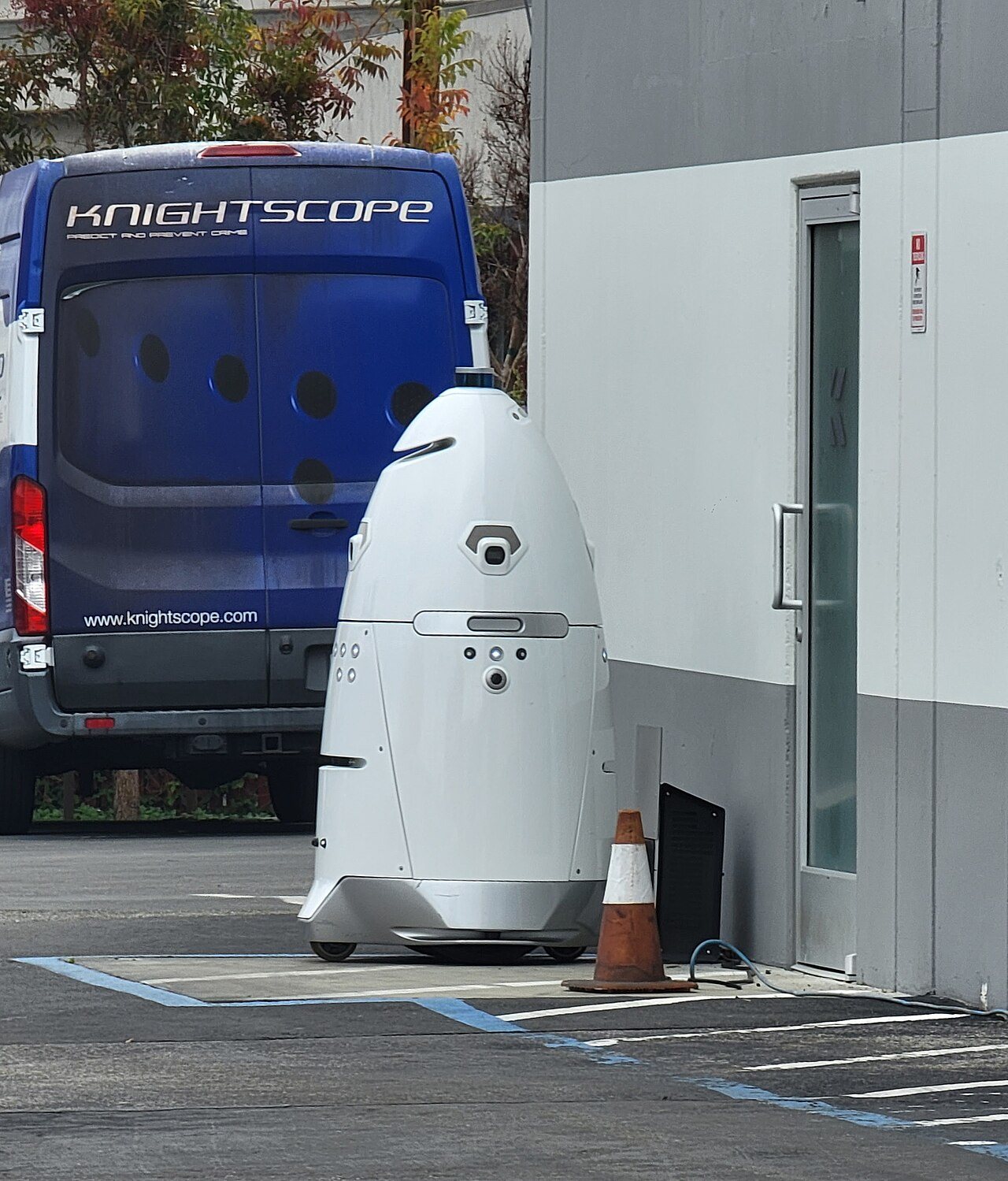
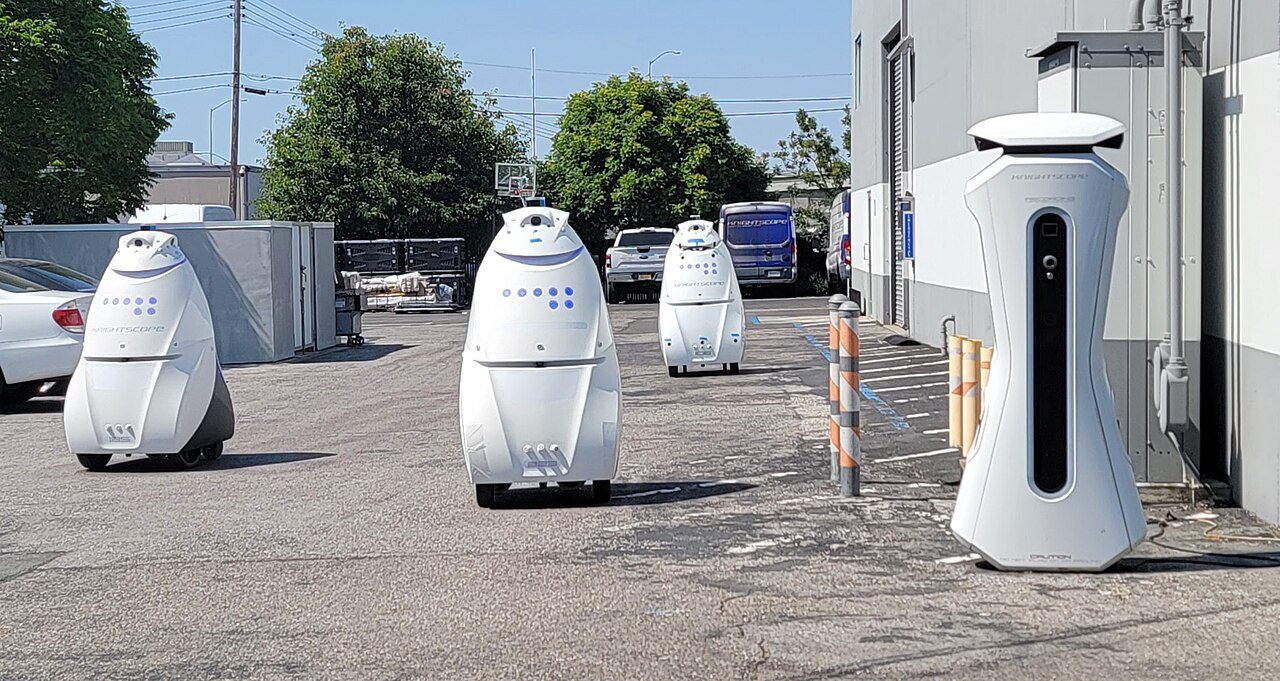
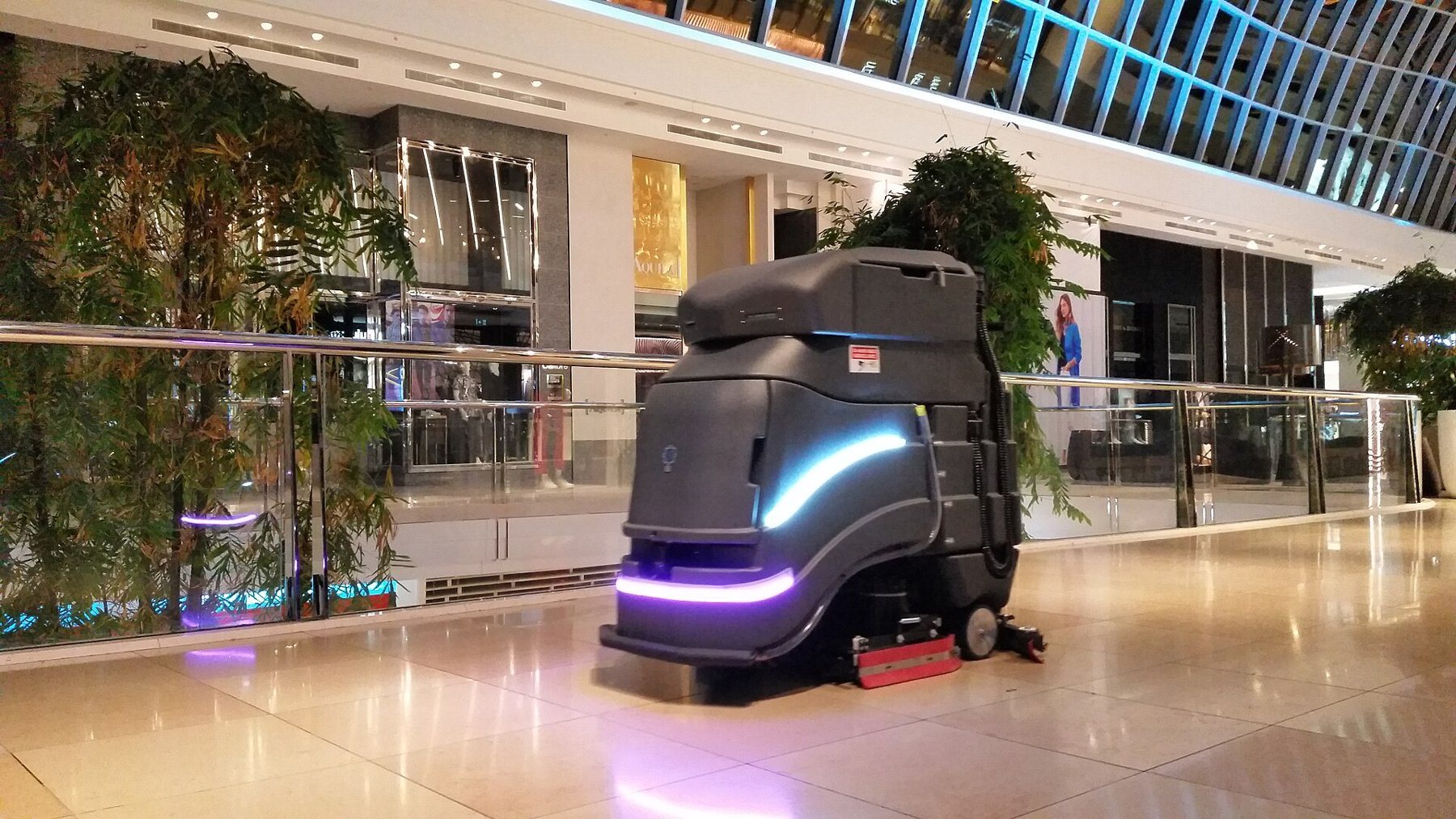
Security patrol robot of the type used at apartment communities.
Photo: Votpuske, CC BY-SA 4.0
Patrol and floor care are the machines residents will see first.
Photos show the type of machine; makers may differ from those named on other pages.
Floor care robots cover the common areas.
The leading brands and what they report.
- Tennant invested $32 million in Brain Corp in 2024.
- Brain Corp licenses its software to makers such as Tennant.
- Veritiv result is a vendor case study, Oct 2024.
What the vendors say
- Most units run in stores and warehouses, not apartments.
- Common-area and garage floors suit the same machines.
- Ask vendors for site-level proof.
How to read it
Floor care is the most proven machine for residential common areas.
Sources: Tennant (Jun 2025); Brain Corp (2024, 2026). Vendor-reported.
Drones, IoT and automation
Sensors, locks, lockers and aerial inspection.
Sensors, locks and drones extend the site team.
54
Sensors, locks and drones extend the site team.
Connected systems that need no new staff.
- 1Leak and HVAC sensors
Flag leaks and failing equipment. Cut after-hours calls. Commercial.
- 2Smart locks and access
Remote entry for vendors and guests. Fewer lockouts and keys. Commercial.
- 3Drones
Roof and facade surveys. Fly under FAA Part 107 rules. Early commercial.
- 4Software assistants
AI leasing and collections assistants. Equity Residential cut headcount 20% from 2020 to 2025. Commercial.
Sensors and software are already changing site staffing, ahead of robots.
Source: Bisnow (2025) on Equity Residential headcount.
Economics and buying
Who pays, how, and how the return is judged.
Owners, managers and REITs each decide differently.
56
A return test for a patrol robot.
57
Owners, managers and REITs each decide differently.
Who pays and who approves.
| Buyer | Decides | Typical hurdle |
|---|---|---|
| Owner-operator | Principal or asset manager | Proof of payback at one site |
| REIT | Operations and technology teams | Portfolio-wide standards and pilots |
| Third-party manager | Regional director, owner approval | The owner must approve the cost |
| Security contractor | Account manager at the client | Needs a guard post it can replace |
| Senior living operator | Operations and resident care leads | Resident acceptance and safety |
Win the owner who pays; managers will not buy what owners have not approved.
Greystar pilots tools against business outcomes, time savings and resident experience (Multifamily Executive, 2025).
A return test for a patrol robot.
Illustrative arithmetic using public wage data.
- Public wage data: security guards earn a median of $18.46 an hour (BLS, May 2024).
- Assume 8 overnight hours a night covered by a robot: about 2,920 hours a year.
- At $18.46 that is about $53,900 in guard wages, before overhead.
- Compare it with the robot fee quoted for that site.
Illustrative arithmetic
- Robot fee, mapping, charging and service.
- Guard hours actually removed, not just reduced.
- Insurance, claims and incident trends.
- Resident feedback.
What to include
Add overhead and a human backup, then compare. The test is hours removed, not robots bought.
Illustrative: 8 h x 365 = 2,920 h; x $18.46 = $53,903. Wage: BLS, May 2024. Typical ballpark values from public sources, not quotes.
Safety, rules and risk
Fair housing, privacy, access and liability.
Residential rules center on people, privacy and access.
59
Residential rules center on people, privacy and access.
Rule sets to check before launch.
| Area | What to check | Why it matters |
|---|---|---|
| Fair Housing Act | No bias in patrols, alerts or screening | Discrimination claims |
| ADA access | Keep accessible routes and doors clear | Blocked routes are a violation risk |
| Privacy and video | Notice for cameras and recording | State privacy laws vary |
| Facial recognition | Check local limits before using it | Some cities restrict it |
| Duty of care | Owners must protect tenants from third-party harm | Robots do not replace a duty |
| Drones | FAA Part 107, local notice to residents | Airspace and neighbor complaints |
Ask counsel to review patrol robots and any facial recognition before they go live.
Sources: HUD (Fair Housing Act); DOJ (ADA); FAA (Part 107). General guidance, not legal advice.
Human-in-the-lead operating model
How site teams and machines share the work.
Site teams stay in charge of residents.
61
Site teams stay in charge of residents.
Human-in-the-lead for apartment communities.
- Sets patrol and cleaning schedules.
- Approves any resident-facing action.
- Owns the resident relationship.
Site lead
- Watches robots and alerts.
- Verifies every threat before anyone acts.
- Reports to the site lead daily.
Remote operator
- Handles charging, mapping and repairs.
- Trains staff to restart a robot.
- Logs faults and fixes.
Technician
People set the rules and make the calls; robots patrol, clean and report.
Pilots, buyers and what to watch
Who buys, what to pilot first and what to track.
Who buys, and who to approach.
63
A first pilot, in three steps.
64
Who buys, and who to approach.
Large residential operators and their roles.
| Player | What is public | Role to approach |
|---|---|---|
| Greystar | Pilots AI tools against outcomes, time and resident experience | Technology and operations leads |
| AvalonBay | Used lockers from 2017; AI rent collections | Corporate initiatives and operations |
| Equity Residential | About 80,000 units; expanding conversational AI | Operations and technology |
| Westland Real Estate Group | 65 communities, 12,000+ units; robot patrol | Operations and security |
| Third-party managers | Manage many owners’ sites | Regional directors |
Start with operators that already pilot technology and name outcomes.
Sources: Multifamily Executive; Bisnow; Security Magazine; company reports. Titles only; no contact data.
A first pilot, in three steps.
One site, one task, one measure.
- Pick a garage or common area with a known problem.
- Agree one measure, such as guard hours removed.
Choose
- Run four to eight weeks with a site lead and an operator.
- Log every incident and resident comment.
Run
- Compare against the baseline.
- Scale only if the measure and resident feedback hold.
Decide
Watch for resident complaints, privacy questions and false alarms.
Commercial property and facilities
Sector and labor picture, where physical AI works, machines in the field, drones, IOT and automation, economics and buying, safety, rules and risk.
Sector and labor picture
Size, staffing and turnover in facility services.
Facility services runs on low pay and high churn.
67
Security guarding is large, and hard to staff.
68
Facility services runs on low pay and high churn.
Cleaning and security labor, U.S., 2024 to 2026.
- Cleaning is a very large, low-wage workforce.
- Most openings come from people leaving, not new growth.
- Security guard turnover is reported near 90%.
What the data shows
- Labor is the main cost for cleaning and guarding contracts.
- Contractors carry the turnover risk.
- Repeated, long-route tasks suit robots.
What it means for machines
Facility services is the sector where robots are most proven and most needed.
Sources: BLS Occupational Outlook Handbook (janitors and building cleaners); The Next Web (2026) on guard turnover.
Security guarding is large, and hard to staff.
Guard workforce and wages.
- About 1.27 million security guards work in the U.S.
- Median pay is $18.46 an hour, $38,370 a year (May 2024).
- About 162,300 openings a year, mostly from turnover.
- Roughly three in four work for contract security firms.
Workforce facts
- Allied Universal was listing about 3,500 open roles in Aug 2026.
- Some clients leave vacant guard posts unfilled when robots cover them.
- Verification of threats stays with a person.
What operators report
Contract guard firms are natural partners for robots, not rivals.
Sources: BLS (May 2024 pay and employment); Allied Universal job postings (Aug 2026); The Next Web (2026).
Where physical AI works
Use cases by task, with their level of proof.
Where machines work in commercial property.
70
Corporate occupiers adopt machines, but integrate slowly.
71
Where machines work in commercial property.
Use cases, with their level of proof.
| Use case | What it does | Proof |
|---|---|---|
| Autonomous floor scrubbing | Cleans lobbies, concourses and warehouses | Commercial |
| Security patrol robots | Patrol campuses, lots and venues | Commercial |
| Parking and perimeter patrol | Cover garages and fences overnight | Early commercial |
| Grounds mowing and snow | Autonomous mowers and sweepers | Early commercial |
| Drone roof and facade checks | Survey large roofs and tall facades | Early commercial |
| Building sensors and controls | Occupancy, air and equipment alerts | Commercial |
| Window and facade cleaning | Robots on tall buildings | Pilot |
Floor care and patrol are ready now; grounds, drones and facades need a careful pilot.
Corporate occupiers adopt machines, but integrate slowly.
JLL survey and market forecasts.
- JLL’s 2025 survey found wide adoption but thin integration.
- Real estate robotics saw a renewal in 2025, driven by AI advances.
- Investment in consumer, logistics and security robots is spilling over.
What JLL reports
- Adoption without integration means machines idle or underused.
- Forecasts are market-research estimates, not facts.
- Integration is the gap Atomgigs fills.
How to read it
Buying robots is easy; fitting them into daily operations is the hard part.
Source: JLL (2025), Global Technology Survey and market forecast. Forecasts are estimates.
Machines in the field
Named robots and where they run today.
Floor care robots are the proven workhorse.
73
Security robots and robot dogs patrol large sites.
75
What facility robots look like on site.
74
Floor care robots are the proven workhorse.
Leading makers and reported scale.
| Maker or platform | What is reported | Date |
|---|---|---|
| Tennant | 10,000th robotic scrubber sold; X6 ROVR cleans up to 75,000 sq ft a cycle | Jun 2025 |
| Brain Corp | Software on more than 50,000 robots; deployments up 68% in six months | 2026 |
| Tennant and Brain Corp | Tennant invested $32 million in an exclusive partnership | 2024 |
| FlagShip Facility Services | Fleet of Tennant robots cleans about 19 million sq ft a day in U.S. airports | Apr 2022 |
| Avidbots, Nilfisk, Karcher | Also sell autonomous scrubbers for malls and airports | 2026 |
Choose a maker with service coverage near each site; support matters as much as the robot.
Sources: Tennant; Brain Corp; FlagShip via Business Wire (2022). Vendor-reported.
What facility robots look like on site.
Patrol, cleaning and disinfection machines.
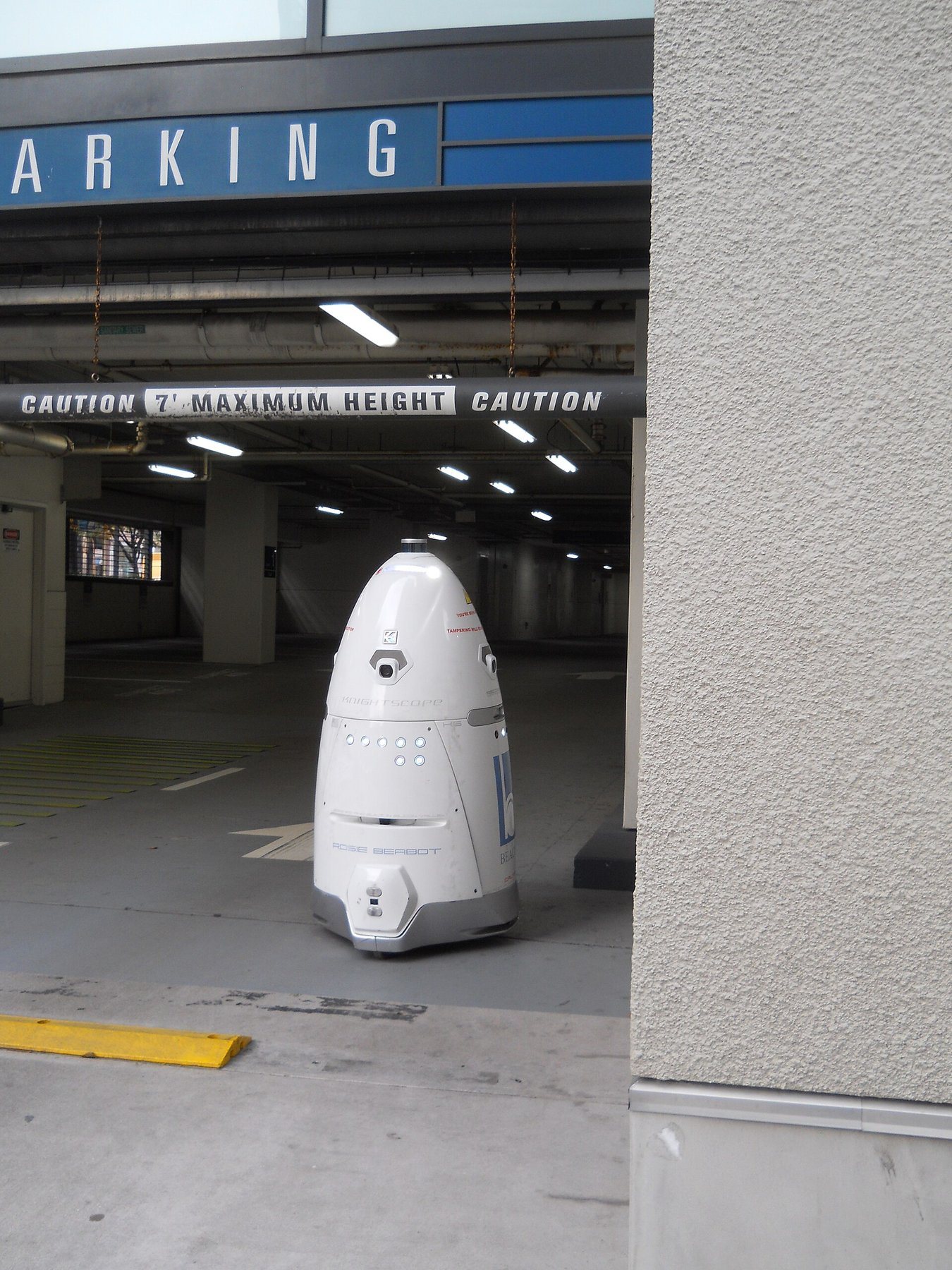
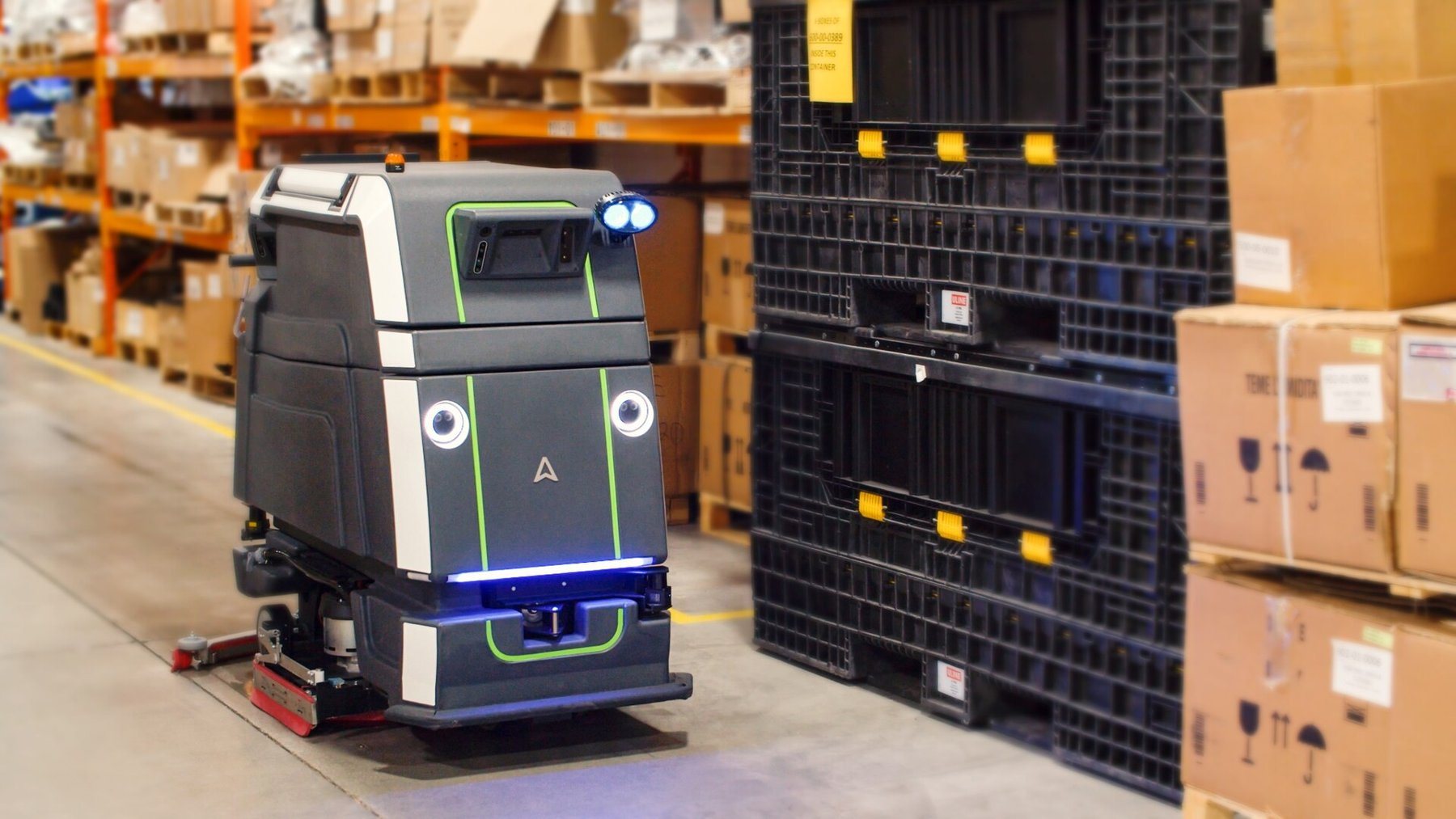
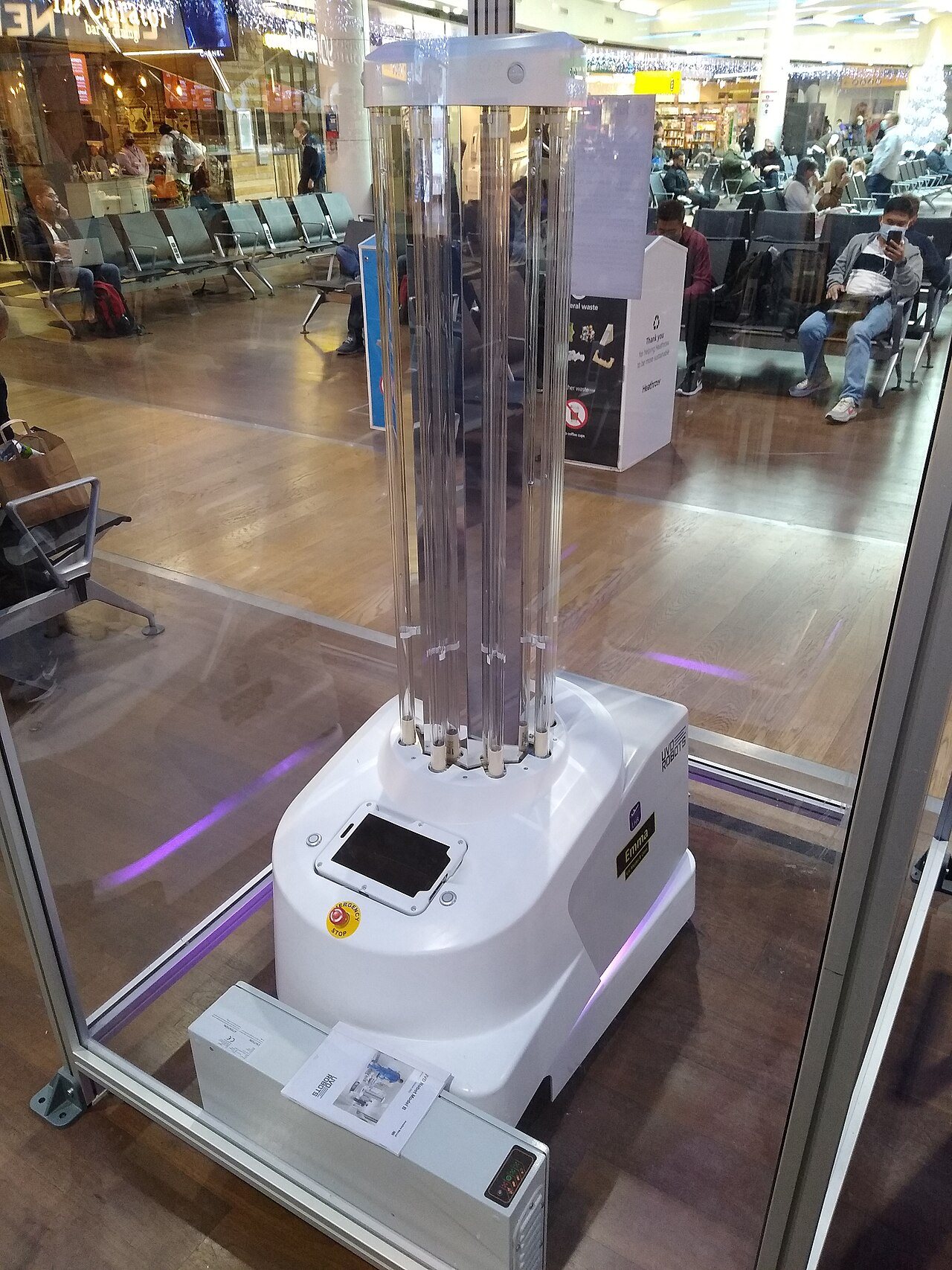
Security patrol robot at a parking garage entrance.
UV disinfection robot in an airport terminal.
Photo: Yngvadottir, CC BY-SA 4.0
Photo: Mx. Granger, CC0
Cleaning, patrol and disinfection are the facility robots to know.
Photos show the type of machine; makers may differ from those named on other pages.
Security robots and robot dogs patrol large sites.
What the makers report.
$120K-170K
Asylon service price per year
6 to 8
Robots one remote operator watches
- Robots and drones are sold as a service with maintenance.
- A robot dog patrols Mercedes-Benz Stadium in Atlanta.
- Robots navigate about 90% of a patrol alone; people handle doors and crossings.
Asylon, as reported
- The largest U.S. guard firm used about two dozen Knightscope robots in 2017.
- Its capabilities brochure now lists robotics and autonomous technology.
- It says robots extend guards and do not replace them.
Allied Universal
Robots cover routine rounds; trained people verify and respond.
Sources: The Next Web (2026), vendor-reported; Philadelphia Inquirer (2017); Allied Universal. Typical ballpark values from public sources, not quotes.
Drones, IoT and automation
Sensors, aerial inspection and building systems.
Building systems and drones add reach.
77
Building systems and drones add reach.
Beyond the robot.
- 1Sensors
Occupancy, air quality and leak alerts. Send crews only where needed. Commercial.
- 2Building automation
Link HVAC, lighting and access. Robots can trigger or respond to events. Commercial.
- 3Drones
Survey roofs, facades and large lots. Fly under FAA Part 107 rules. Early commercial.
- 4Digital twins
Live models of campuses. Test patrol and cleaning routes. Early commercial.
Connected buildings give robots the context to act when and where it matters.
Economics and buying
Who pays, how, and how the return is judged.
Contracts decide who pays for the robot.
79
A return test for a floor robot.
80
Contracts decide who pays for the robot.
Buying paths in facility services.
| Model | Who pays | Note |
|---|---|---|
| In-house | Property owner or corporate real estate | Capex budget and ROI hurdle |
| Contractor buys | Cleaning or security firm | Recovers cost in the contract price |
| Contractor leases or RaaS | Monthly fee to a maker or integrator | Spreads cost, shifts upkeep |
| Pay for capacity | Client pays for hours cleaned or patrolled | Atomgigs commercial model |
Align the contract with the savings: whoever pays must share the benefit.
A return test for a floor robot.
Illustrative arithmetic using public wage data.
- Public wage data: janitors earn a median of $17.27 an hour (BLS, May 2024).
- Assume a robot takes 120 scrubbing hours a month.
- That is $2,072 a month of cleaner time at the median wage.
- A fully loaded wage is higher, so the saving is higher.
Illustrative arithmetic
- Robot fee, mapping, charging and service.
- Hours moved to detail work, not removed.
- Cleaning quality, reports and audit scores.
- Time to map and retrain staff.
What to include
Check the robot fee against the freed hours at the real, loaded wage.
Illustrative: 120 h x $17.27 = $2,072. Wage: BLS, May 2024. Typical ballpark values from public sources, not quotes.
Safety, rules and risk
Standards, access, privacy and liability.
Standards and rules for commercial sites.
82
Standards and rules for commercial sites.
What to check before launch.
| Rule or standard | Covers | Note |
|---|---|---|
| ANSI/CSA C22.2 No. 336 | Battery-powered commercial robotic floor machines | Floor-cleaning robots |
| ANSI/CAN/UL 3300 | Service robots: safety of the robotic function | Edition May 2024 |
| ADA | Accessible routes, doors, elevators | No blocked paths |
| OSHA | Employee safety, training, lockout | Employer duty |
| Privacy and video | Notice for cameras and recording | State laws vary |
| FAA Part 107 | Commercial drone flights | Remote pilot certificate |
Ask for the standard that applies to each machine and the certificate that proves it.
Sources: UL Standards and Engagement; CSA Group; OSHA; FAA; DOJ (ADA). General guidance, not legal advice.
Human-in-the-lead operating model
How facility teams and machines share the work.
Contractor crews and machines share the shift.
84
Contractor crews and machines share the shift.
Human-in-the-lead for facility services.
- Sets routes, hours and priorities.
- Keeps people and robots out of each other’s way.
- Signs off on quality.
Site supervisor
- Watches fleet status and alerts.
- Verifies every security alert.
- Reports to the supervisor.
Remote operator
- Charges, maps and repairs robots.
- Trains staff to recover a stuck robot.
- Logs faults.
Technician
The crew keeps the building running; the robots take the long, repeated routes.
Pilots, buyers and what to watch
Who buys, what to pilot first and what to track.
Who buys, and who to approach.
86
A first pilot, in three steps.
87
Who buys, and who to approach.
Facility-services players and what is public.
| Player | What is public | Role to approach |
|---|---|---|
| Allied Universal | Largest U.S. guard firm; lists robotics services | Technology and account leads |
| FlagShip Facility Services | Airport cleaning fleet of Tennant robots | Operations |
| Property managers (JLL, CBRE, Cushman) | JLL tracks occupier robotics adoption | Facility and technology leads |
| Universities and campuses | Buy guard and cleaning contracts | Facilities and public safety |
| Corporate occupiers | 69% use conventional robots (JLL) | Corporate real estate |
Start with contractors that carry labor risk and want fewer vacant posts.
Sources: Allied Universal; Business Wire (2022); JLL (2025). Titles only; no contact data.
A first pilot, in three steps.
One site, one task, one measure.
- Pick a large floor or a vacant guard post.
- Agree one measure: hours freed or posts covered.
Choose
- Run four to eight weeks.
- Log stops, alerts and audit scores.
Run
- Compare against the baseline.
- Scale when quality and cost both hold.
Decide
Watch for stuck robots, false alarms and staff concerns about their jobs.
Hospitality, entertainment and sports
Sector and labor picture, where physical AI works, machines in the field, drones, IOT and automation, economics and buying, safety, rules and risk.
Sector and labor picture
Size, staffing and turnover in hospitality and venues.
Hotels and venues sell service, and staff it thinly.
90
Entertainment and sports run on peaks.
91
Hotels and venues sell service, and staff it thinly.
Employment, pay and labor cost in hospitality.
- Hotel jobs are still below 2019 levels.
- Housekeeping and front desk are the hardest roles to fill.
- Pay is rising faster than inflation in some markets.
What the data shows
- Back-of-house hauling and floor care are repeat tasks.
- Guest contact stays with people.
- Union contracts shape how and when machines arrive.
What it means for machines
Labor is the largest hotel cost, and the hardest to hire.
Sources: AHLA (2025 projection; counts more roles than BLS, which shows 1.92M); BLS, Sep 2026; HotStats (2025).
Entertainment and sports run on peaks.
Crowds arrive in hours and leave in minutes.
- Concession lines at halftime and intermission.
- Cleaning between events, often overnight.
- Security and crowd flow at entry and exit.
Where the pressure falls
- Grab-and-go and kiosk checkout at concessions.
- Floor care between events.
- Show robots and greeters as attractions.
Where machines fit
Peaks favor machines that add capacity fast, without hiring for a few hours.
Where physical AI works
Use cases by task, with their level of proof.
Where machines work in hotels and venues.
93
Guests like robots, but only when they work.
94
Where machines work in hotels and venues.
Use cases, with their level of proof.
| Use case | What it does | Proof |
|---|---|---|
| Room delivery robots | Carry towels, snacks and orders to rooms | Commercial |
| Lobby and hall floor care | Scrub and vacuum on a schedule | Commercial |
| Server and runner robots | Carry plates and clear tables | Commercial |
| Linen and waste hauling | Move carts in back-of-house corridors | Early commercial |
| Concession grab-and-go | Camera checkout, no cashier | Commercial |
| Humanoid show robots | Entertain and guide guests | Early commercial |
| Fully robot-run hotel | Robots for most guest services | Concept |
Start with delivery, floor care and back-of-house hauling. Treat full automation as a concept.
Guests like robots, but only when they work.
Three guest-facing patterns.
- Relay says its robots have served hotels since 2014.
- Guests enjoy them, vendors report.
- Best for small, fast items.
Delivery to rooms
- Sphere in Las Vegas runs five humanoid greeters.
- Disney droids roam its parks.
- Entertainment, not labor savings.
Show and greet
- Aramark reports faster checkout at venues.
- Operator figures, not independent.
- Fewer cashiers, more floor staff.
Self-service
Use robots where they delight guests or remove a wait.
Sources: Hotel Dive; Front Office Sports (2026); press reports on Sphere (Aug 2025). Vendor and operator claims.
Machines in the field
Named robots and where they run today.
Named robots and deployments.
96
Price points are low, but proof is vendor-made.
98
Robots guests meet in hotels and restaurants.
97
Named robots and deployments.
What operators and vendors report.
| Vendor or operator | What is reported | Maturity |
|---|---|---|
| Relay Robotics | 1.5 million deliveries in hotels and hospitals, vendor figure | Commercial |
| Aloft Silicon Valley (Marriott) | Delivery time cut from 15 to 2 minutes, vendor case | Commercial |
| TechForce TIM-E | Linen and waste robot at a Homewood Suites, Del Mar | Early commercial |
| Aramark | About 65 grab-and-go units across 21 venues | Commercial |
| Sphere Las Vegas | Five Aura humanoid greeters in the atrium | Early commercial |
| Pudu | Plans a 44-room robot-served hotel in Shenzhen, 2027 | Concept |
Proof is narrow: delivery, hauling, cleaning and greeting.
Sources: Hotel Dive; Relay Robotics; Hotel Technology News (Jul 2026); Front Office Sports. Vendor-reported.
Robots guests meet in hotels and restaurants.
Reception, serving and runner machines.

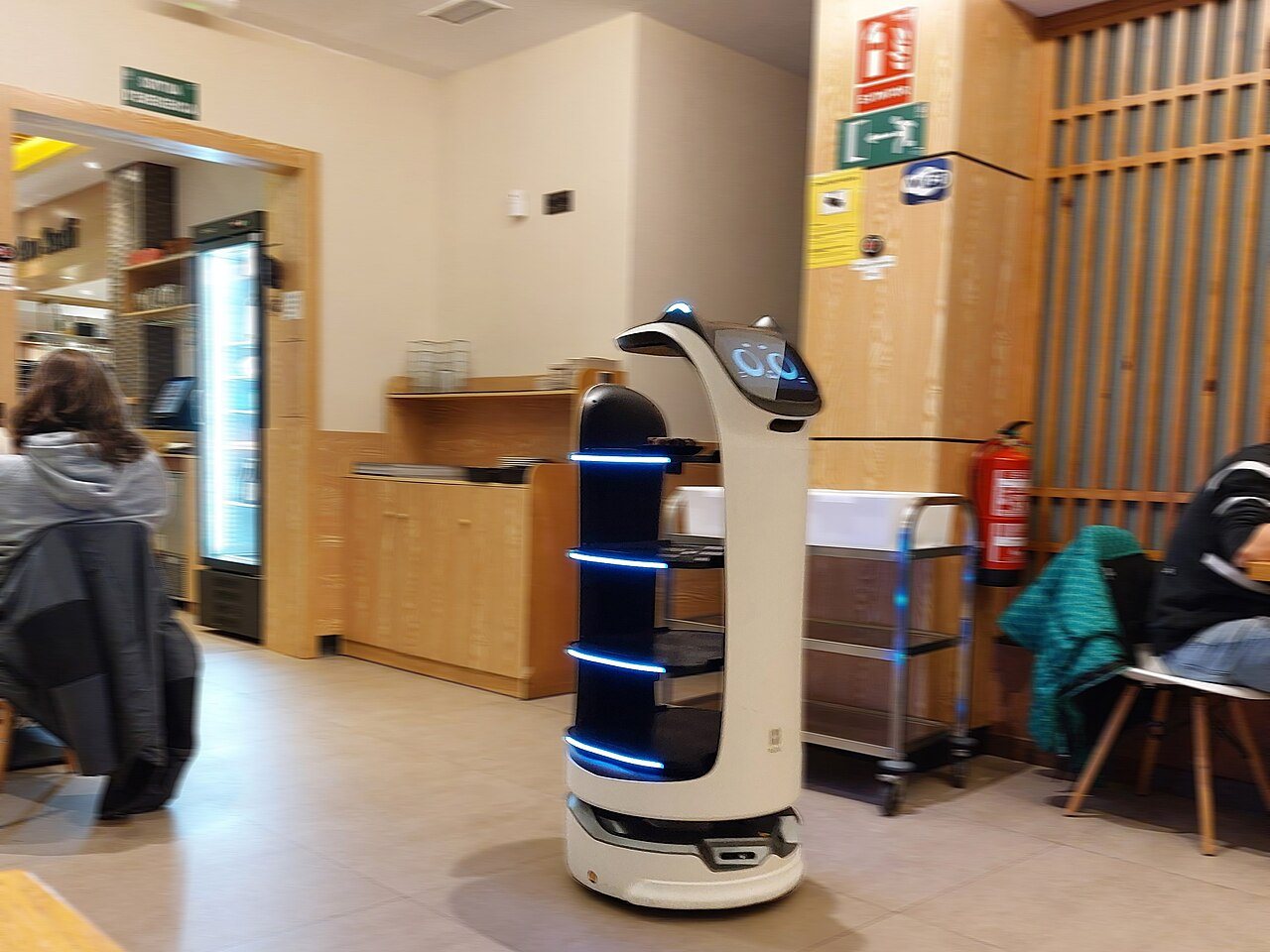

Guests meet robots at reception, in dining rooms and in corridors.
Photos show the type of machine; makers may differ from those named on other pages.
Price points are low, but proof is vendor-made.
Reported fees for hotel robots.
<$400
Per month, Bear Robotics Servi lease, 36 months
- Fees are vendor quotes and vary by site.
- Market sizes are secondary estimates.
- Ask for references at hotels like yours.
How to read it
- Uptime and elevator access.
- Hours of work actually replaced.
- Guest feedback on the same floor.
What to test
Cheap per month is not cheap if it removes no hours.
Sources: Hotel Dive (2026); Hotelier Times (2026); Mordor Intelligence. Typical ballpark values from public sources, not quotes.
Drones, IoT and automation
Sensors, kiosks, drones and show systems.
Kiosks, sensors and drones stretch the team.
100
Kiosks, sensors and drones stretch the team.
Systems that need no new staff.
- 1Checkout-free bars
Amazon Just Walk Out opened at a Dutch arena in July 2026. Used at some U.S. ballparks. Early commercial.
- 2Self-order kiosks
Operators claim 50% faster than a cashier. Reduces lines at peaks. Commercial.
- 3Drone shows
Light shows replace fireworks at venues. Entertainment asset. Commercial.
- 4Room sensors
Energy, leak and occupancy sensors. Cut waste and call-outs. Commercial.
Checkout and sensing are the proven systems; show tech is a guest attraction.
Sources: Retail Tech Innovation Hub (Jul 2026); Front Office Sports (2026). Operator claims.
Economics and buying
Who pays, how, and how the return is judged.
Owners, brands and operators each hold a vote.
102
A return test for a back-of-house robot.
103
Owners, brands and operators each hold a vote.
Who pays and who approves.
| Buyer | Decides | Typical hurdle |
|---|---|---|
| Hotel owner | Asset manager or principal | Proof of payback at one hotel |
| Management company | Regional vice president, owner approval | Owner must approve the cost |
| Hotel brand | Brand standards and technology teams | Franchise approval across the system |
| Casino resort | Operations and labor relations | Union notice rules |
| Venue or concessionaire | General manager, food and beverage lead | Event-day reliability |
Win the owner who pays. Brand standards and union terms set the pace.
In Las Vegas, the Culinary Union contract with Caesars requires six months’ notice of new technology (2023).
A return test for a back-of-house robot.
Illustrative arithmetic using public wage data.
- Assume the robot takes 6 hours of hauling a day: 2,190 hours a year.
- At $25.57 an hour that is about $56,000 in wages.
- A $150-a-day fee is $54,750 a year.
- So the saving is small unless hours are truly removed.
Illustrative arithmetic
- Fee, service, charging and elevator work.
- Hours removed, not just moved.
- Guest and staff feedback.
- Overhead and benefits, which raise wage cost.
What to include
Savings appear when the robot frees a person for guest work, not when it just runs.
Illustrative: 6 h x 365 = 2,190 h; x $25.57 = $56,000; $150 x 365 = $54,750. Typical ballpark values from public sources, not quotes.
Safety, rules and risk
Guest safety, access, privacy and liability.
Guest safety, access and union terms lead the rules.
105
Guest safety, access and union terms lead the rules.
Rule sets to check before launch.
| Area | What to check | Why it matters |
|---|---|---|
| UL 3300 | Safety class for service robots in public spaces | Speed, sensing and contact limits |
| ADA access | Keep halls, ramps and doors clear | Blocked access is a violation risk |
| Food safety | Local health rules for food-carrying robots | Health departments approve equipment |
| Privacy | Camera notice for guests and staff | State laws vary |
| Union agreements | Notice before new technology | Las Vegas contracts require months of notice |
| Liability | Who answers for a guest injury | Settle in the contract |
Read union and franchise terms before the first demo.
Sources: UL Standards and Engagement (UL 3300); DOJ (ADA). General guidance, not legal advice.
Human-in-the-lead operating model
How teams and machines share the work.
Hotel teams stay in charge of guests.
107
Hotel teams stay in charge of guests.
Human-in-the-lead for hotels and venues.
- Sets service hours and zones.
- Approves guest-facing tasks.
- Owns brand standards.
Operations lead
- Watches robots and alerts.
- Steps in when a guest blocks a robot.
- Reports to the operations lead.
Remote operator
- Charges, maps and repairs robots.
- Trains staff on restarts.
- Logs faults and fixes.
Technician
People host the guest; machines carry, clean and report.
Pilots, buyers and what to watch
Who buys, what to pilot first and what to track.
Who buys, and who to approach.
109
A first pilot, in three steps.
110
Who buys, and who to approach.
Operators with public robot activity.
| Player | What is public | Role to approach |
|---|---|---|
| Marriott, Hilton, IHG, Wyndham | Robots at branded hotels through Relay | Brand technology and operations |
| Aramark Sports and Entertainment | Grab-and-go units at 21 venues | Sports and entertainment leadership |
| Sphere Entertainment | Five humanoid greeters | Venue operations |
| Disney parks | Droids and character robots | Imagineering and park operations |
| Las Vegas resorts | Union notice rules apply | Operations and labor relations |
Start with operators that already host robots and name outcomes.
Sources: Hotel Dive; Front Office Sports; company reports. Titles only; no contact data.
A first pilot, in three steps.
One hotel, one task, one measure.
- Pick one hotel and one task, such as linen hauling.
- Agree a measure, such as hours removed.
Choose
- Run four to eight weeks with staff and an operator.
- Log faults, guest comments and elevator use.
Run
- Compare against the baseline.
- Scale only if hours and guest feedback hold.
Decide
Watch for guest complaints, elevator delays and union notice rules.
Healthcare
Sector and labor picture, where physical AI works, machines in the field, drones, IOT and automation, economics and buying, safety, rules and risk.
Sector and labor picture
Size, staffing and turnover in healthcare.
Nurse turnover is a costly, measurable loss.
113
Clinicians lose time to logistics.
114
Nurse turnover is a costly, measurable loss.
Staffing figures from the 2026 NSI report.
- Each point of turnover costs a hospital $295,000.
- Filling a role takes about 78 days.
- Behavioral health turnover reaches 22.5%.
What the data shows
- Delivery, fetching and restocking eat nursing time.
- Robots do not replace bedside care.
- Retaining one nurse pays for real automation.
What it means for machines
Every nurse who stays saves a hospital about $60,000.
Source: NSI Nursing Solutions, 2026 National Health Care Retention and RN Staffing Report (2025 data).
Clinicians lose time to logistics.
Where the hours go.
- Moxi’s maker says nurses spend up to 30% of time on logistics.
- Hospital staff walk long distances for supplies.
- Moxi’s maker reports 575,000 staff hours saved.
What the sector reports
- The 30% and 575,000 figures are vendor claims.
- Nurses in one study said they had more time to talk to patients.
- Unions ask to be consulted before rollout.
How to read it
The test is hours returned to patient care, measured on your units.
Sources: Diligent Robotics (vendor claims); Becker’s Hospital Review (2023); Seattle Met (2023).
Where physical AI works
Use cases from logistics to clinical-adjacent work.
Where machines work in healthcare.
116
Clinical-adjacent tools need extra care.
117
Where machines work in healthcare.
Use cases, with their level of proof.
| Use case | What it does | Proof |
|---|---|---|
| Supply and linen delivery | Cart items between floors | Commercial |
| Pharmacy last-mile delivery | Carry medicines from pharmacy to unit | Commercial |
| Mobile manipulators | Open doors, fetch and restock | Early commercial |
| UV disinfection robots | Disinfect empty rooms | Commercial |
| Floor care and cleaning | Scrub corridors and lobbies | Commercial |
| Pharmacy and lab automation | Pick, count and sort in back rooms | Commercial |
| Virtual nursing, telepresence | Remote staff see and speak to patients | Early commercial |
| Autonomous patient care | Robots handle bedside tasks | Concept |
Start with logistics. Keep clinical judgment with clinicians.
Clinical-adjacent tools need extra care.
Where the clinical line sits.
- Moves goods, not patients.
- No patient contact required.
- Lowest regulatory burden.
Logistics
- Handles medicines, samples, or patient environment.
- Needs chain of custody and hospital approval.
- Check privacy and device rules.
Clinical-adjacent
- Touches diagnosis or treatment.
- Regulated as a medical device by the FDA.
- Outside Atomgigs sourcing scope for now.
Clinical
Atomgigs works on the first two bands, with clinical leaders in charge.
Machines in the field
Named robots and where they run today.
Named robots and what they report.
119
Rental pricing now follows the hospital’s capacity.
121
Robots seen in hospitals today.
120
Exoskeletons help patients walk and caregivers lift.
122
Named robots and what they report.
Vendors and results.
| Vendor | What is reported | Maturity |
|---|---|---|
| Diligent Moxi | 25+ hospitals; 1.25 million deliveries; 575,000 hours saved, vendor | Early commercial |
| Aethon TUG | Used in over 37 VA hospitals, 2024 report | Commercial |
| Swisslog Healthcare | Partnered with Diligent for last-mile delivery, Oct 2025 | Commercial |
| Serve Robotics | Bought Diligent for $29M, Jan 2026 | Commercial |
| Moxi 2.0 | Rolling out Aug 2026 at three health systems | Early commercial |
Moxi has the most reported hospital use; TUG has the longest record.
Sources: Diligent Robotics; Serve Robotics; Swisslog Healthcare; The Robot Report (Aug 2026). Vendor-reported.
Robots seen in hospitals today.
Delivery and disinfection machines.
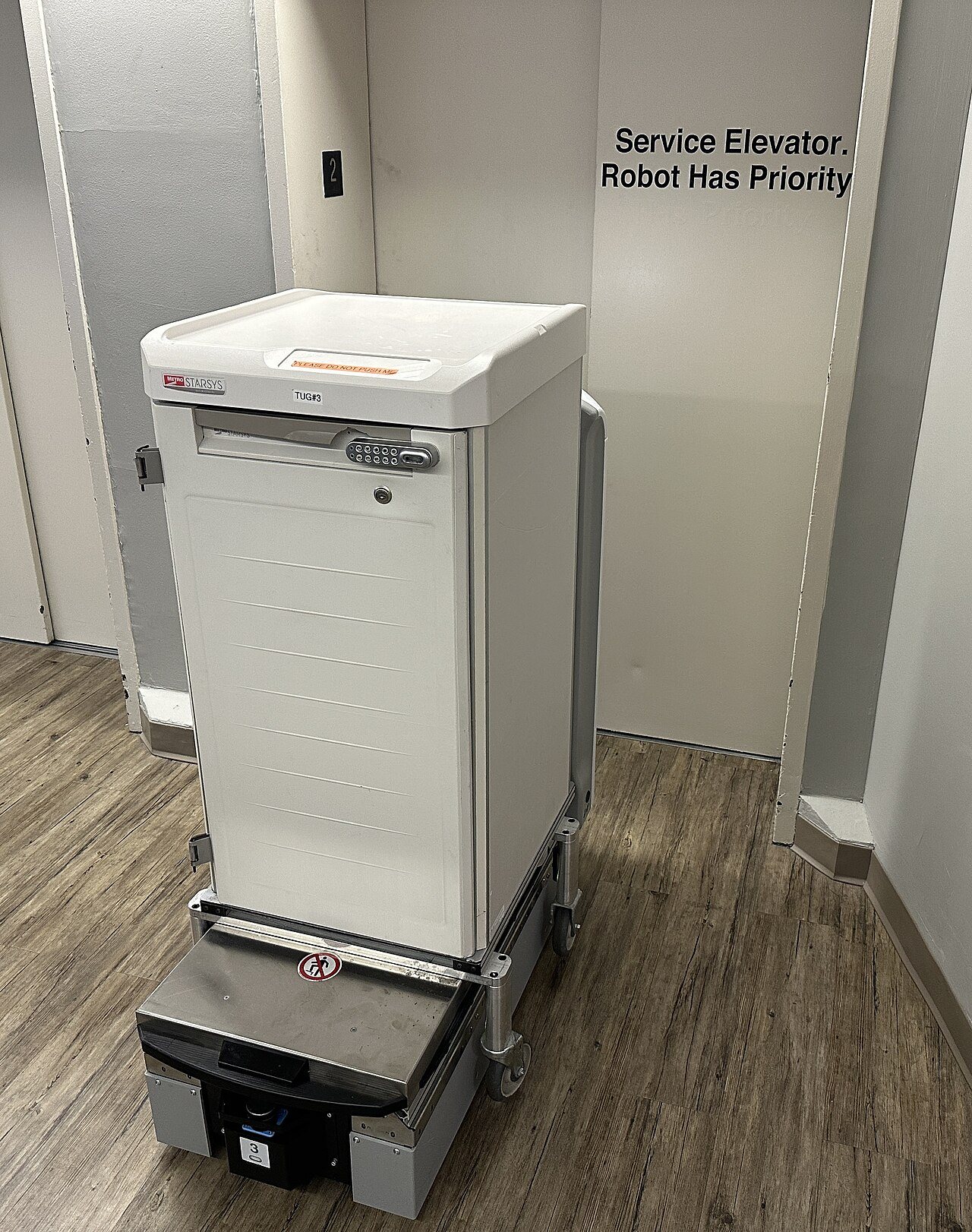
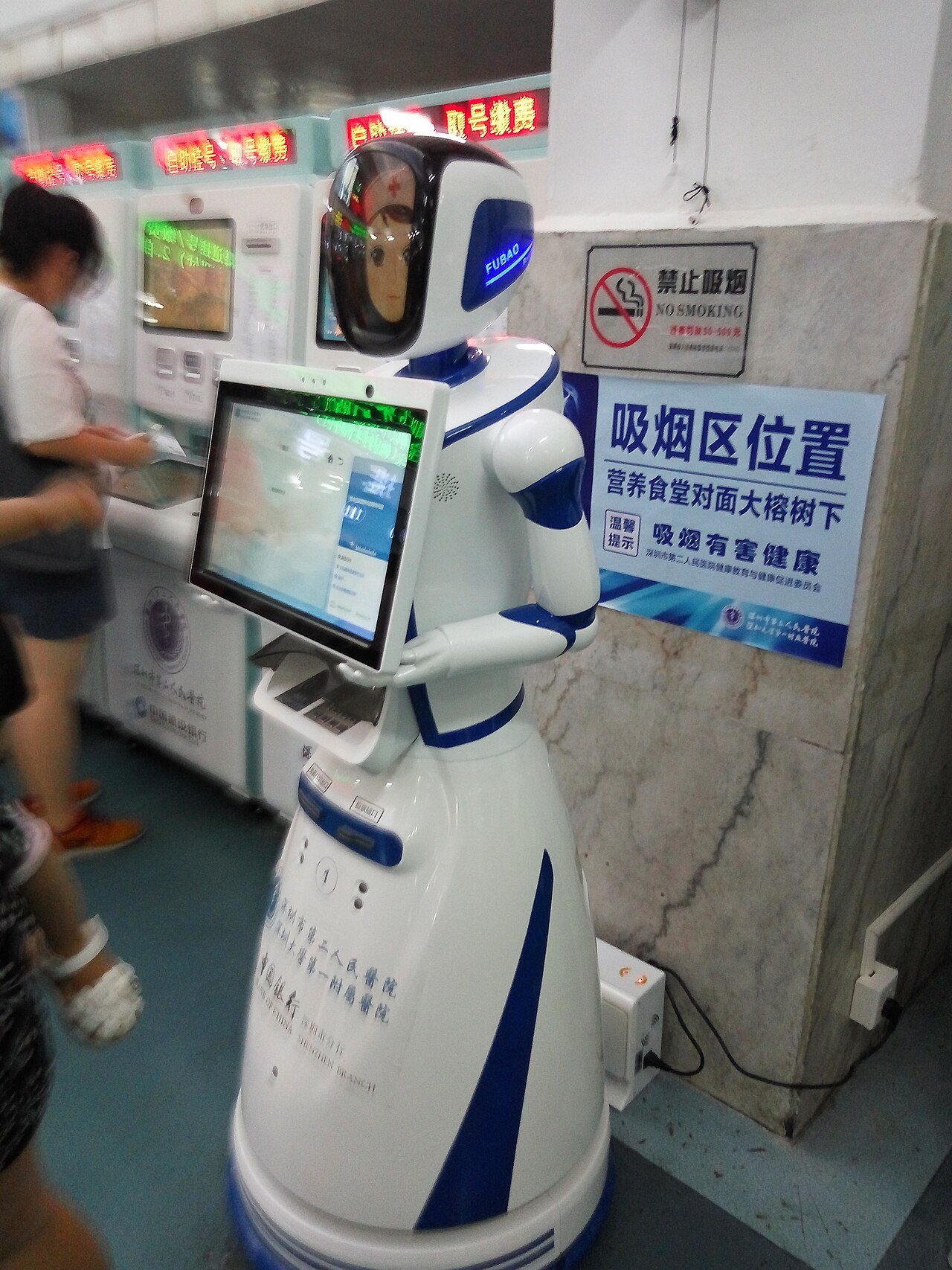
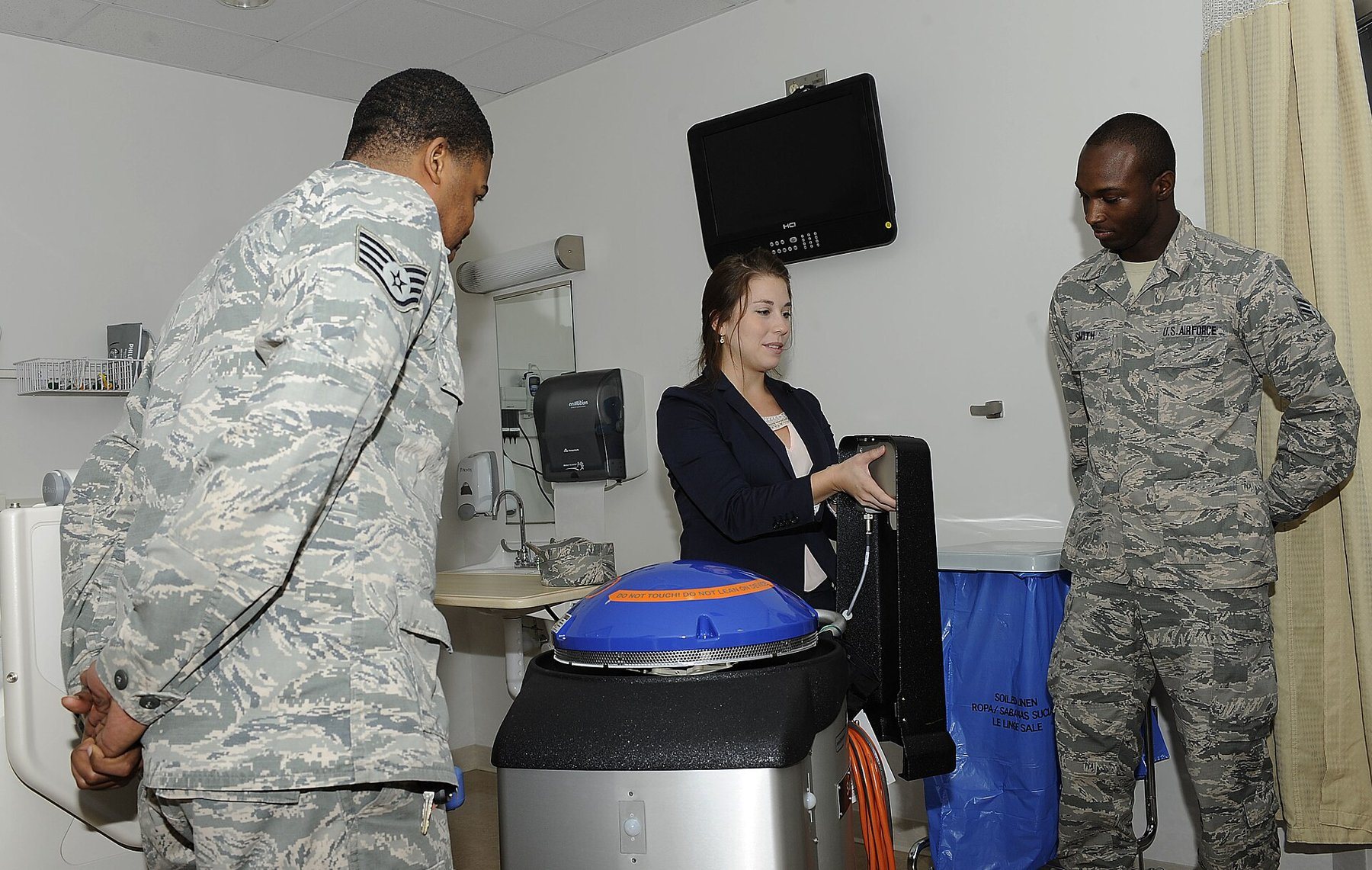
Hospital delivery robot sharing an elevator.
Guide robot in a hospital in Shenzhen, China.
Photo: Mikael Häggström, CC0
Photo: Lhzss8, CC BY-SA 4.0
Delivery and disinfection are the hospital robots with the longest record.
Photos show the type of machine; makers may differ from those named on other pages.
Rental pricing now follows the hospital’s capacity.
What buyers are quoted.
$200K to $400K
Yearly revenue Serve expects from each hospital running Moxi
- Moxi is sold as a subscription with remote support.
- Robot makers rent capacity instead of selling machines.
- Hospitals add robots unit by unit.
What it shows
- The price range is the maker’s expectation, not a quote.
- Delivery counts are vendor figures.
- Ask for site references with your pharmacy setup.
How to read it
Moxi is priced like staff capacity, not like equipment.
Sources: PYMNTS (2026); The Robot Report (Aug 2026). Vendor figures. Typical ballpark values from public sources, not quotes.
Exoskeletons help patients walk and caregivers lift.
Wearable robots in healthcare in brief; Primer 01 Robotics covers them in full.
Rehab and mobility (clinical)
- Powered leg frames for gait training after stroke or spinal cord injury.
- Makers: Wandercraft and Ekso Bionics (merging, Oct 2026), Lifeward (ReWalk), Cyberdyne.
- FDA-cleared; therapists run them. Reviews find gains for some stroke patients.
- Medicare pays about $91,000 for a personal unit (since 2024).
Caregiver lift support (workplace)
- Back-support suits for lifting and repositioning patients.
- Makers: German Bionic, Cyberdyne (HAL Lumbar), Innophys (Muscle Suit).
- Lab studies show less low-back load; injury-rate evidence is still thin.
- An add-on to ceiling lifts and safe patient handling, not a substitute.
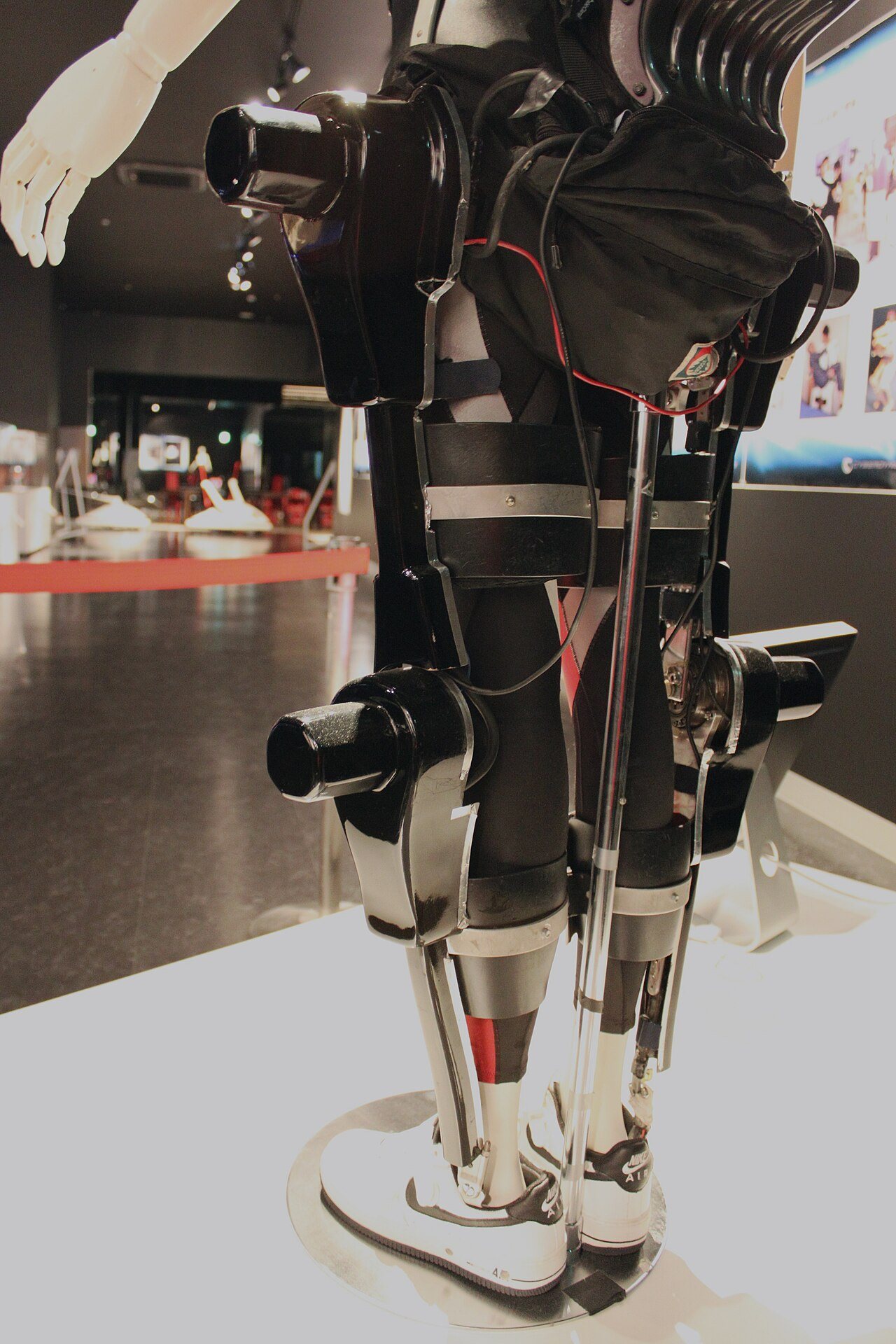
Cost, model and where Atomgigs fits
• Rehab units are capital equipment for rehab centers; caregiver suits cost far less and are often rented monthly. Atomgigs can pilot caregiver suits on one unit, measured by strain reports and lost workdays.
Leg exoskeleton (Cyberdyne HAL) of the type used for gait training.
Photo: Yuichiro C. Katsumoto, CC BY 2.0
Rehab exoskeletons stay with therapists; caregiver lift suits are a good first pilot.
Sources: FDA; CMS fee schedule (Apr 2024); company reports; Wandercraft (Oct 2026). Typical ballpark values from public sources, not quotes.
Drones, IoT and automation
Sensors, tracking and smart-room systems.
Sensors, tracking and smart rooms help quietly.
124
Sensors, tracking and smart rooms help quietly.
Systems that need no new staff.
- 1Asset tracking
Find pumps and beds fast. Cut hours spent searching. Commercial.
- 2Smart rooms
Cameras and sensors for virtual nursing. Remote nurse supports bedside staff. Early commercial.
- 3Fall and wander alerts
Alert staff when patients move. Needs privacy review. Commercial.
- 4Environmental sensors
Track temperature and air quality. Protect medicines and rooms. Commercial.
Sensing is quicker to approve than moving machines, and often as valuable.
Economics and buying
Who pays, how, and how the return is judged.
Systems, departments and purchasing groups all weigh in.
126
A return test for a hospital delivery robot.
127
Systems, departments and purchasing groups all weigh in.
Who pays and who approves.
| Buyer | Decides | Typical hurdle |
|---|---|---|
| Health system | Operations, supply chain and nursing leaders | Clinical and IT review |
| Hospital department | Pharmacy, environmental services, nursing | Needs a system sponsor |
| Purchasing group | Vizient, Premier and similar contracts | Contract vehicles speed buying |
| Skilled nursing | Administrator | Small budgets |
| Labs and clinic groups | Operations director | Process fit |
Nursing leaders and supply chain together decide; IT and safety teams gate.
A return test for a hospital delivery robot.
Illustrative arithmetic using public turnover data.
- Assume a subscription of $200,000 to $400,000 a year.
- One nurse replaced costs $60,090.
- So the fee equals 3.3 to 6.7 nurses kept.
- Add any logistics hours returned to units.
Illustrative arithmetic
- Subscription, setup, elevator integration and Wi-Fi.
- Nurse hours returned, measured on the unit.
- Retention change, if tracked.
- Staff time for training.
What to include
Measure hours returned and nurses retained on a pilot unit first.
Illustrative: $200,000 / $60,090 = 3.3; $400,000 / $60,090 = 6.7. Typical ballpark values from public sources, not quotes.
Safety, rules and risk
Clinical safety, privacy, devices and liability.
Safety, privacy and clinical rules lead.
129
Safety, privacy and clinical rules lead.
Rule sets to check before launch.
| Area | What to check | Why it matters |
|---|---|---|
| FDA device rules | Is the tool a medical device? | Clinical use needs approval |
| HIPAA | Patient data in cameras and logs | Privacy fines and trust |
| OSHA | No robot-specific rule; hospital writes policy | Staff safety falls to the hospital |
| Infection control | Cleaning of robots between rooms | Spread of infection |
| UL 3300 | Safety class for service robots | Contact and speed limits |
| Joint Commission and CMS | Accreditation standards for equipment | Surveyors ask for policy |
Involve infection control, security and compliance before the first demo.
Sources: FDA; HHS (HIPAA); OSHA; UL Standards and Engagement; The Joint Commission. General guidance, not legal advice.
Human-in-the-lead operating model
How care teams and machines share the work.
Clinicians stay in charge of care.
131
Clinicians stay in charge of care.
Human-in-the-lead for hospitals.
- Chooses tasks and units.
- Approves any patient-facing use.
- Owns clinical judgment.
Nurse manager
- Watches robots and alerts.
- Steps in on blocked halls or elevators.
- Reports to the unit lead.
Remote operator
- Maintains, cleans and updates.
- Trains staff on restarts.
- Logs faults and infection control steps.
Technician
People care for patients; machines carry, clean and report.
Pilots, buyers and what to watch
Who buys, what to pilot first and what to track.
Who buys, and who to approach.
133
A first pilot, in three steps.
134
Who buys, and who to approach.
Named hospitals and roles.
| Player | What is public | Role to approach |
|---|---|---|
| Cedars-Sinai | Moxi at the Los Angeles hospital | Nursing and operations leaders |
| Children’s Hospital Los Angeles | Moxi from the first children’s pilot; Moxi 2.0, 2026 | Pharmacy and operations |
| Providence Saint John’s and Endeavor Health Edward | Moxi 2.0 rollout, Aug 2026 | Operations and nursing |
| Odessa Regional Medical Center | Moxi on the job, Jun 2026 | Operations and nursing |
| Mercy and the VA | TUG robots at many hospitals | Supply chain and pharmacy |
Start with systems that already host robots and publish results.
Sources: CBS News; The Robot Report (Aug 2026); Robotics 24/7; NBC Palm Springs (Jun 2026). Titles only; no contact data.
A first pilot, in three steps.
One unit, one task, one measure.
- Pick one unit and one task, such as pharmacy delivery.
- Agree a measure, such as nurse hours returned.
Choose
- Run four to eight weeks with nurses and an operator.
- Log delays, elevator use and staff comments.
Run
- Compare against the baseline.
- Scale only if hours and safety hold.
Decide
Watch for elevator access, staff trust, infection control and union questions.
Food service
Sector and labor picture, where physical AI works, machines in the field, drones, IOT and automation, economics and buying, safety, rules and risk.
Sector and labor picture
Size, staffing and turnover in food service.
Restaurants employ millions on thin margins.
137
Pressure has eased, not gone.
138
Restaurants employ millions on thin margins.
Size, pay and pressure in food service.
- Labor costs are 39% above six years ago.
- Food costs are 34% above six years ago.
- Turnover costs over $2,700 per hourly worker.
What the data shows
- Fry, prep and dish stations are repeat work.
- Tight margins demand quick payback.
- Guest contact stays with people.
What it means for machines
Margins are thin, so machines must pay back fast or not at all.
Sources: National Restaurant Association (Feb 2026); BLS, Sep 2026 (BLS counts 12.4M, a narrower scope); Black Box Intelligence.
Pressure has eased, not gone.
Openings fell, but wages and turnover remain high.
- Openings fell from 989,000 to 659,000 in a year.
- Separations ran at 6.2% in September 2026.
- Full-service jobs remain 3.7% below pre-pandemic levels.
What the data shows
- Nearly three quarters plan to hire.
- Experienced managers and chefs are hard to find.
- Immigration enforcement is cited as cutting labor supply.
What operators say
Machines are a hedge against the next hiring squeeze.
Sources: BLS JOLTS (accommodation and food services, Sep 2025 and Sep 2026); National Restaurant Association (2026).
Where physical AI works
Use cases by task, with their level of proof.
Where machines work in food service.
140
Voice ordering scaled fastest, with exits.
141
Where machines work in food service.
Use cases, with their level of proof.
| Use case | What it does | Proof |
|---|---|---|
| Drive-thru voice ordering | Takes orders by speech | Early commercial |
| Server and bussing robots | Carry plates and clear tables | Commercial |
| Sidewalk delivery | Carry orders to homes and dorms | Commercial |
| Fry and grill robots | Cook baskets on a timer | Early commercial |
| Bowl and salad assembly | Build bowls from ingredient bins | Early commercial |
| Pizza, coffee and dish robots | Single-task kitchen units | Pilot |
| Fully autonomous restaurant | No staff in the kitchen | Concept |
Voice, serving and delivery lead; kitchen robots are still small.
Voice ordering scaled fastest, with exits.
Rollouts and pullbacks by chain.
| Chain | Status | Date |
|---|---|---|
| Taco Bell | Voice AI in 890+ restaurants in 38 states | Jul 2026 |
| Wendy’s | FreshAI in 100+ restaurants, 500 to 600 planned | Feb 2025 |
| White Castle | SoundHound voice AI in about 100 drive-thrus | 2026 |
| McDonald’s | Ended IBM test; tests a new system in 5 restaurants | 2024; Jun 2026 |
| Del Taco | Presto voice pilot stopped | 2023 |
Voice ordering works at scale for some chains, and has been dropped by others.
Sources: company statements and trade press (2023 to 2026). Accuracy claims are not independent.
Machines in the field
Named robots and where they run today.
Kitchen robots are few, and some have closed.
143
Delivery robots have scaled the furthest.
145
Robots seen in restaurants and on sidewalks.
144
Kitchen robots are few, and some have closed.
Named deployments and outcomes.
| Vendor or chain | What is reported | Maturity |
|---|---|---|
| Miso Robotics Flippy | 13 to 14 restaurants installed, 2025 | Early commercial |
| Sweetgreen Infinite Kitchen | About 20 of 270 locations; unit maker sold for $186.4M | Early commercial |
| Chipotle Autocado | In-store test in two California stores, Sep 2024 | Pilot |
| Picnic pizza robots | Shut down and sold assets, 2026 | Closed |
| Kernel (Manhattan) | Closed within about a year | Closed |
Kitchen robots are small and risky. Pick vendors with reference sites.
Sources: Restaurant Dive (2025); Fortune (Feb 2026); The Spoon (2026). Unit counts differ by source.
Robots seen in restaurants and on sidewalks.
Serving and delivery machines.
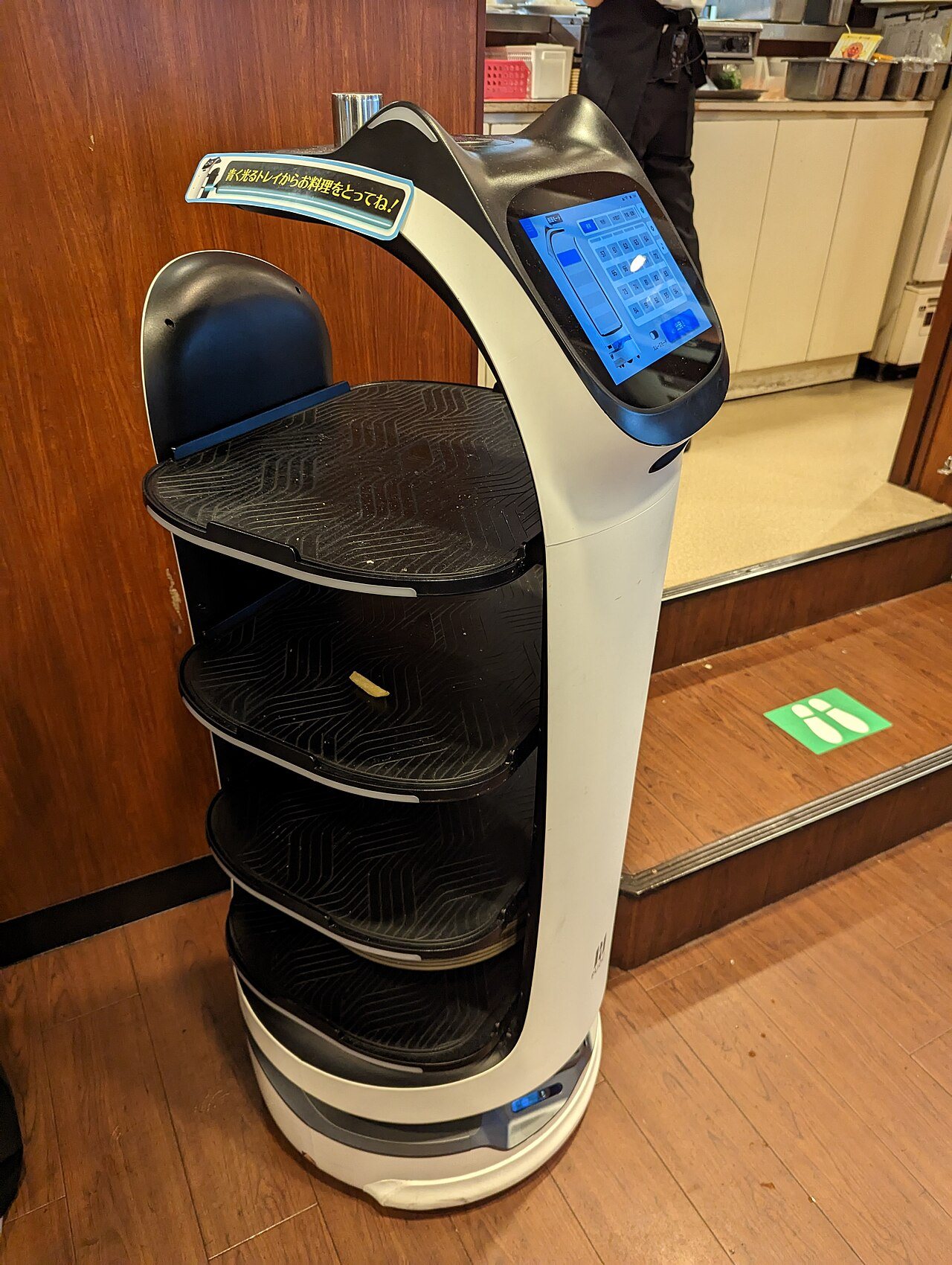
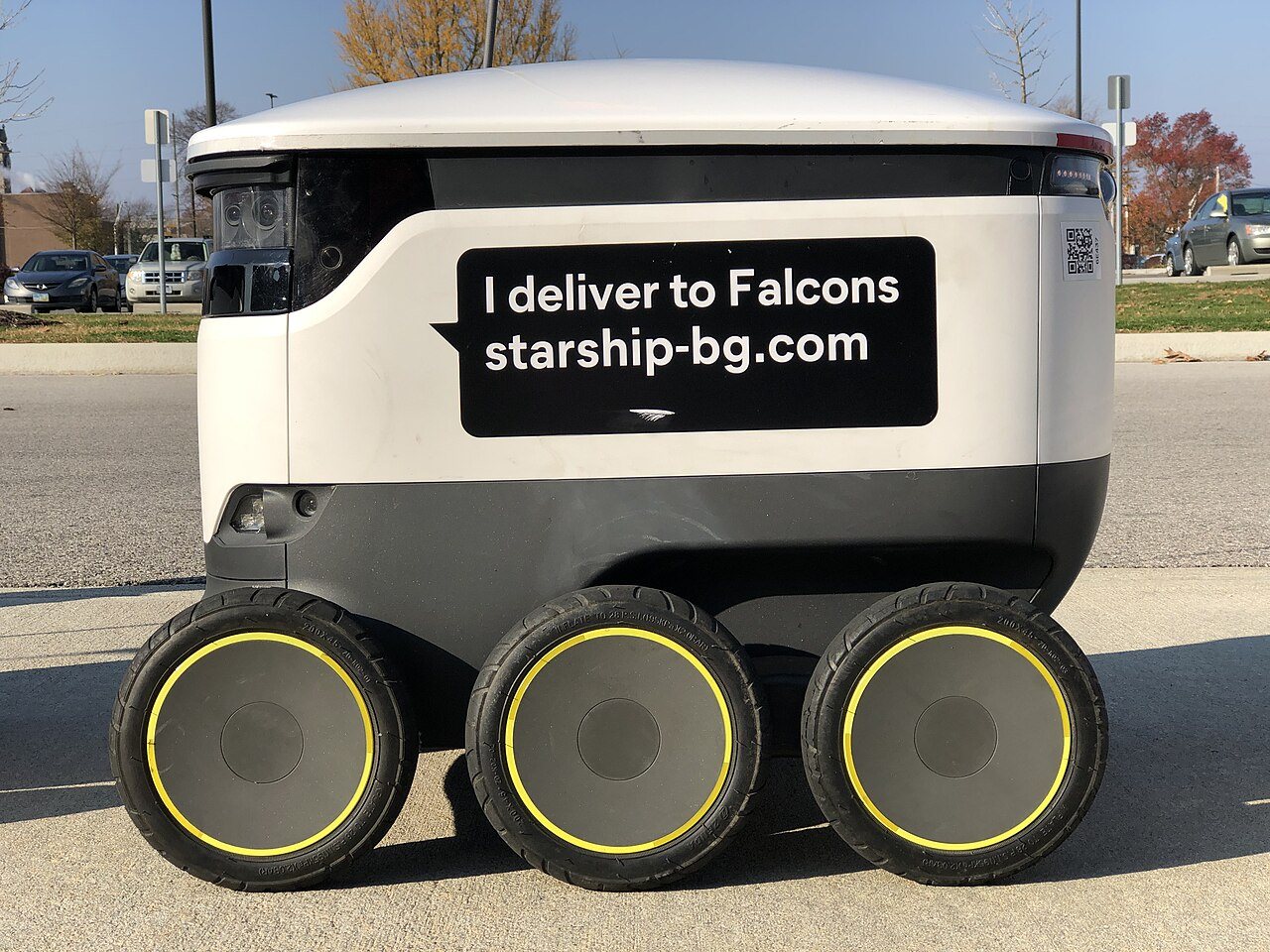
Robot serving dishes at a restaurant in Japan.
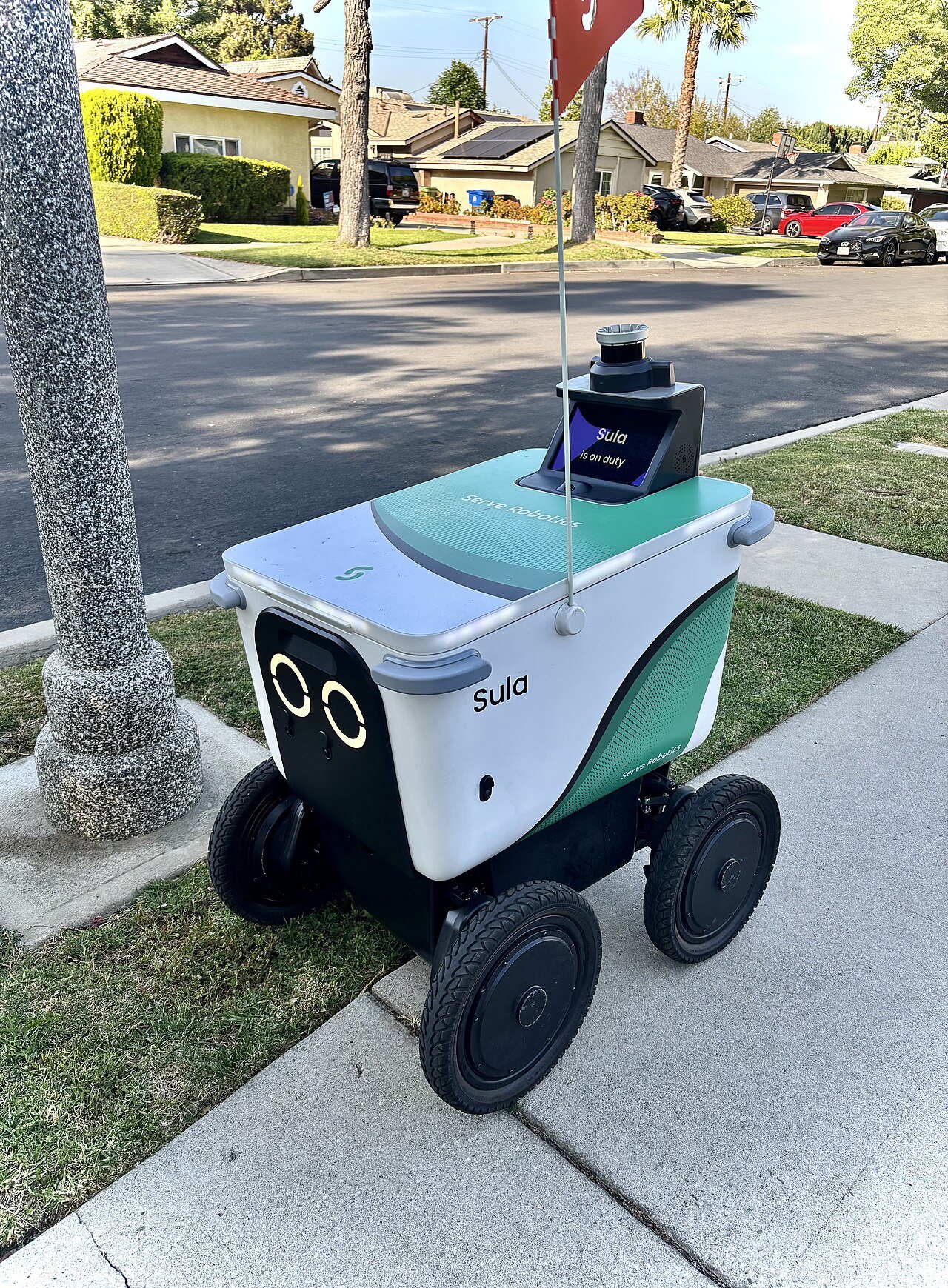
Sidewalk delivery robot of the Serve Robotics type.
Photo: Syced, CC0
Photo: The Squirrel Game, CC BY 4.0
Serving and delivery robots are the visible face of food service automation.
Photos show the type of machine; makers may differ from those named on other pages.
Delivery robots have scaled the furthest.
Sidewalk and campus delivery.
- Serve works with Uber Eats and DoorDash.
- Robot.com serves campuses for Sodexo and Aramark.
- Fleets grew, but revenue is still small.
What it shows
- Serve reports 99.8% completion; vendor figure.
- Campuses are closed, mapped sites.
- Ask for completion rates by site.
How to read it
Delivery robots suit campuses and dense districts, not every street.
Sources: Serve Robotics FY2025 results (Mar 2026); Unite.AI (Aug 2026). Vendor-reported.
Drones, IoT and automation
Kitchen sensors, ordering and delivery systems.
Sensors, kiosks and software lift kitchens.
147
Sensors, kiosks and software lift kitchens.
Systems that need no new staff.
- 1Order scales
McDonald’s weighs outgoing orders for accuracy. In thousands of stores. Commercial.
- 2Self-order kiosks
Cut lines at peaks. Free staff for the kitchen. Commercial.
- 3Kitchen sensors
Track fryer oil, cold storage and hand-wash. Cut waste and violations. Commercial.
- 4Delivery drones
Wing and Walmart plan 150 more stores. Restaurant volume unknown. Early commercial.
Sensors and software are cheaper and faster to prove than robots.
Sources: QSR Pro (Mar 2026); Axios (Jan 2026).
Economics and buying
Who pays, how, and how the return is judged.
Chains, franchisees and caterers each buy differently.
149
A return test for a fry station.
150
Chains, franchisees and caterers each buy differently.
Who pays and who approves.
| Buyer | Decides | Typical hurdle |
|---|---|---|
| Chain corporate | Technology and operations teams | Pilot in company stores first |
| Franchisee | Owner-operator, brand approval | Needs brand sign-off and quick payback |
| Independent restaurant | Owner | Small budget, no technology team |
| Contract caterer | Regional food service director | Client contract terms |
| Campus dining | Food service and digital campus leads | Student acceptance |
Chains pilot in company stores, then offer to franchisees.
A return test for a fry station.
Illustrative arithmetic using public wage data.
- Assume the robot replaces one 8-hour shift a day: 2,920 hours a year.
- At $22.25 an hour that is about $65,000 in wages.
- The vendor reports about $5,000 a month: $60,000 a year.
- Savings are slim unless the robot also cuts waste or churn.
Illustrative arithmetic
- Fee, install, training and service.
- Hours removed, not just moved.
- Turnover cost, over $2,700 per worker.
- Throughput and food waste.
What to include
At thin margins, only removed hours and lower churn pay for the robot.
Illustrative: 8 h x 365 = 2,920 h; x $22.25 = $64,970; $5,000 x 12 = $60,000 (vendor figure). Typical ballpark values from public sources, not quotes.
Safety, rules and risk
Food safety, guest safety and liability.
Food safety and worker safety lead the rules.
152
Food safety and worker safety lead the rules.
Rule sets to check before launch.
| Area | What to check | Why it matters |
|---|---|---|
| FDA Food Code | State and local adoption of the 2026 edition | Health departments approve equipment |
| UL 3320 | Outline for robotic commercial kitchen equipment | Standards do not cover every risk |
| UL 3300 | Service robots in dining rooms | Speed, sensing and contact limits |
| Worker safety | Guards, lockout and training near hot oil | Burns and entrapment |
| Guest acceptance | Brand reaction to robots | Sweetgreen flags brand risk in its filing |
| Privacy | Voice recording at the drive-thru | State laws vary |
Involve the local health department before installing a kitchen robot.
Sources: FDA Food Code; UL Solutions (UL 3320); UL Standards and Engagement; Sweetgreen 10-K. General guidance, not legal advice.
Human-in-the-lead operating model
How kitchen and floor teams share work with machines.
Cooks and managers stay in charge of food.
154
Cooks and managers stay in charge of food.
Human-in-the-lead for restaurants.
- Sets recipes and quality checks.
- Approves any change at the station.
- Owns food safety.
Kitchen lead
- Watches orders and alerts.
- Steps in on voice-order errors.
- Reports to the kitchen lead.
Remote operator
- Installs, cleans and repairs.
- Trains staff on resets.
- Logs faults and fixes.
Technician
People own taste and safety; machines repeat the routine.
Pilots, buyers and what to watch
Who buys, what to pilot first and what to track.
Who buys, and who to approach.
156
A first pilot, in three steps.
157
Who buys, and who to approach.
Operators with public robot activity.
| Player | What is public | Role to approach |
|---|---|---|
| White Castle | Flippy and voice AI | Operations and technology |
| Jack in the Box | Flippy installs | Restaurant technology |
| Sweetgreen | Infinite Kitchen, bought via supply agreement | Operations and restaurant technology |
| Taco Bell (Yum) | Voice AI in 890+ restaurants | Digital and operations leads |
| Sodexo and Aramark | Campus delivery and venue kiosks | Food service and digital campus leads |
Start with chains that pilot in company stores and publish results.
Sources: Restaurant Dive; Fortune (Feb 2026); Unite.AI (Aug 2026). Titles only; no contact data.
A first pilot, in three steps.
One store, one task, one measure.
- Pick one store and one station with a known bottleneck.
- Agree a measure such as hours removed or order accuracy.
Choose
- Run four to eight weeks with the crew and an operator.
- Log errors, waste and guest comments.
Run
- Compare against the baseline.
- Scale only if payback holds at thin margins.
Decide
Watch for kitchen heat, grease, crew pushback and health inspector questions.
Agriculture
Sector and labor picture, where physical AI works, machines in the field, drones, IOT and automation, economics and buying, safety, rules and risk.
Sector and labor picture
Size, labor supply and cost in farming.
On fruit and nut farms, labor is the big cost.
160
Enforcement fears reach farms through absences.
161
On fruit and nut farms, labor is the big cost.
Labor share of expenses by farm type.
- H-2A jobs grew from 48,000 in FY2005.
- Farmworkers are under 1% of U.S. wage workers.
- California has about 800,000 farmworkers.
What the data shows
- Labor-heavy crops gain most from automation.
- Harvest is the hardest task to automate.
- Weeding, spraying and milking are proven.
What it means for machines
Machines pay where labor is a large share of cost.
Sources: USDA ERS, Farm Labor (2022 Census of Agriculture); Ag Alert (Feb 2026).
Enforcement fears reach farms through absences.
A California farmer survey.
- Under 1% lost workers directly to enforcement.
- About 15% lost workers over enforcement concerns.
- About 14% cut production.
What the survey found
- Labor risk is real even when direct loss is rare.
- Researchers saw no major food shortages.
- Machines hedge supply risk, not replace crews.
What it means
Labor supply risk, not only cost, drives interest in automation.
Source: Michigan State University and California Farm Bureau survey of 500+ farmers (Ag Alert, Feb 2026).
Where physical AI works
Use cases by crop and task, with their level of proof.
Where machines work on the farm.
163
Agriculture is a top five service robot market.
164
Where machines work on the farm.
Use cases, with their level of proof.
| Use case | What it does | Proof |
|---|---|---|
| Milking robots | Milk cows without a parlor shift | Commercial |
| Camera-guided spraying | Spray only where weeds are seen | Commercial |
| Spray drones | Apply crop products from the air | Commercial, supply-limited |
| Laser and vision weeding | Kill weeds by laser or precise tools | Commercial, early scale |
| Tractor autonomy kits | Add driving to existing tractors | Early commercial |
| Berry and fruit harvesting | Pick ripe fruit | Pilot |
| Indoor farm robots | Plant and tend crops indoors | Struggling |
Milking, spraying and weeding work. Harvest robots are still pilots.
Agriculture is a top five service robot market.
The industry view.
#4
Agriculture rank among service robot uses, 2025
- Labor shortages and climate drive adoption.
- Barn cleaning and feeding robots are growth areas.
- Cost, rough terrain and weak rural networks hold it back.
What IFR says
- Unit counts are read from an IFR chart and rounded.
- Milking robots are the mature benchmark.
- Other robot types are earlier in the curve.
How to read it
Farms buy robots when cost and connectivity allow.
Sources: IFR World Robotics 2026 (unit counts read from a chart, rounded); Farmers Journal (Jul 2024).
Machines in the field
Named machines and where they run today.
Named machines and what they report.
166
Failures are a warning for buyers.
168
Machines on the farm.
167
Named machines and what they report.
Vendors and results.
| Vendor | What is reported | Maturity |
|---|---|---|
| Deere See and Spray | Over 5 million acres in 2025; herbicide down about 50%, vendor claim | Commercial |
| Carbon Robotics | Passed $100M revenue, year to Mar 2026; about 20 countries | Commercial |
| Lely | 2025 revenue EUR 1,014M, up 18% | Commercial |
| DailyRobotics | Strawberry harvester launched in California, 2026 | Pilot |
| Burro | Rents robots that follow workers | Early commercial |
Winners add robots to proven machines; harvesters need field proof.
Sources: Deere; Carbon Robotics; Lely; DailyRobotics. Vendor-reported.
Machines on the farm.
Milking, spraying and weeding.
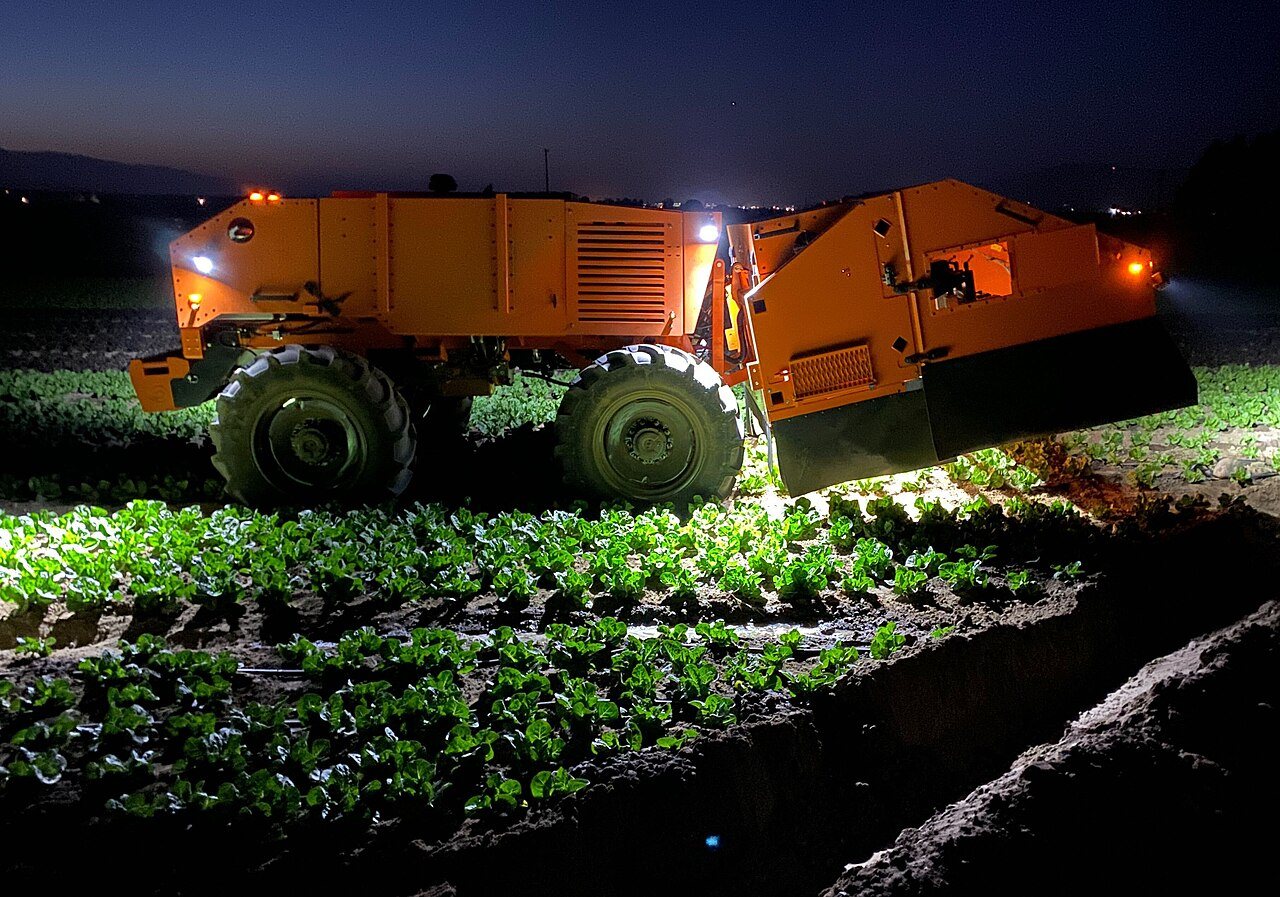
Milking, spraying and weeding are the farm robots with field proof.
Photos show the type of machine; makers may differ from those named on other pages.
Failures are a warning for buyers.
Vendors that closed or sold.
| Company | What happened | Date |
|---|---|---|
| Monarch Tractor | Left its HQ; assets bought by Caterpillar | Apr 2026 |
| FarmWise | Shut down; sought a buyer for its weeder | Apr 2025 |
| AppHarvest and AeroFarms | Bankruptcies in indoor farming | 2023 |
| Iron Ox | Laid off nearly half its staff | Nov 2022 |
Pick vendors with dealer service and uptime, not only technology.
Sources: TechCrunch; Farm Equipment; FertilizerDaily; FoodNavigator; AgFunderNews.
Drones, IoT and automation
Drones, sensors and precision tools.
Drones and sensors carry much of the load.
170
Drones and sensors carry much of the load.
Aerial and connected systems.
- 1Spray drones
A DJI T50 lists near $18,000. U.S. sales fell from 8,950 to 3,711 in 2025. Supply-limited.
- 2Camera spraying
Cameras fire nozzles at weeds. Kit fits many sprayers. Commercial.
- 3Livestock sensors
Barn feeding and cleaning robots grow. Data not yet public. Commercial.
- 4Retrofit kits
Add autonomy to existing tractors. Dealer channel. Early commercial.
Retrofit and drone products sell; new vehicles have struggled.
Sources: DroneXL (Jan 2026); AgFunderNews (2026); IFR. Typical ballpark values from public sources, not quotes.
Economics and buying
Who pays, how, and how the return is judged.
Growers, packers and dealers each have a role.
172
A return test for a labor-heavy crop.
173
Growers, packers and dealers each have a role.
Who pays and who approves.
| Buyer | Decides | Typical hurdle |
|---|---|---|
| Grower | Farm or ranch manager, owner | Season timing and capital |
| Packer or shipper | Grower services director | Wants steady labor for contract growers |
| Equipment dealer | Dealer general manager | Service and uptime |
| Custom applicator | Owner-operator | Drone rules and supply |
| Dairy | Herd manager, owner | Milk price swings |
Dealers and packers are channels as important as growers.
A return test for a labor-heavy crop.
Illustrative arithmetic using a sourced labor share.
- Assume a fruit farm has $1,000,000 in production expenses.
- At a 40% labor share, labor costs $400,000.
- If machines cut labor hours by 10%, the saving is $40,000.
- Compare that with the machine fee for the same acres.
Illustrative arithmetic
- Fee, fuel, service and operator time.
- Crop timing: a late machine misses the season.
- Waste or damage to crops.
- Hired labor you still need.
What to include
Test the savings on one block before buying for the whole farm.
Illustrative: $1,000,000 x 40% = $400,000; x 10% = $40,000. Labor share: USDA ERS. Typical ballpark values from public sources, not quotes.
Safety, rules and risk
Chemical, aviation and worker-safety rules.
Drone policy is the main new risk.
175
Drone policy is the main new risk.
Rule sets to check before launch.
| Area | What to check | Why it matters |
|---|---|---|
| FCC drone rules | Foreign-made drones added to Covered List, Dec 2025 | Limits new drone models |
| FAA drone rules | Part 107 and Part 137 for spraying | Pilot and operator licensing |
| H-2A wage rules | DOL wage method under court order by Dec 2026 | Sets labor cost floor |
| Pesticide rules | EPA label and state applicator rules | Drift and liability |
| Worker safety | OSHA and state ag rules near machines | No robot-specific rule |
| Rural connectivity | Cell and GPS coverage | IFR names it a barrier |
Check drone supply and licensing before planning a spraying program.
Sources: FCC; FAA; DOL; EPA; Congressional Research Service (Oct 2026); IFR. General guidance, not legal advice.
Human-in-the-lead operating model
How crews and machines share the work.
Growers stay in charge of the crop.
177
Growers stay in charge of the crop.
Human-in-the-lead for farms.
- Sets crop plans and quality.
- Approves field and spray plans.
- Owns safety and rules.
Grower or manager
- Runs and monitors machines.
- Steps in on obstacles.
- Reports to the manager.
Machine operator
- Maintains, repairs and updates.
- Keeps machines ready for season.
- Logs faults and fixes.
Technician
People own the crop; machines scout, spray, weed and milk.
Pilots, buyers and what to watch
Who buys, what to pilot first and what to track.
Who buys, and who to approach.
179
A first pilot, in three steps.
180
Who buys, and who to approach.
Buyer groups and public activity.
| Player | What is public | Role to approach |
|---|---|---|
| Large growers | Labor is 40% of fruit farm cost | Director of Operations or Harvest |
| Packers such as Taylor Farms | Invested in FarmWise | Grower services |
| Dairy operators | Lely sells to dairy farms worldwide | Herd manager |
| Equipment dealers | Sell Deere kits and others | Dealer general manager |
| Custom applicators | Buy spray drones | Owner-operator |
Start with high-labor crops and dealers who service the machines.
Sources: USDA ERS; Lely; Farms.com; FertilizerDaily. Titles only; no contact data.
A first pilot, in three steps.
One block, one task, one measure.
- Pick one block and one task, such as weeding.
- Agree a measure, such as labor hours or herbicide use.
Choose
- Run one season stage with the crew and an operator.
- Log downtime, crop damage and weather.
Run
- Compare against the baseline.
- Scale only if the full season confirms it.
Decide
Watch for weather, connectivity gaps, supply delays and dealer service.
Retail
Sector and labor picture, where physical AI works, machines in the field, drones, IOT and automation, economics and buying, safety, rules and risk.
Sector and labor picture
Size, staffing and turnover in retail.
Retail is one of the largest employers, with high churn.
183
Stores run on routine tasks.
184
Retail is one of the largest employers, with high churn.
Pay, turnover and workforce.
- Cashiers: 2.6 million jobs.
- Retail salespeople: 3.4 million jobs.
- Stock clerks and order fillers: 1.8 million jobs.
What the data shows
- Repeat tasks: scanning shelves, cleaning, stocking.
- Customers make stores unpredictable.
- Staff stay with customers.
What it means for machines
High churn makes store tasks costly to train and easy to automate.
Sources: BLS (CES and JOLTS, Sep 2026; OEWS, May 2024).
Stores run on routine tasks.
Where the work is.
- Checking shelves for gaps and prices.
- Cleaning floors, often overnight.
- Receiving, stocking and online order picking.
Where the hours go
- Shelf-scanning robots.
- Autonomous floor scrubbers.
- Self-checkout and camera checkout.
Where machines fit
Machines fit the back-of-aisle tasks; customers keep the human touch.
Where physical AI works
Use cases by task, with their level of proof.
Where machines work in stores.
186
Some retail robots have failed.
187
Where machines work in stores.
Use cases, with their level of proof.
| Use case | What it does | Proof |
|---|---|---|
| Autonomous floor scrubbers | Clean aisles without a rider | Commercial |
| Shelf-scanning robots | Find gaps, wrong prices and misplaced items | Commercial |
| Self-checkout and kiosks | Customers scan and pay | Commercial |
| Camera-based checkout | No scanning at all | Early commercial |
| Drone and curbside delivery | Carry orders to homes | Early commercial |
| Security and loss prevention | Patrol and watch for theft | Early commercial |
| Humanoid store helpers | Assist shoppers and stock shelves | Concept |
Start with floor scrubbers and shelf scanning. Treat humanoids as a concept.
Some retail robots have failed.
Learn from the exits.
- Walmart ended its shelf-scanning program in Nov 2020.
- Cost and value were not clear.
Bossa Nova
- Amazon removed it from U.S. Fresh grocery stores in Apr 2024.
- Still used elsewhere.
Amazon Just Walk Out
- Walmart expanded from 300 stores to 1,500 more.
- Now over 1,860 machines run BrainOS.
Floor scrubbers
Winners fit store routines and show value on a dashboard.
Sources: The Robot Report (2020); CNBC (Apr 2024); Chain Store Age; Brain Corp.
Machines in the field
Named robots and where they run today, and where they stopped.
Named robots and what they report.
189
Simbe has more units contracted than deployed.
191
Robots seen in stores.
190
Named robots and what they report.
Vendors and results.
| Vendor or retailer | What is reported | Maturity |
|---|---|---|
| Simbe Tally | 3,000+ units under contract across 75+ banners, Sep 2026 | Commercial |
| Walmart with Tennant and Brain Corp | Over 1,860 floor cleaners run BrainOS | Commercial |
| Brain Corp ShelfOptix | Plans thousands of units in 2026, fully managed | Early commercial |
| Harmons, Theisen’s, Homebase | Tally deployed or piloted | Commercial; pilot |
| Wing with Walmart | Drone delivery to 150 more stores, Jan 2026 | Early commercial |
Shelf scanning and floor care are the proven robots in stores.
Sources: TechRepublic (Sep 2026); Simbe; Brain Corp; Walmart. Vendor-reported; not all units are deployed.
Robots seen in stores.
Shelf-scanning and floor-care machines.
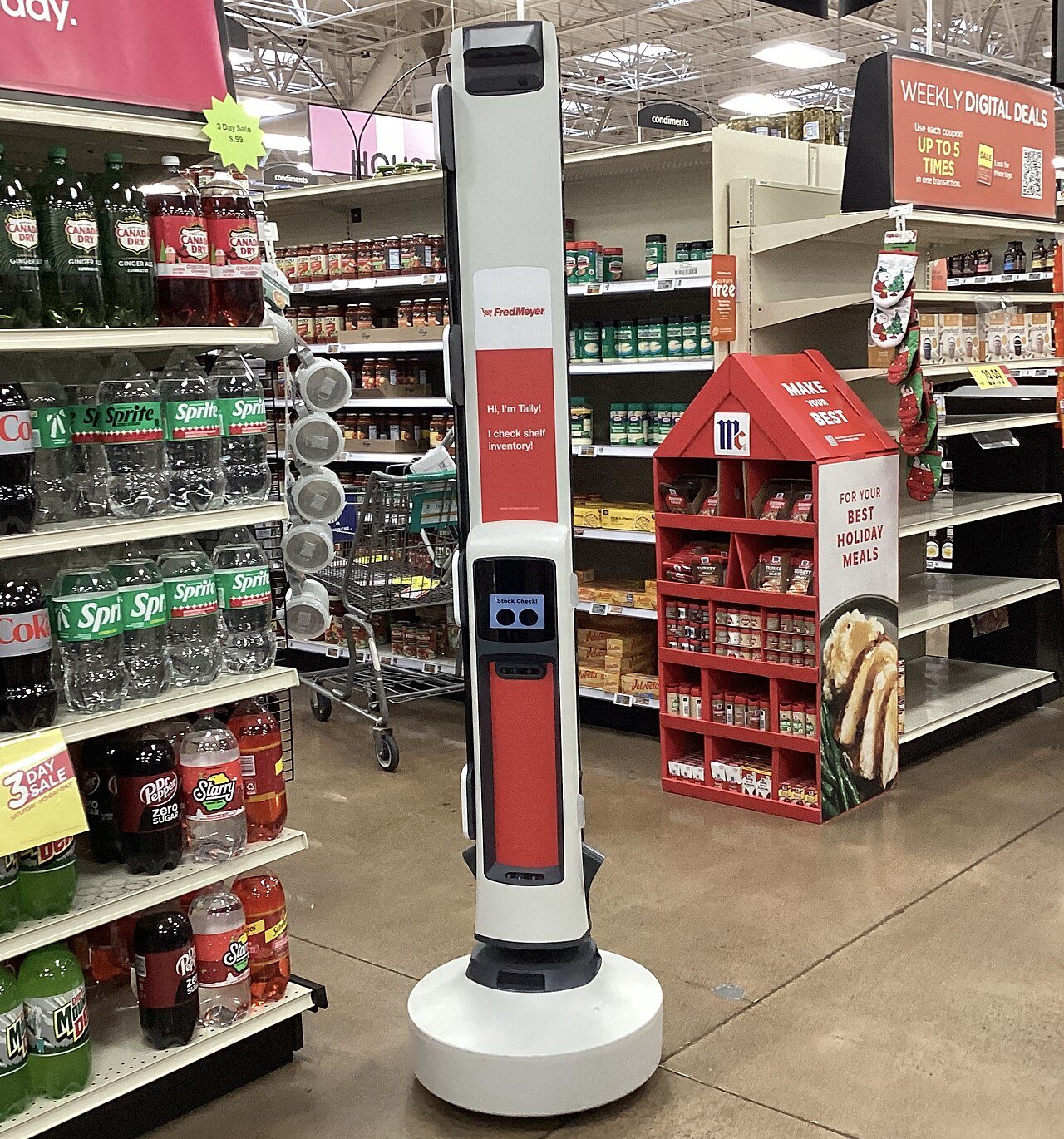
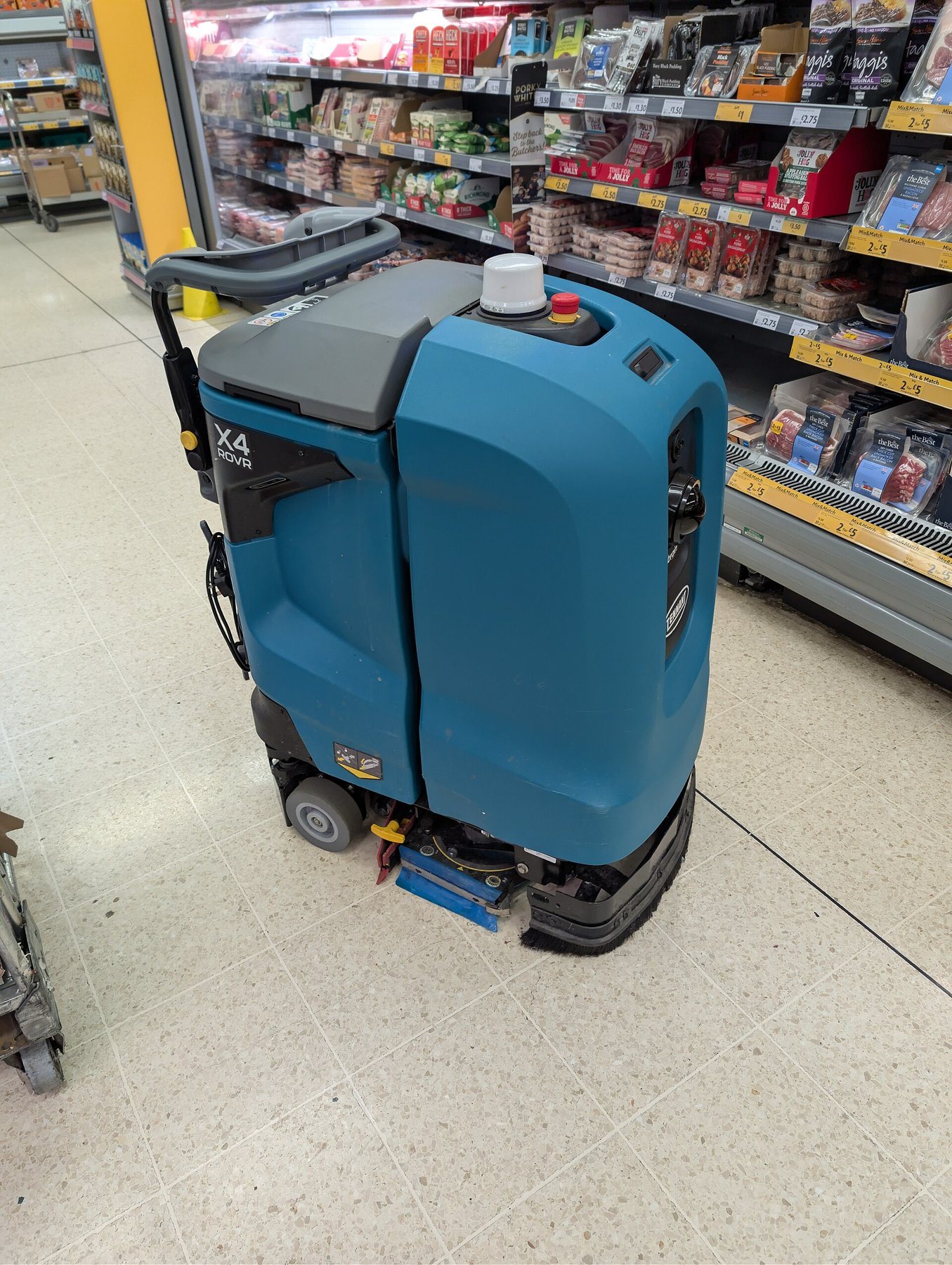
Shelf-scanning robot in a grocery store.
Autonomous floor scrubber in a supermarket aisle.
Photo: Trimetwes fan1003, CC BY-SA 4.0
Photo: Andy Li, CC0
Shelf scanning and floor care are the robots shoppers already pass.
Photos show the type of machine; makers may differ from those named on other pages.
Simbe has more units contracted than deployed.
Reading retail robot numbers.
UL 3300
Safety certification, vendor claim
- It calls this the largest committed fleet.
- It did not say how many are deployed.
- Robots capture shelf data for staff tasks.
What the vendor says
- Contracted is not deployed.
- Value depends on acting on the data.
- Ask for store-level results.
How to read it
Contracts show intent; field proof comes from deployed units.
Sources: TechRepublic (Sep 2026); Simbe. Vendor-reported.
Drones, IoT and automation
Cameras, sensors, checkout and delivery systems.
Sensors, kiosks and drones extend the store.
193
Sensors, kiosks and drones extend the store.
Systems that need no new staff.
- 1Self-checkout
Customers scan their own items. Less cashier time. Commercial.
- 2Shelf sensors
Cameras and tags show stock levels. Fewer manual audits. Commercial.
- 3Delivery drones
Wing and Walmart expand to 150 more stores. Local orders only. Early commercial.
- 4Security analytics
Video analytics for theft. Privacy and bias review. Early commercial.
Self-service and sensors already change store staffing.
Sources: Walmart (Jun 2025); The Robot Report.
Economics and buying
Who pays, how, and how the return is judged.
Chains, franchisees and landlords each buy differently.
195
A return test for a store floor scrubber.
196
Chains, franchisees and landlords each buy differently.
Who pays and who approves.
| Buyer | Decides | Typical hurdle |
|---|---|---|
| National chain | Store operations and technology teams | Pilot stores, then rollout |
| Regional grocer | Operations and IT leads | Smaller budgets |
| Franchise or independent | Owner | Cost and support |
| Mall or center owner | Property manager | Shared cleaning and security |
| Cleaning contractor | Account manager | Client approves new machines |
Chains pilot in a few stores; regionals follow after proof.
A return test for a store floor scrubber.
Illustrative arithmetic using public wage data.
- Assume the robot replaces 4 rider hours a night: 1,460 hours a year.
- At $22.63 an hour that is about $33,000 in wages.
- Compare it with the machine fee or lease quoted.
- Add any time to empty tanks and move the machine.
Illustrative arithmetic
- Fee, service and training.
- Hours removed, not just moved.
- Floor cleanliness and safety incidents.
- Customer response.
What to include
Savings come from reusing rider hours on shelves and customers.
Illustrative: 4 h x 365 = 1,460 h; x $22.63 = $33,040. Wage: BLS, Sep 2026. Typical ballpark values from public sources, not quotes.
Safety, rules and risk
Shopper safety, access, privacy and liability.
Customer safety and data rules lead.
198
Customer safety and data rules lead.
Rule sets to check before launch.
| Area | What to check | Why it matters |
|---|---|---|
| UL 3300 | Safety class for service robots in stores | Customers share the aisle |
| ADA access | Keep aisles clear for shoppers | Blocked access is a violation risk |
| Privacy and video | Notice for cameras and shelf scans | State laws vary |
| Worker safety | Training near moving machines | Slips and collisions |
| Labor terms | Union agreements on new technology | Notice may be required |
| Liability | Who answers for a customer injury | Settle in the contract |
Walk the aisles with store managers before the pilot.
Sources: UL Standards and Engagement; DOJ (ADA); OSHA. General guidance, not legal advice.
Human-in-the-lead operating model
How store teams and machines share the work.
Store teams stay in charge of customers.
200
Store teams stay in charge of customers.
Human-in-the-lead for retail.
- Sets store tasks and hours.
- Approves any customer-facing use.
- Owns service standards.
Store manager
- Watches robots and alerts.
- Steps in on blocked aisles.
- Reports to the manager.
Remote operator
- Maps, repairs and updates.
- Trains staff on restarts.
- Logs faults and fixes.
Technician
People serve customers; machines clean, scan and report.
Pilots, buyers and what to watch
Who buys, what to pilot first and what to track.
Who buys, and who to approach.
202
A first pilot, in three steps.
203
Who buys, and who to approach.
Retailers with public robot activity.
| Player | What is public | Role to approach |
|---|---|---|
| Walmart | Floor cleaners at thousands of stores; drones | Central operations and technology |
| Harmons | Tally deployed after pilot | Store operations |
| Theisen’s | Tally deployed | Store operations |
| Homebase USA | Two-store Tally pilot | Operations and IT |
Start with regional chains that already run robots and publish results.
Sources: Chain Store Age; Simbe (Oct 2025); Robotics 24/7. Titles only; no contact data.
A first pilot, in three steps.
Two stores, one task, one measure.
- Pick two stores and one task, such as overnight floor care.
- Agree a measure, such as hours removed or gaps found.
Choose
- Run four to eight weeks with store staff and an operator.
- Log blocked aisles and customer comments.
Run
- Compare against the baseline.
- Scale only if the measure holds across both stores.
Decide
Watch for customer reactions, aisle clutter, Wi-Fi gaps and staff buy-in.
Waste and recycling
Sector and labor picture, where physical AI works, machines in the field, drones, IOT and automation, economics and buying, safety, rules and risk.
Sector and labor picture
Size, safety record and staffing in waste.
Waste collection is among the most dangerous jobs.
206
Sorting lines depend on people and equipment.
207
Waste collection is among the most dangerous jobs.
Safety and injury data.
#5
Rank among all U.S. occupations
- Fatality rate was 11 times the all-worker rate.
- Injury rate rose from 4.3 to 5.0 in a year.
- Drivers are hard to hire.
What the data shows
- Cameras and sensors reduce collisions.
- Robots take sorting-line work.
- Heavy equipment autonomy is a pilot.
What it means for machines
Safety, not only cost, makes the case for automation in waste.
Sources: BLS Census of Fatal Occupational Injuries 2024, via SWANA and Waste Dive (Feb 2026).
Sorting lines depend on people and equipment.
What a recycling plant looks like.
- Republic’s Denver plant runs 25 to 35 line workers.
- It handles 500 tons a day.
- Residue is 25%, with a target in the high teens.
The plant today
- Optical sorters and robot arms pick material.
- Managers plan to retrain staff for maintenance.
- Headcount stays; picks per minute rise.
Where machines fit
Robots lift sorting speed; people keep the plant running.
Source: Colorado Sun (Jul 2026) on Republic Services, Denver.
Where physical AI works
Use cases by task, with their level of proof.
Where machines work in waste and recycling.
209
Funded demand is arriving through producer rules.
210
Where machines work in waste and recycling.
Use cases, with their level of proof.
| Use case | What it does | Proof |
|---|---|---|
| Optical sorters | Separate materials by sensor | Commercial |
| AI robot picking arms | Pick items from the sort line | Commercial |
| In-cab safety cameras | Coach drivers, settle claims | Commercial |
| Route optimization | Plan efficient routes | Commercial |
| Smart bins and fill sensors | Signal when bins are full | Commercial |
| AI mixed-waste sorting | Sort bagged household waste | Early commercial |
| Landfill autonomy | Drive heavy machines | Pilot |
Cameras, routing and sorting are proven. Autonomy is a pilot.
Funded demand is arriving through producer rules.
Packaging EPR laws and what they fund.
- California, Colorado, Maine, Maryland, Minnesota, Oregon and Washington have packaging laws.
- Deadlines run 2025 to 2030.
Seven states
- Producers pay fees to an industry group.
- Colorado fees began in 2026.
Producer fees
- Fees fund collection and sorting upgrades.
- Haulers add AI and optical sorting.
Plant upgrades
Producer fees put money behind better sorting.
Sources: National Law Review (May 2026); Colorado Sun (Jul 2026).
Machines in the field
Named machines and where they run today.
Named sorting systems and what they report.
212
Large haulers put numbers on AI.
214
Machines in waste and recycling.
213
Named sorting systems and what they report.
Vendors and results.
| Vendor or operator | What is reported | Maturity |
|---|---|---|
| AMP Robotics | 20-year SPSA contract, 540,000 tons a year; $70M project debt | Early commercial |
| Glacier arm at Republic Denver | 60 to 70 picks a minute vs 40 to 50 by a person | Commercial |
| Sortera | Aluminum sorting; claims 95% accuracy, vendor claim | Early commercial |
| Prairie Robotics | Truck cameras in about 40 cities | Early commercial |
| Waste Management | Cameras on commercial trucks; autonomous landfill pilots | Commercial; pilot |
AI sorting is now financeable infrastructure at municipal scale.
Sources: AMP Robotics; Colorado Sun (Jul 2026); TechCrunch (Nov 2025); Waste Dive. Vendor-reported.
Machines in waste and recycling.
Sorting and collection.
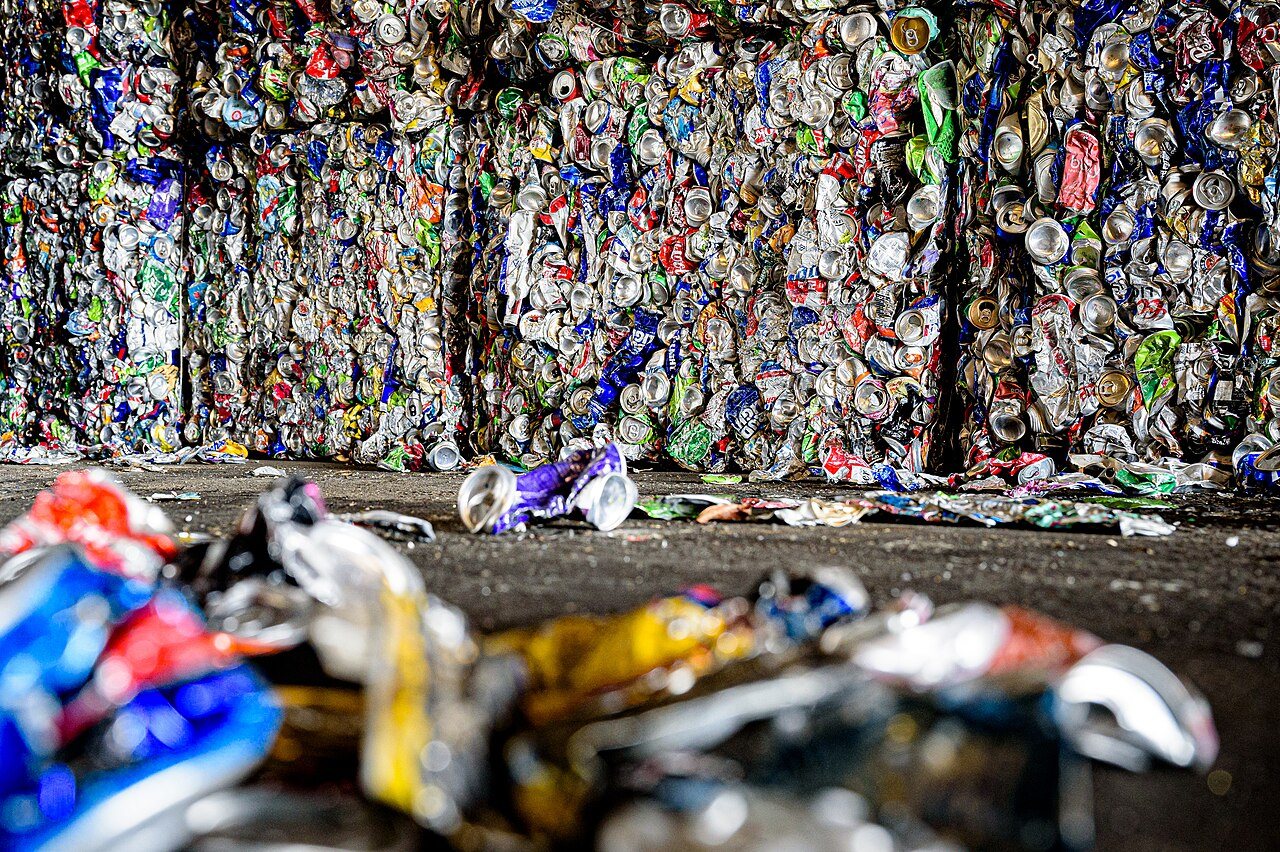
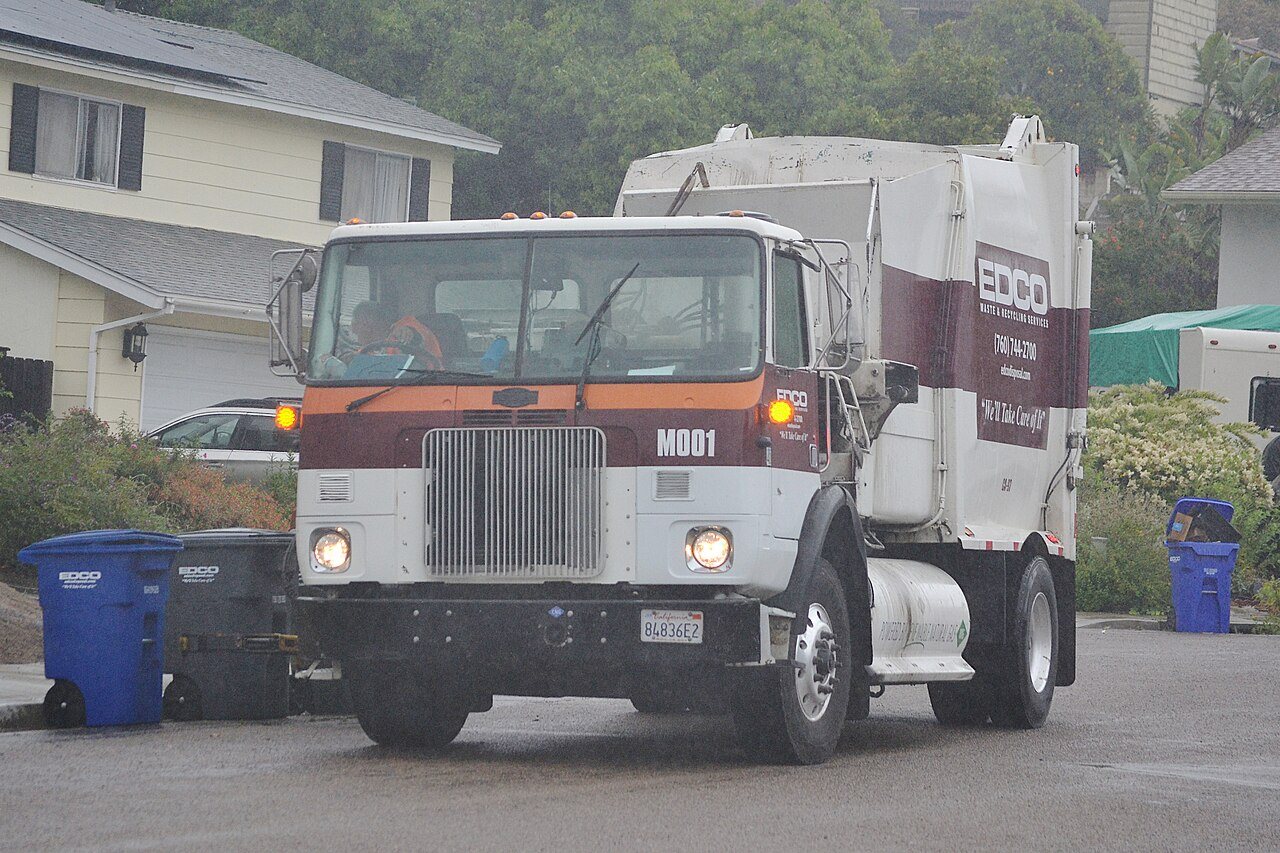
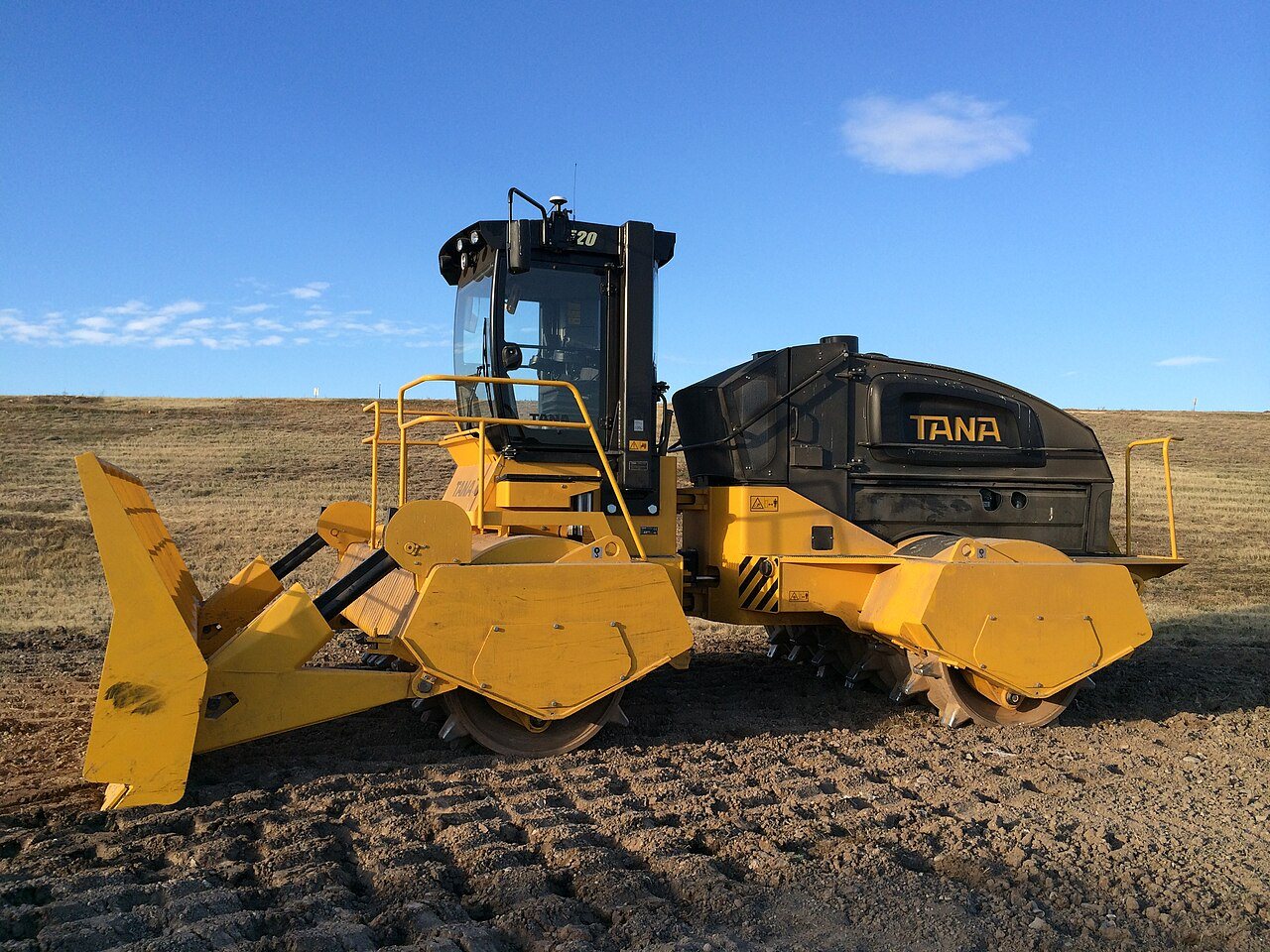
Sorting lines, trucks and landfill equipment are where machines now enter waste work.
Photos show the type of machine; makers may differ from those named on other pages.
Large haulers put numbers on AI.
Targets stated by the big haulers.
50 to 60
Margin gain in basis points, AI routing, 14,000 trucks
- The biggest gains come from routing.
- Haulers choose projects with consultants.
- Targets are company statements.
What it shows
- None is independently audited.
- Routing needs data and driver buy-in.
- Ask for the baseline behind each target.
How to read it
The big haulers fund AI through earnings targets, not pilots alone.
Source: Waste Dive (Jun 2026). Company targets, not independent.
Drones, IoT and automation
Smart bins, truck cameras and fire detection.
Cameras and sensors are the data layer.
216
Cameras and sensors are the data layer.
Systems that need no new staff.
- 1Truck cameras
Flag contamination and lithium batteries. Coach drivers. Commercial.
- 2Smart bins
St. Paul put $475,000 into solar smart bins. Pickups only when bins are full. Commercial.
- 3Fire detection
Fires cost recyclers heavily. Thermal cameras spot hot loads early. Pilot.
- 4Predictive maintenance
One Maine fleet cut exhaust failures 41%, vendor claim. About $1,600 saved per truck a year. Early commercial.
Cameras come first; they feed every later AI use.
Sources: Waste Dive (2025, 2026); Kurrant (2026), vendor-reported.
Economics and buying
Who pays, how, and how the return is judged.
Haulers, cities and authorities each buy differently.
218
A return test for AI routing.
219
Haulers, cities and authorities each buy differently.
Who pays and who approves.
| Buyer | Decides | Typical hurdle |
|---|---|---|
| National hauler | COO, CFO and technology teams | Capital plans and consultant programs |
| Regional hauler | Owner and operations lead | Smaller budgets |
| City or county | Public works or solid waste manager | Contracts and grants |
| Waste authority | Executive director and board | Long-term contracts |
| Recycling plant owner | Plant manager, operations VP | Project financing |
Cities buy through grants and contracts; haulers buy through capital plans.
Tacoma’s truck-camera project was funded by a $1.8M EPA grant (Waste Dive, Aug 2025).
A return test for AI routing.
Illustrative arithmetic using a sourced gain.
- Waste Connections targets a 50 to 60 basis point margin gain.
- On $100 million of hauling revenue, 0.50% is $500,000.
- At 0.60% it is $600,000.
- Compare with the software and change cost.
Illustrative arithmetic
- Software fee, integration and training.
- Driver and dispatcher time.
- Fuel, overtime and missed stops.
- The baseline route data.
What to include
The test is the margin gain on your own routes, not the vendor’s average.
Illustrative: $100M x 0.50% = $500,000; x 0.60% = $600,000. Gain: company target (Waste Dive, Jun 2026). Typical ballpark values from public sources, not quotes.
Safety, rules and risk
Worker safety, fire risk and regulation.
Worker safety and producer rules lead.
221
Worker safety and producer rules lead.
Rule sets to check before launch.
| Area | What to check | Why it matters |
|---|---|---|
| Worker safety | OSHA rules near automated lines | Collection is among the deadliest jobs |
| Fire safety | Battery detection and plant fire codes | Batteries in loads cause fires |
| Driver cameras | Notice and privacy rules for drivers | State law varies |
| EPR laws | Producer fee rules in seven states | Fees fund sorting |
| Landfill autonomy | Site safety plans for driverless equipment | Pilot stage |
| Liability | Who answers for a sorting or truck incident | Settle in the contract |
Start with safety. Add camera notices before any rollout.
Sources: BLS; National Law Review (May 2026); Waste Dive. General guidance, not legal advice.
Human-in-the-lead operating model
How crews and machines share the work.
Plant and fleet teams stay in charge of safety.
223
Plant and fleet teams stay in charge of safety.
Human-in-the-lead for waste.
- Sets line and route plans.
- Approves any change to safety rules.
- Owns incident response.
Plant or fleet lead
- Watches sorting and camera alerts.
- Reviews flagged events.
- Reports to the lead.
Remote operator
- Calibrates, cleans and repairs.
- Trains staff on restarts.
- Logs faults and fixes.
Technician
People own safety and judgment; machines sort, spot and report.
Pilots, buyers and what to watch
Who buys, what to pilot first and what to track.
Who buys, and who to approach.
225
A first pilot, in three steps.
226
Who buys, and who to approach.
Operators with public AI programs.
| Player | What is public | Role to approach |
|---|---|---|
| Waste Management | Cameras on every commercial truck; autonomous pilots | Fleet, safety and technology leads |
| Republic Services | 80 recycling centers; $100M AI target | Recycling operations and technology |
| Waste Connections and GFL | AI routing programs | COO and technology leads |
| SPSA and Kent County | AI sorting contracts | Executive director, public works |
| City of Tacoma | EPA-funded camera project | Solid waste manager |
Start with haulers and authorities that publish AI targets.
Sources: Waste Dive; AMP Robotics; Colorado Sun. Titles only; no contact data.
A first pilot, in three steps.
One plant or route, one measure.
- Pick one line or route with a known problem.
- Agree a measure, such as picks per minute or route time.
Choose
- Run four to eight weeks with plant staff and an operator.
- Log contamination, downtime and safety events.
Run
- Compare against the baseline.
- Scale only if safety and the measure hold.
Decide
Watch for fire risk, dust and grime on cameras, and driver acceptance.
The people
The workforce today, tasks that change, new roles machines create, training and reskilling, labor relations and communication.
The workforce today
Who does service work and why they leave.
Service work is large, low-paid and always in demand.
229
People leave service jobs for known reasons.
230
Service work is large, low-paid and always in demand.
Who does the work, and what it pays.
| Job | Median hourly pay | Jobs in the U.S. | Source year |
|---|---|---|---|
| Janitors and cleaners | $17.27 | 2.4 million | 2023 to 2024 |
| Security guards | $18.46 | 1.27 million | 2024 |
| Food service workers (average, all) | $22.25 | 12.4 million | Sep and Oct 2026 |
| Hotel and lodging workers (average, all) | $25.57 | 1.92 million | Sep and Oct 2026 |
| Retail workers (average, all) | $22.63 | 15.4 million | Sep 2026 and Jan 2026 |
The largest job groups pay modest wages and see high turnover.
Sources: BLS (Occupational Outlook Handbook, May 2024; CES, Sep and Oct 2026). Averages cover all employees, not medians.
People leave service jobs for known reasons.
What turnover costs and why it persists.
- Accommodation and food separate at 6.2% a month.
- Restaurant turnover costs $2,700 or more per worker.
- Nurse turnover costs $60,090 per nurse.
What the data shows
- Unpredictable schedules drive churn in retail.
- Heavy, repeat tasks wear workers down.
- Pay competes with warehouse and delivery jobs.
What workers say
Machines should remove the hardest tasks, not the job.
Sources: BLS JOLTS (Sep 2026); Black Box Intelligence; NSI Nursing Solutions (2026); Asurint (May 2026).
Tasks that change
Which tasks machines take and which stay with people.
Machines take tasks, not whole jobs.
232
Machines take tasks, not whole jobs.
Which tasks change and which stay.
| Task | Who does it with machines | What stays human |
|---|---|---|
| Floor scrubbing | Robot on a taught route | Setup, spills, detail work |
| Night patrol | Robot reports; remote operator checks | Response to a real threat |
| Hauling linen or supplies | Delivery robot | Loading and exceptions |
| Sorting recycling | Robot picks the line | Maintenance and quality |
| Shelf checks | Robot scans aisles | Restocking and customer help |
| Fry or prep station | Robot cooks to a timer | Taste, safety and cleaning |
In every case, the person handles the exception and the customer.
Republic Services keeps 25 to 35 line workers beside its new sorting robot in Denver (Colorado Sun, Jul 2026).
New roles machines create
Operators, technicians, coordinators and site leads.
New roles appear around the machines.
234
New roles appear around the machines.
Four jobs that did not exist at most sites.
- 1Remote operator
Watches robots and alerts. One operator can supervise six to eight robots. Vendor figure.
- 2Robot technician
Charges, repairs and maps. Trains staff on restarts. Often the vendor supplies this.
- 3Site coordinator
Schedules tasks and routes. Speaks for the site team. Often a current supervisor.
- 4Data analyst
Reads route and shelf data. Finds waste and gaps. Grows with fleet size.
Many of these roles can come from the current workforce.
Operator ratio: Asylon via The Next Web (2026), vendor figure.
Training and reskilling
How to prepare teams and what it takes.
Training follows four steps.
236
Training follows four steps.
From first demo to daily use.
- 1Explain
Say what the robot does and does not do. Share the plan before the pilot.
- 2Show
Demonstrate on site. Let staff ask questions.
- 3Practice
Staff run and restart the robot. Practice stops and handoffs.
- 4Support
A contact for faults. Check in every week.
Staff who help set the routes accept the robot faster.
Walmart associates teach floor machines a route by driving it once (Chain Store Age).
Labor relations and communication
Unions, announcements and trust.
Trust is built before the robot arrives.
238
Trust is built before the robot arrives.
Labor relations and communication.
| Topic | What to do | Evidence |
|---|---|---|
| Notice | Tell staff early and in plain words | Caesars contract: six months notice |
| Consultation | Ask workers where the robot should help | Nurses asked to be consulted at MultiCare |
| Job promises | Say what happens to current roles | Walmart: scrubbers will not cut jobs |
| Retraining | Offer paths into new roles | Contracts include retraining and severance |
| Feedback | Keep a channel open during the pilot | Atomgigs practice |
Announce the plan before the demo, and keep asking.
Sources: Bloomberg Law (2023); Seattle Met (2023); Chain Store Age. Contract terms vary.
Working beside machines safely
Rules of the shared workspace.
Shared workspaces need clear rules.
240
Shared workspaces need clear rules.
Working beside machines safely.
| Rule | What it means | Why |
|---|---|---|
| Know the zones | Mark robot routes and no-go areas | Avoid collisions |
| Know the stop | Staff can stop any robot at once | Fast response |
| Right of way | People and guests always go first | Safe public spaces |
| Clean sensors | Wipe cameras and sensors daily | False stops and misses |
| Report faults | Log every stop and near miss | Better routes and trust |
| Follow the standard | Use machines certified to UL 3300 or ISO 13482 | Recognized safety class |
Safe habits protect people and keep machines running.
Sources: UL Standards and Engagement (UL 3300); ISO 13482.
Buyer segments and big players
How to read the segments, residential and property buyers, hospitality and food buyers, healthcare buyers, retail, farm and waste buyers.
How to read the segments
What each profile shows and how to use it.
Each segment gets the same five-part profile.
243
Each segment gets the same five-part profile.
How to read the next pages.
| Part | What it tells you |
|---|---|
| Big players | Named operators with public robot or AI activity |
| Top concerns | What the buyer worries about, from public reports |
| Pitch | How Atomgigs frames the offer for that buyer |
| Starting pilot | One site, one task, one measure |
| Roles to approach | Job titles only; no names and no contact data |
Profiles use only public information and give titles, never contacts.
Residential and property buyers
Multifamily, commercial property and facility services.
Multifamily and residential owners.
245
Commercial property and facility services.
246
Multifamily and residential owners.
Profile.
| Item | Profile |
|---|---|
| Big players | Greystar, AvalonBay, Equity Residential, Westland Real Estate Group. |
| Top concerns | Resident privacy, fair housing, owners approving the cost, resident acceptance. |
| Pitch | Cover overnight patrol and parcel gaps with a human-led service, paid by capacity. |
| Starting pilot | One garage or common area, patrol or floor care, four to eight weeks. |
| Roles to approach | Technology lead, regional operations director, asset manager. |
Win the owner who pays; site teams stay in charge.
Titles only; no contact data.
Commercial property and facility services.
Profile.
| Item | Profile |
|---|---|
| Big players | Allied Universal, Tennant and Brain Corp customers, airports (FlagShip), large campuses. |
| Top concerns | Thin contract margins, guard turnover, client approval, uptime. |
| Pitch | Add machine capacity to an existing contract so a contractor wins and keeps work. |
| Starting pilot | One building, floor care or patrol on a night shift, six weeks. |
| Roles to approach | Regional operations director, account manager, facility director. |
Contractors need a way to cut labor hours without losing the contract.
Titles only; no contact data.
Hospitality and food buyers
Hotels, venues, restaurants and caterers.
Hotels, venues and resorts.
248
Restaurants and caterers.
249
Hotels, venues and resorts.
Profile.
| Item | Profile |
|---|---|
| Big players | Marriott, Hilton, IHG, Wyndham brands; Aramark Sports and Entertainment; Sphere; Disney parks. |
| Top concerns | Guest experience, brand standards, union notice, elevator and corridor access. |
| Pitch | Capacity for back-of-house hauling and floor care, so staff spend more time with guests. |
| Starting pilot | One hotel or venue, one back-of-house task, six weeks. |
| Roles to approach | VP Operations, Director of Engineering, Director of Housekeeping, venue general manager. |
Owners and brands decide together; start where the guest never sees the robot.
Titles only; no contact data.
Restaurants and caterers.
Profile.
| Item | Profile |
|---|---|
| Big players | White Castle, Jack in the Box, Sweetgreen, Taco Bell (Yum), Sodexo, Aramark. |
| Top concerns | Thin margins, franchisee sign-off, food safety rules, guest reaction. |
| Pitch | Pay for capacity and outcomes at one station, with a human-led crew. |
| Starting pilot | One store, one station, 4 to 8 weeks, tracking hours and errors. |
| Roles to approach | COO, VP Restaurant Technology, franchise operations lead, campus dining director. |
Prove it in company stores first; franchisees follow proof.
Titles only; no contact data.
Healthcare buyers
Systems, hospitals and care providers.
Hospitals and health systems.
251
Hospitals and health systems.
Profile.
| Item | Profile |
|---|---|
| Big players | Cedars-Sinai, Children’s Hospital Los Angeles, Providence, Endeavor Health, VA and Mercy hospitals. |
| Top concerns | Patient safety, privacy, infection control, nurse trust, integration with IT. |
| Pitch | Return nursing hours with logistics robots, and keep clinical work with clinicians. |
| Starting pilot | One unit, pharmacy or supply delivery, 6 to 8 weeks. |
| Roles to approach | Chief Nursing Officer, VP Supply Chain, Director of Pharmacy, Director of Environmental Services. |
Logistics first, with nursing leaders as sponsors.
Titles only; no contact data.
Retail, farm and waste buyers
Retailers, growers and haulers.
Retailers.
253
Waste and recycling operators.
255
Farms and agribusiness.
254
Retailers.
Profile.
| Item | Profile |
|---|---|
| Big players | Walmart, Harmons, Theisen’s, Homebase USA; Tennant and Simbe as vendors. |
| Top concerns | Customer safety, aisle clutter, store staff buy-in, proof of value. |
| Pitch | Floor care and shelf data for a few stores, with store teams in charge. |
| Starting pilot | Two stores, overnight floor care or shelf scanning, six weeks. |
| Roles to approach | VP Store Operations, Director of Technology, regional manager. |
Show value in a few stores before asking for a chain-wide rollout.
Titles only; no contact data.
Farms and agribusiness.
Profile.
| Item | Profile |
|---|---|
| Big players | Large fruit and vegetable growers, Taylor Farms, dairy operators, equipment dealers. |
| Top concerns | Season timing, drone supply, dealer service, workers and immigration rules. |
| Pitch | Source proven machines and run them with an operator for one crop stage. |
| Starting pilot | One block, one task such as weeding or spraying, one season stage. |
| Roles to approach | Director of Operations or Harvest, farm manager, grower services director, dealer manager. |
Dealers and packers are as important a channel as growers.
Titles only; no contact data.
Waste and recycling operators.
Profile.
| Item | Profile |
|---|---|
| Big players | Waste Management, Republic Services, Waste Connections, GFL, AMP customers, SPSA. |
| Top concerns | Worker safety, fire risk, driver shortage, capital rules, public contracts. |
| Pitch | Add sorting and camera capacity with safety outcomes as the main measure. |
| Starting pilot | One sorting line or route, four to eight weeks. |
| Roles to approach | COO, VP Recycling Operations, plant manager, fleet director, public works lead. |
Safety and cost both count; cities buy through grants and contracts.
Titles only; no contact data.
What buyers ask for
Proof, terms and support that close deals.
Buyers ask for four things.
257
Buyers ask for four things.
What closes the deal.
- 1Proof
Site references like theirs. Results from a pilot. Independent data when it exists.
- 2Terms
Pay for capacity or outcomes. No long lock-in at the start. Clear exit.
- 3Support
Operator on call. Technician and parts. Training for staff.
- 4Safety
Certified machines. A plan for incidents. Counsel-reviewed contract.
Show a result, a fair term, a support plan and a safety plan.
Atomgigs and the outlook
What Atomgigs does, the engagement path, where to start by segment, outlook, ten things to remember, go deeper.
What Atomgigs does
The role between the maker and the operator.
Atomgigs works between the maker and the operator.
260
Humans in the lead, physical AI in the loop.
261
Atomgigs works between the maker and the operator.
Sourcing, staffing and running physical AI.
- 1Source
Pick the right machine for the task. Compare makers on proof.
- 2Staff and integrate
Operators, technicians and training. Connect to site systems.
- 3Deploy
Run a pilot at one site. Set one measure.
- 4Scale and operate
Grow what works. Run it with the operator.
Atomgigs does not build robots; it makes them work for operators.
Humans in the lead, physical AI in the loop.
Our principle.
- People set goals, rules and limits.
- Machines do repeat, heavy or risky tasks.
- People make the final call.
What it means
- Replacing people to hit a number.
- Hidden robots or surprise rollouts.
- Deploying without a human backup.
What it rules out
The operator keeps control of the work, the data and the customer.
The engagement path
Consulting engagement, pilot and production.
Three steps from idea to production.
263
The commercial model follows capacity and outcomes.
264
Three steps from idea to production.
The engagement path.
- Review the site and the task.
- Choose machines and a measure.
Consulting engagement
- Usually 4 to 8 weeks; one crop stage on farms.
- One scope, one site, one metric.
Pilot
- Scale what the pilot proved.
- Run it with the operator.
Production
Every step ends with a decision the operator makes.
The commercial model follows capacity and outcomes.
Not a fixed price list.
- Pay for machine capacity, not just equipment.
- Link fees to agreed outcomes.
- Start small and scale on proof.
How clients pay
- IFR reports robots-as-a-service is the dominant U.S. model.
- Moxi and Servi are rented, not sold.
- Operators avoid big upfront capital.
Why this fits the market
Operators pay for capacity and outcomes: no capital outlay for machines, no long-term headcount.
Atomgigs does not publish prices.
Where to start by segment
A first pilot for each type of operator.
A first pilot for every segment.
266
A first pilot for every segment.
One site, one task, one measure.
| Segment | First pilot | Measure |
|---|---|---|
| Multifamily | Overnight garage patrol | Guard hours removed |
| Commercial property | Night floor care in one building | Rider hours removed |
| Hospitality | Back-of-house linen hauling | Hours removed |
| Healthcare | Pharmacy delivery on one unit | Nurse hours returned |
| Food service | One kitchen station | Hours and errors |
| Retail | Floor care in two stores | Hours removed |
| Agriculture | Weeding on one block | Labor hours |
| Waste | One sorting line or route | Safety events and picks |
Choose the pilot where the problem is known and the measure is easy.
Outlook
What the evidence says about the next few years.
The evidence points to steady, narrow growth.
268
The evidence points to steady, narrow growth.
What the numbers say about the next few years.
#2
Hospitality among service robot uses (IFR)
- Floor care, delivery and shelf scanning.
- Sorting robots in waste.
- Subscription pricing.
What is growing
- Failures of kitchen and farm start-ups.
- Policy risk, such as drone limits.
- Contracted units versus deployed units.
What to watch
Growth is real, but narrow: proven tasks scale, new ones stall.
Sources: IFR World Robotics 2026: Service Robots; TechRepublic (Sep 2026).
Ten things to remember
The takeaways of this primer.
Ten things to remember.
270
Ten things to remember.
The takeaways of this primer.
| 1 Labor is the pressure | Service jobs lose staff faster than any other, and the work repeats. |
|---|---|
| 2 Machines take tasks | Not whole jobs; people handle exceptions and customers. |
| 3 Start with proven tasks | Floor care, delivery, patrol and sorting have field proof. |
| 4 Treat humanoids as a pilot | Pilot one bounded task; ask for site references. |
| 5 Sensors come first | Cameras and sensors are quick wins and feed later AI. |
| 6 Pay for capacity | Robots as a service lowers the upfront risk. |
|---|---|
| 7 Test the return | Count hours removed and people kept, not robots bought. |
| 8 Check the rules | Safety standards, privacy, labor terms and liability. |
| 9 Humans in the lead | Operators, technicians and site leads run the work. |
| 10 Pilot small | One site, one task, one measure, four to eight weeks. |
Start small, prove it on one site, then scale what works.
Go deeper
Other primers in the Atomgigs series.
Go deeper in the Atomgigs series.
272
Go deeper in the Atomgigs series.
Every primer is readable on atomgigs.com or in presentation mode.
| Primer | Address | Read it for |
|---|---|---|
| 01 Robotics | atomgigs.com/robots | Every robot type, including the service robots in this primer |
| 02 OEMs, Drones and VTOL | atomgigs.com/oems | Drones, IoT, kiosks, sensors and the makers behind them |
| 03 Talent | atomgigs.com/talent | The operators, technicians and experts who run the machines |
| 04 Investors | atomgigs.com/investors | Where physical AI capital is going, and how to track it |
| 05 Enablers | atomgigs.com/enablers | Financing, leasing, insurance, platforms and standards |
| 06 Channel Partners | atomgigs.com/channel-partners | Firms that bring projects and deliver them with physical AI |
| 07 Data Centers | atomgigs.com/data-center | Campus cleaning, security and facility work at data centers |
| 08 Manufacturing and Logistics | atomgigs.com/manufacturing | Food plants, warehouses and the back rooms behind stores |
| 09 Construction and Infrastructure | atomgigs.com/construction | Building, renovating and running facilities and campuses |
| 10 Public Safety and Defense | atomgigs.com/public-safety | Security, patrol and emergency work beside the sites here |
| 12 Physical AI Labs | atomgigs.com/labs | Site data from service work, used to train robots with approval |
| 13 Physical AI Technology | atomgigs.com/technology | The stack: compute, sensing, control, AI models, simulation |
For the whole picture, start with Primer 00 Value Proposition at atomgigs.com.
About us and notes
The primers, Atomgigs, Mavengigs, Monty Pandey, notes, sectors at a glance.
The primers, one address each
Every primer is readable on atomgigs.com or in presentation mode.
| # | Primer | Address | What it promises |
|---|---|---|---|
| 00 | Value Proposition | atomgigs.com | Why Atomgigs, and how it works. |
| 01 | Robotics | atomgigs.com/robots | Every robot type, for every application. |
| 02 | OEMs, Drones and VTOL | atomgigs.com/oems | Everything that helps people work in the physical world, other than robots. |
| 03 | Talent | atomgigs.com/talent | The experts who work alongside physical AI. |
| 04 | Investors | atomgigs.com/investors | Where physical AI capital is going, and how to find and track deals. |
| 05 | Enablers | atomgigs.com/enablers | The organizations that pay for, insure, run and approve machines at work. |
| 06 | Channel Partners | atomgigs.com/channel-partners | Winning and delivering projects with physical AI. |
| 07 | Data Centers | atomgigs.com/data-center | How data centers are built, run and paid for, and who buys them. |
| 08 | Manufacturing and Logistics | atomgigs.com/manufacturing | How goods are made, stored and moved. |
| 09 | Construction and Infrastructure | atomgigs.com/construction | How we build and run the physical world. |
| 10 | Public Safety and Defense | atomgigs.com/public-safety | Extending public safety and defense teams with machines. No weapons. |
| 11 | Commercial Services | atomgigs.com/commercial | Where robots, drones and automation work in service businesses. |
| 12 | Physical AI Labs | atomgigs.com/labs | Physical AI data for training robots, only with customer approval. |
| 13 | Physical AI Technology | atomgigs.com/technology | The stack behind robots, from silicon to fleet. |
Atomgigs: Physical AI Delivered as Jobs Done
Machines and people as one hybrid workforce, to scale up what you build and run. Primers hold the details.
What Atomgigs is
- Robots, drones, VTOL, IoT and automation, with people, as one hybrid workforce.
- Humans in the lead, physical AI in the loop.
- Not a machine builder: it sources from makers, then staffs, integrates, deploys and operates.
The sources
- Robots: every robot type, profiled in depth.
- Everything other than robots: drones, VTOL, IoT and automation, from many makers.
- The humans: role families across the trades, engineering and safety, every person a contractor.
Who we work with
- Investors: consulting before and after the deal.
- Enablers: financiers, insurers, platforms and regulators behind every deal.
- Channel partners: engineering, design, MEP and construction firms.
Buyer groups
- Data centers
- Manufacturing and logistics
- Construction and infrastructure
- Public safety and defense (no weapons)
- Commercial services
- Physical AI labs
How it works
- Consulting engagement, then a short pilot, then production.
- One scope, one site, one metric in the pilot.
- A small senior pod runs every site, with a named human manager for every robot.
How we are paid
- Pilot, managed crew, outcome-based or advisory.
- No capital outlay for machines and no long-term headcount.
- Pay for capacity and outcomes; scale up as results are proven.
Atomgigs is a Mavengigs venture. Atomgigs is a division of Panvisage Inc.
Mavengigs: the Scale Up Guys
Consulting, Capital and Ventures.
Mavengigs Consulting
- Strategic M&A, transformation and optimization
- Focused on the part of M&A that begins after everyone shakes hands
- Built for PE-backed and Fortune 500 teams
Mavengigs Capital
- An independent sponsor platform
- Family office strategy and management
Mavengigs Ventures
- Funding and mentorship for founders we back
- Panmedical: digital health in India, run as CEO
- Atomgigs, Mavens Life and Mavens Health
Mavengigs is a division of Panvisage Inc.
Monty Pandey: Founder and CEO
Founder, CEO and driving force behind Atomgigs

Career and experience
- 30+ years of management consulting: managed major M&A deals totaling $20 billion; scaled 50+ companies for $100 million of impact
- Deep expertise in M&A consulting, including integrations and divestitures
- 2018 to present: Mavengigs: Consulting, Capital and Ventures
- 2004 to present: Founded Panvisage, CEO for 22 years
- 2024 to present: Panmedical CEO (digital health)
- 1998 to 2004: Oracle, led 14 enterprise programs
- 1994 to 1996: Rolled out nationwide cell networks
- 1992 to 1994: Car and truck design (CAD, CAM, CIM)
- 1991: B.E. Electrical and Electronics Engineering
- 1989 to 1991: Designed robots, AGVs and manufacturing transfer lines
- Data centers: built one from scratch in 2000; data center migration in 2008; Equinix in 2020
- E&C companies: WSP, Jacobs, Worley, Halliburton, Fluor, Brown & Root
- Managed the buildout of a manufacturing plant and a distribution center
Monty Pandey
- Founder and CEO, Atomgigs
- Founder and CEO, Mavengigs
- Co-founder and CEO, Panmedical
| Selected transactions | Value | Role |
|---|---|---|
| GE Appliances / Haier | $5.6B | Readied for sale |
| Jacobs / CH2M / Worley | $3.3B | Integration, Divestiture |
| ITW Signode / Carlyle | $3.2B | Carve-out, then sale |
| AMLI / Morgan Stanley | $2.1B | Take-private |
| Fortune Brands / ACCO / GBC | $2B | Divestiture, Integration |
| Equinix / Packet | $335M | Integration |
Notes on use
Three things to keep in mind when reading this deck.
Not investment advice
Atomgigs provides consulting. We are not an investment advisor, so you make your own decisions on investments.
Products belong to their owners
Company, product and robot names, logos and photos are used as examples and belong to their owners. This deck is for information only and is not a contract or an offer.
About the numbers
Numbers come from publicly available sources and are the latest available at publication. Costs, prices and returns are typical ballpark values, not quotes; they will be updated for your specific engagement.
REFERENCE
Quick reference and sources
Sector summary, maturity labels and sources.
A one-page view of every sector, how to read the maturity labels, and the main sources.
B.1
Sectors at a glance
280
B.2
B.3
Maturity labels
Main sources
281
282
Sectors at a glance.
Proven machines and a first pilot, by sector.
| Sector | Machines with field proof | First pilot |
|---|---|---|
| Multifamily | Patrol robots, floor care, lockers, sensors | Overnight garage patrol |
| Commercial property | Floor care, patrol, drones | Night floor care in one building |
| Hospitality | Delivery, floor care, hauling, kiosks | Back-of-house hauling |
| Healthcare | Delivery, UV disinfection, pharmacy robots | Pharmacy delivery on one unit |
| Food service | Voice ordering, serving, sidewalk delivery | One kitchen station |
| Agriculture | Milking, camera spraying, drones, laser weeding | Weeding on one block |
| Retail | Floor scrubbers, shelf scanners, self-checkout | Floor care in two stores |
| Waste | Optical sorters, picking arms, truck cameras | One sorting line or route |
| See Chapters 2 to 9 for the evidence behind each row. | ||
How to read the maturity labels.
Four levels of proof used throughout.
| Label | Meaning | Example |
|---|---|---|
| Commercial | Many sites, repeat buyers, published results | Floor scrubbers in stores |
| Early commercial | A few sites or a few years of use | Hotel linen hauling robots |
| Pilot | Trials at one or two sites | Berry harvesting robots |
| Concept | Announced, not proven at a site | Fully robot-run hotel |
Vendor figures are labeled as vendor-reported; ask for site references.
Main sources.
The main publishers behind the figures in this primer.
Labor, wages and safety
U.S. Bureau of Labor Statistics (CES, JOLTS, OEWS, Occupational Outlook Handbook, fatal injury census); USDA Economic Research Service; National Restaurant Association; American Hotel and Lodging Association; NAA and RCLCO; NSI Nursing Solutions.
Robot markets
International Federation of Robotics (World Robotics 2026: Service Robots); Omdia; JLL.
Standards and rules
UL Standards and Engagement; UL Solutions; CSA Group; ISO; FDA; CMS; HHS; OSHA; FAA; FCC; EPA; DOL; HUD; DOJ; Congressional Research Service.
Trade and business press
Waste Dive, Restaurant Dive, Hotel Dive, Multifamily Dive, Healthcare Dive, Bisnow, Multifamily Executive, Chain Store Age, The Robot Report, Robotics 24/7, TechCrunch, AgFunderNews, Farm Equipment, Fortune, Bloomberg Law, Colorado Sun.
Company reports
Tennant, Brain Corp, Knightscope, Simbe, Diligent and Serve Robotics, Swisslog, Relay Robotics, Miso Robotics, Deere, Carbon Robotics, Lely, AMP Robotics, Republic Services, Waste Connections, Lifeward, Wandercraft. Vendor figures are marked vendor-reported.
Photos
Wikimedia Commons and U.S. government sources, licensed as credited on each photo.
Have a project that needs hands and machines?
Tell us about the site, the scope and the schedule. We will come back with a pilot proposal.