
Data center cooling
What a data center is, why heat is the central problem, and every way the industry removes it.
A data center is a factory for computing
Every watt of electricity that reaches a server leaves as heat. Power in, heat out, around the clock.
White space
The halls of racks, servers, GPUs, storage and network switches. This is the critical load that every other system exists to keep running.
Grey space
Power and cooling plant: utility feed, transformers, UPS and batteries, generators, chillers, towers, pumps and distribution.
Types of operator
Hyperscalers build for themselves. Colocation and wholesale providers lease space and power. Neoclouds rent AI capacity. Enterprises and edge sites run smaller rooms.
5 to 15 kW
traditional rack power
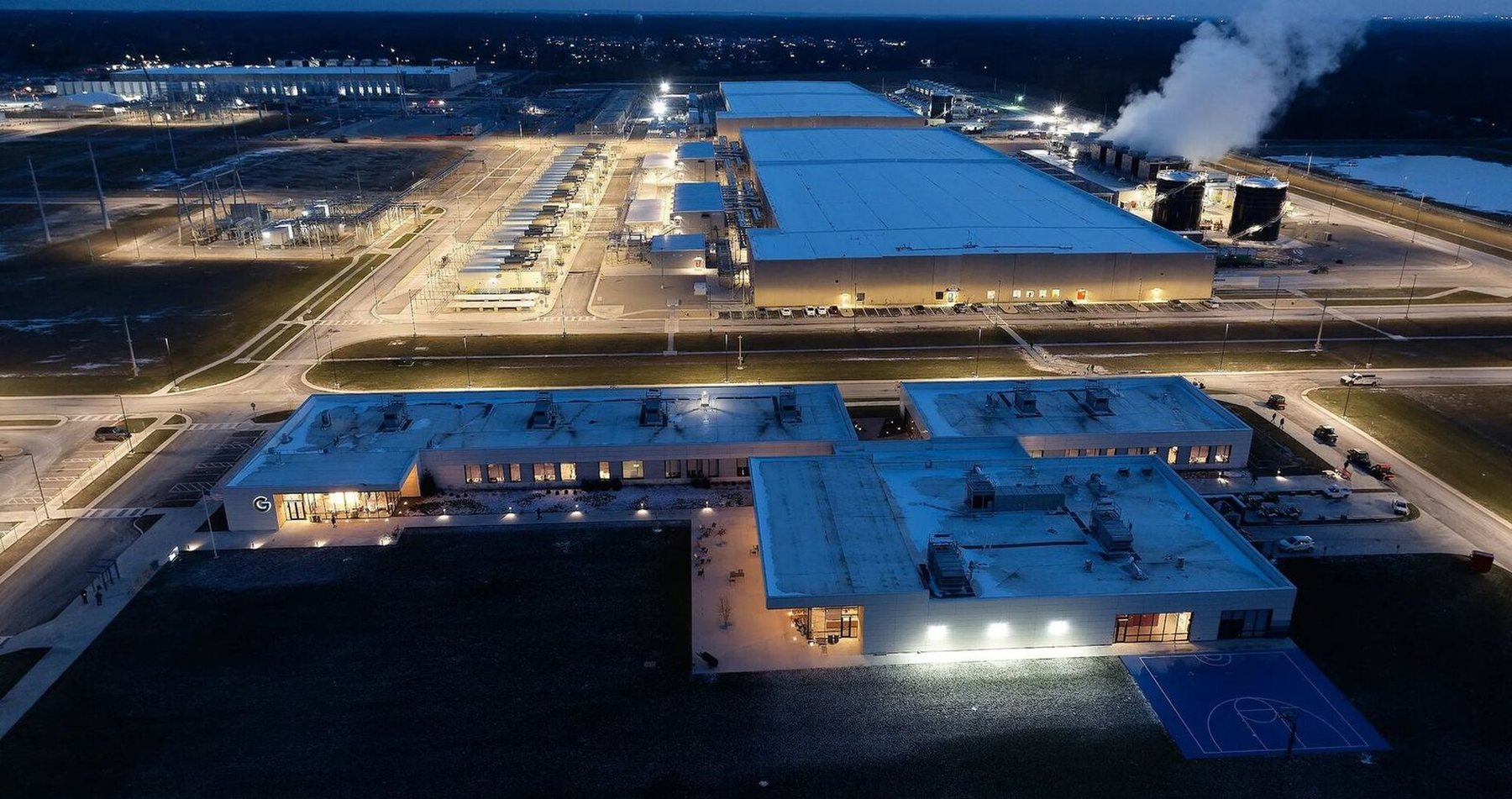
A hyperscale campus from the air
Several identical halls on one site, built in phases as demand grows.
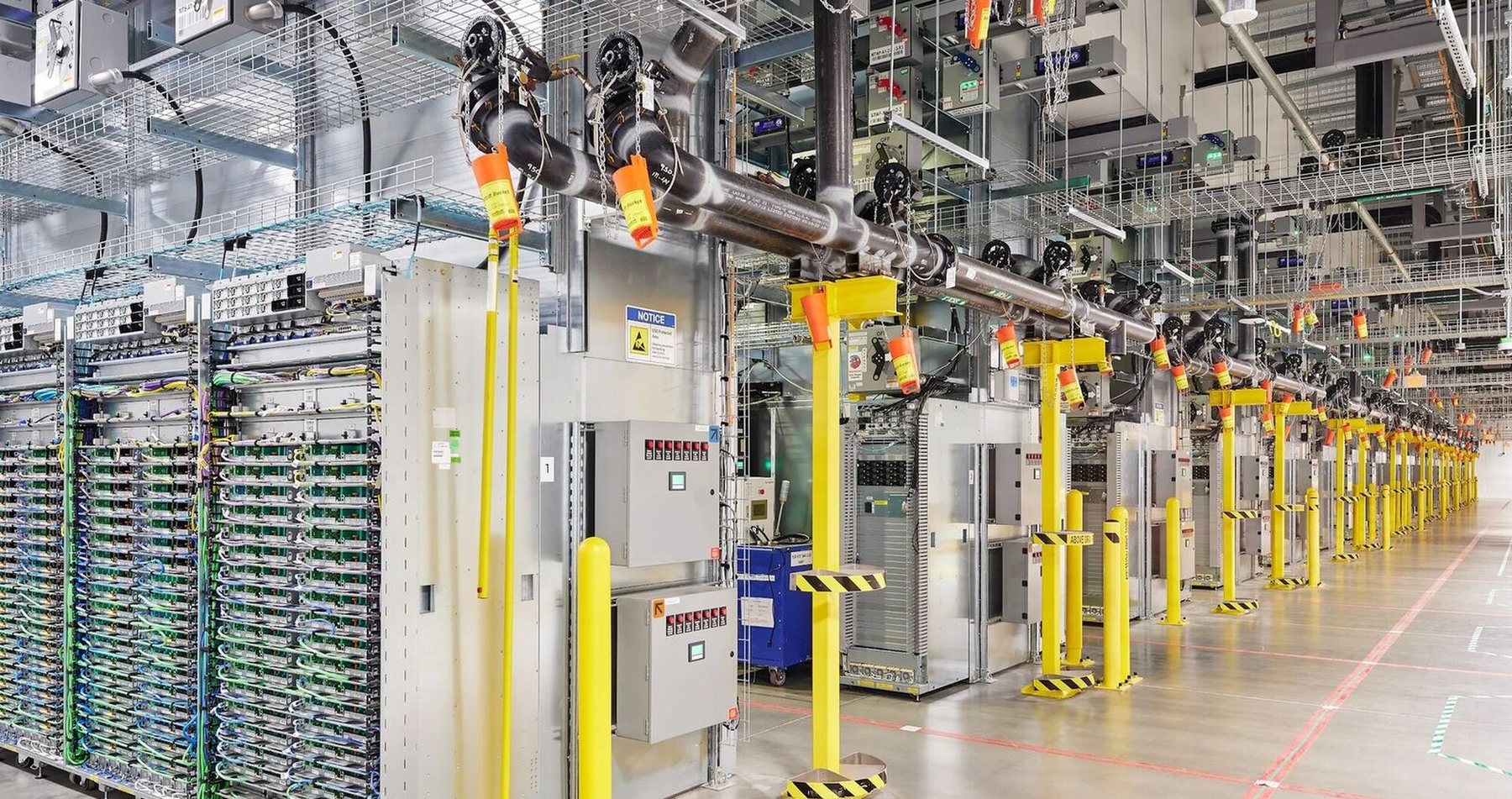
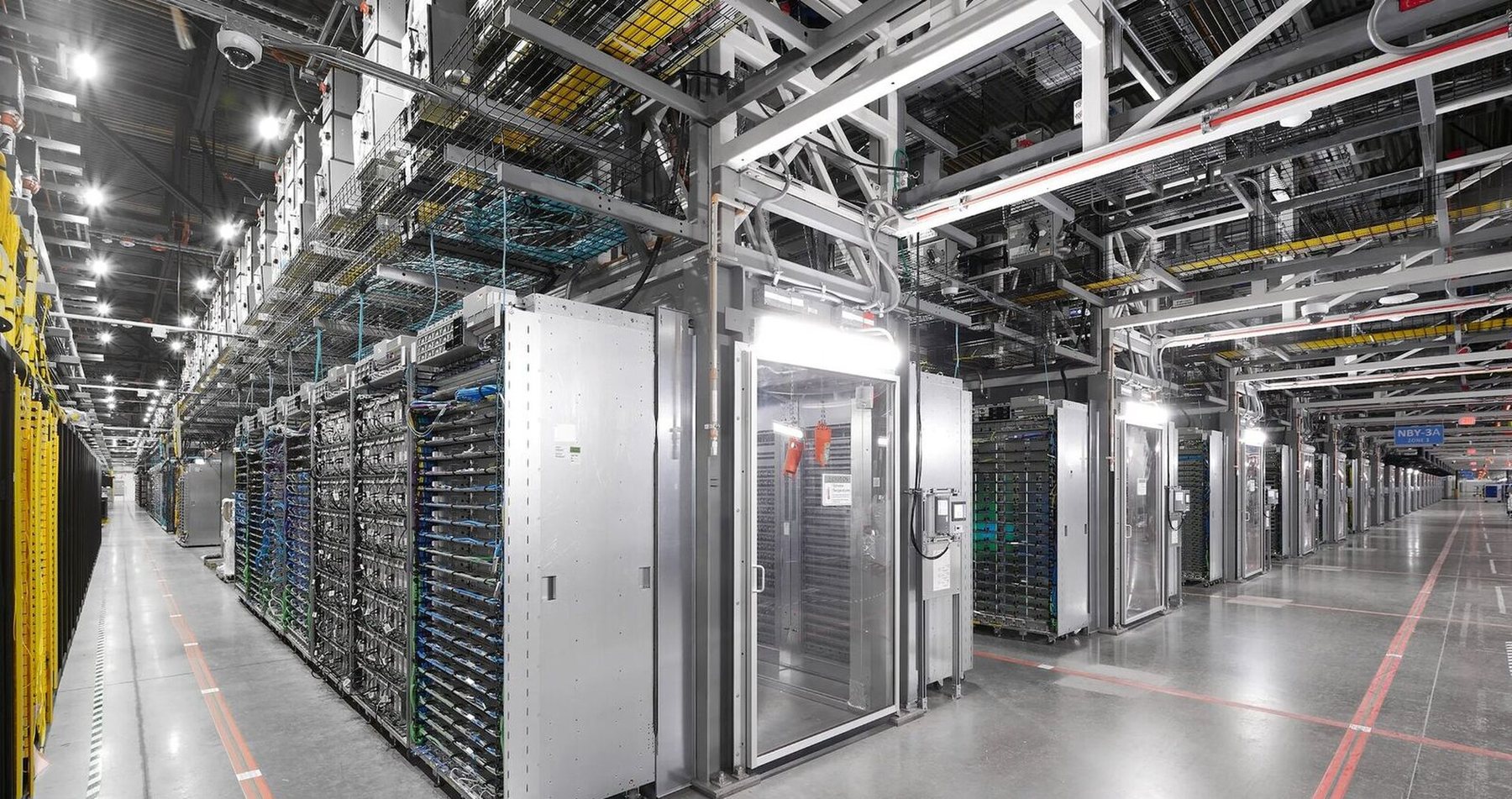
Inside a modern data hall
Rows of equipment under overhead pipework, power and cable trays.
Cooling is the second largest use of power on site
Cooling decides how much computing a site can host, how much power it needs from the grid, and how fast it can open.
PUE = total facility power / IT power
A PUE of 1.5 means 0.5 W of overhead, mostly cooling, for every 1 W of computing. Each 0.1 of PUE is worth millions of dollars a year at 20 MW.
- Energy: in air-cooled legacy facilities, cooling can take 30 to 40% of total electricity. Average PUE has sat near 1.55 for years; leading hyperscalers run about 1.1 to 1.2.
- Density: AI racks draw about ten times the power of a traditional rack in the same footprint, which air alone cannot remove.
- Uptime: temperatures climb within minutes if cooling stops, so cooling gets the same redundancy as electrical power.
- Grid: average U.S. grid connection waits are about four years, and commercial electricity rates are up nearly 30% since 2020.
- Flexibility: cooling is often 10 to 30% of a site's peak electrical load and, unlike computing, can be shifted in time.
From air in a room to liquid at the chip
Heat takes the same path in every design. What changes is how close to the chip the liquid gets.
Chip
GPU or CPU
Rack
cold plate or air
Room loop
air or CDU
Chilled water
chillers, storage
Heat rejection
tower, dry cooler
Atmosphere
heat released
Heat flows left to right. Thermal storage sits on the chilled-water step.
1960s to 80s
Water-cooled mainframes in dedicated rooms
1990s
Raised floor and CRAC units become the standard
2000s
Hot and cold aisle containment, chilled-water plants
2010s
Hyperscale free cooling, evaporative and adiabatic designs
2023 on
Direct-to-chip liquid cooling for AI, hybrid halls
Now
Flexible load: storage, warm-water loops, heat reuse
Room air: CRAC and CRAH units
- Era
- Since the 1970s
- Typical Density
- Up to about 10 to 15 kW per rack
- Leading Vendors
- Vertiv (Liebert), Schneider Electric (Uniflair), Stulz, Airedale by Modine, Munters, Daikin Applied
Computer room air conditioners (CRAC, built-in compressor) and air handlers (CRAH, chilled-water coil) push cold air under a raised floor or overhead. Servers pull it in and blow hot air back to the unit.
Strengths
- Simple, proven, understood by every operator
- Low upfront cost for small and mid-size rooms
- Works with any chilled-water plant
Considerations
- Fans use real energy and hot spots are common
- Does not reach AI rack densities
- CRACs lose efficiency at scale
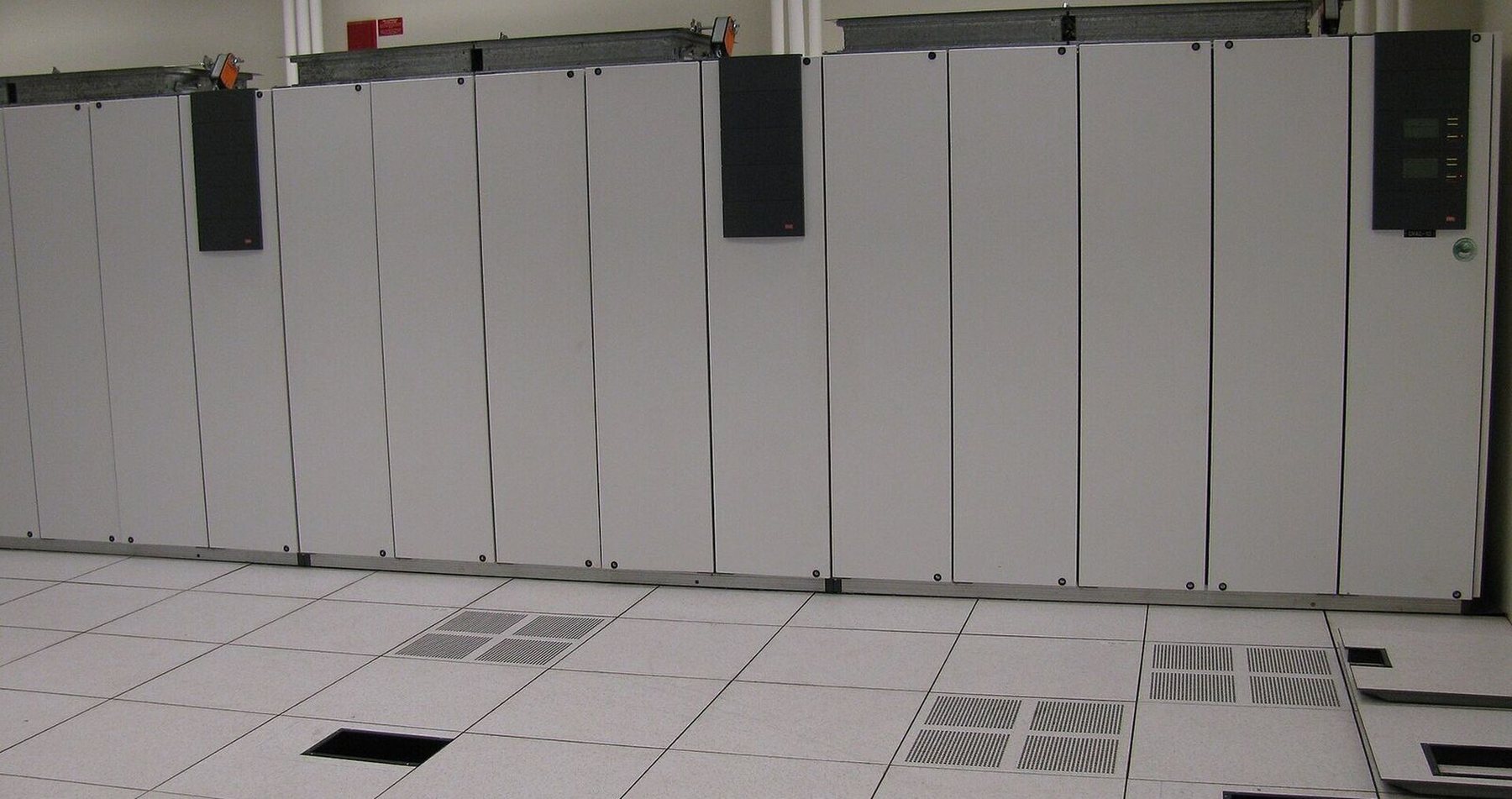
Computer room air handlers
Floor-standing cooling units at the edge of the hall push cold air under the raised floor.
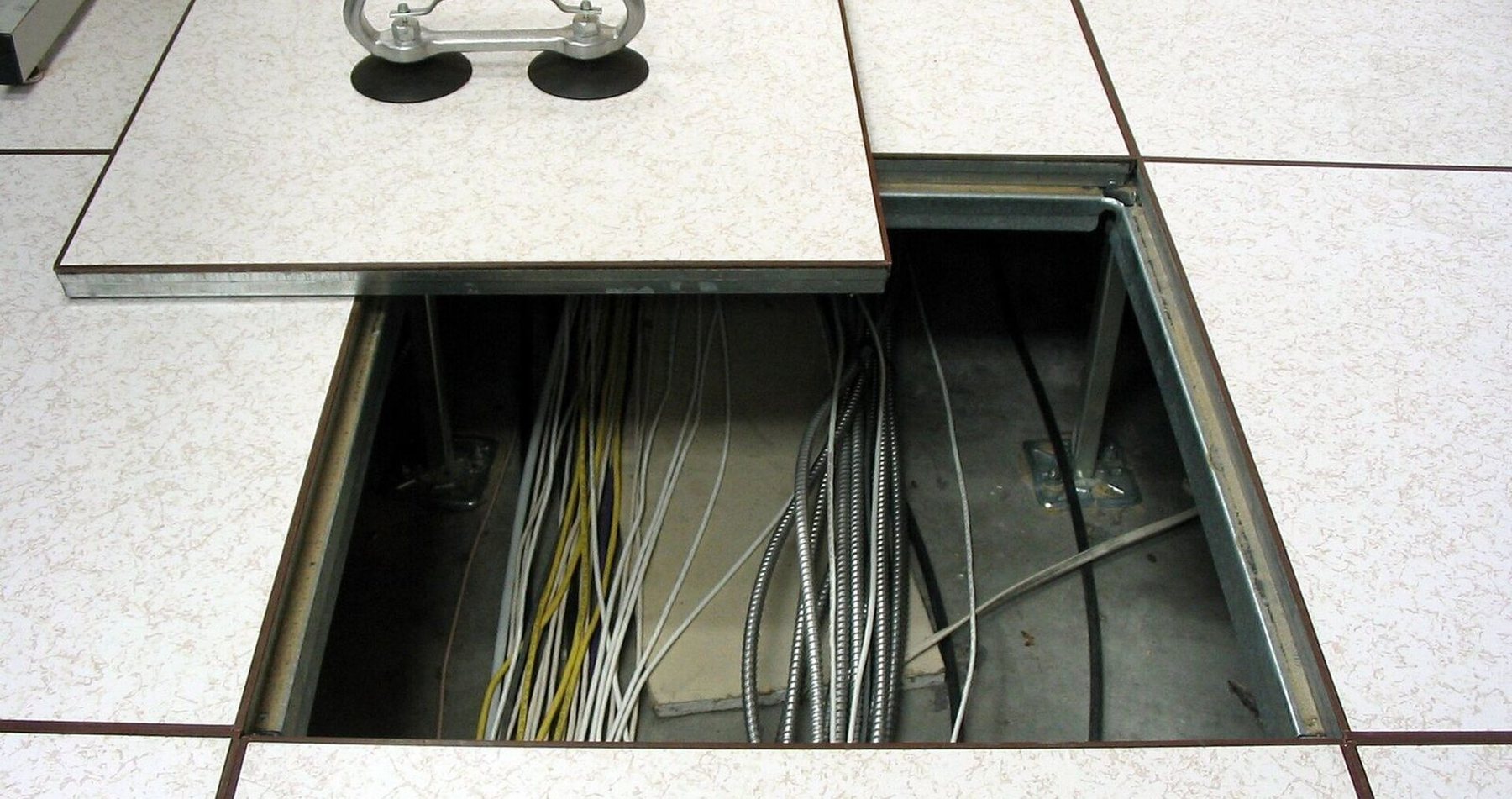
The raised floor
Lifting a floor tile reveals the cold-air plenum and the cabling beneath.
Aisle containment and in-row cooling
- Era
- 2000s
- Typical Density
- About 15 to 30 kW per rack
- Leading Vendors
- Schneider Electric (APC), Vertiv, Rittal, Stulz
Barriers keep hot and cold air apart. In-row coolers sit between racks and take hot exhaust directly, so the same air system can run warmer and move less air.
Strengths
- Large efficiency gain for little capital
- Easy to retrofit into live halls
- Raises usable supply temperature
Considerations
- Still air-based, ceiling near 30 kW
- Fire code and airflow design need care
- Mixed densities need zoning
Aisle containment
Doors and panels enclose the aisles so hot and cold air cannot mix.
Chilled-water plants: chillers
- Era
- The backbone, 1990s on
- Typical Density
- Plant scale: campus loads from 1 MW to 100+ MW
- Leading Vendors
- Trane, Johnson Controls (York), Carrier, Daikin Applied, Mitsubishi Electric, Vertiv, Stulz, Smardt
Chillers make cold water and pump it to air handlers, in-row units and liquid-cooling distribution units. Water-cooled chillers pair with cooling towers; air-cooled chillers reject heat straight to the air.
Strengths
- Efficient at scale and fully modular
- Feeds every downstream cooling method
- Natural home for thermal storage
Considerations
- Compressors are the largest cooling load
- Capital cost and long lead times
- Refrigerant rules are tightening
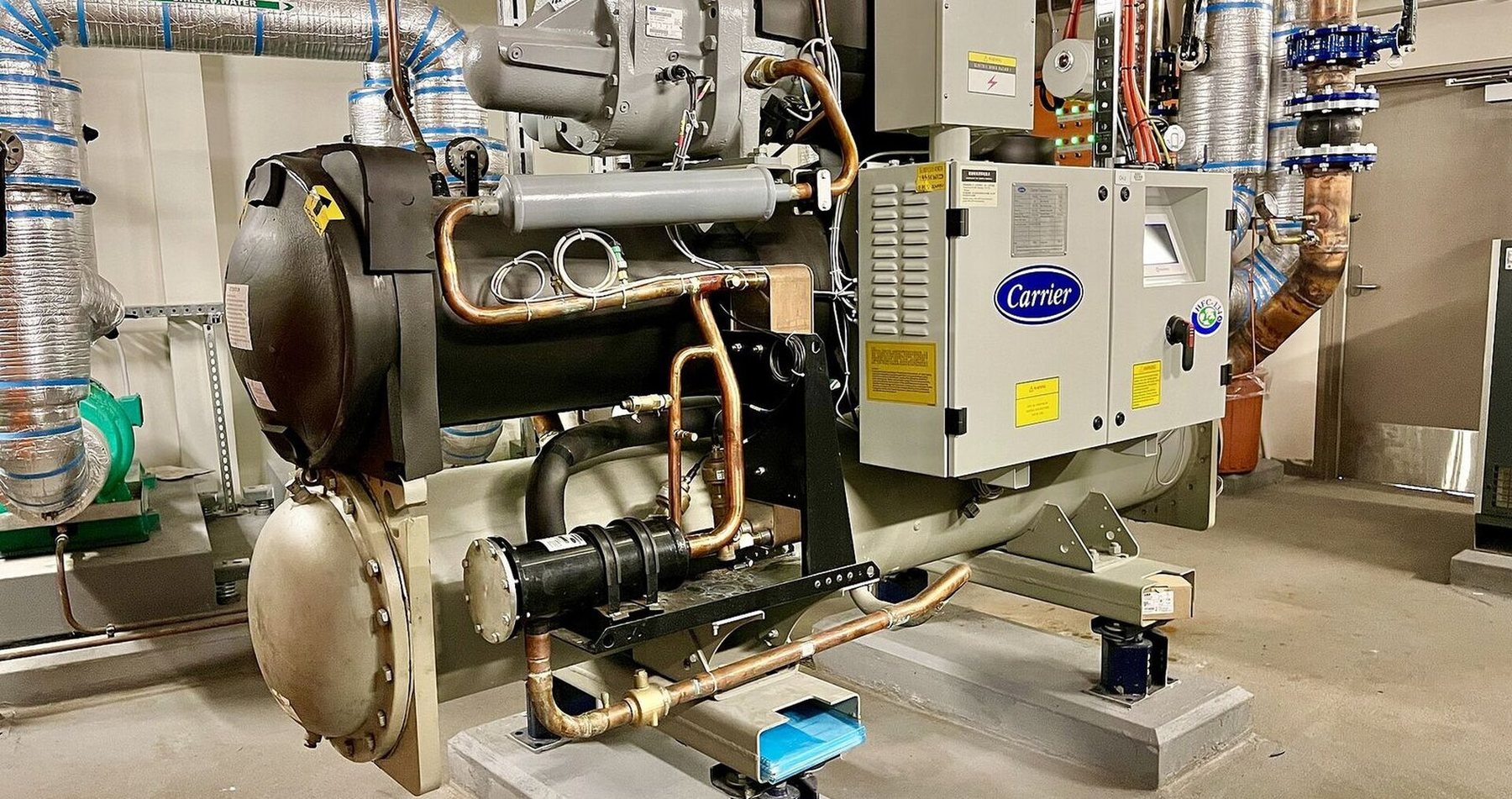
A water-cooled chiller
The heart of a chilled-water plant: it removes heat from the building's water loop.
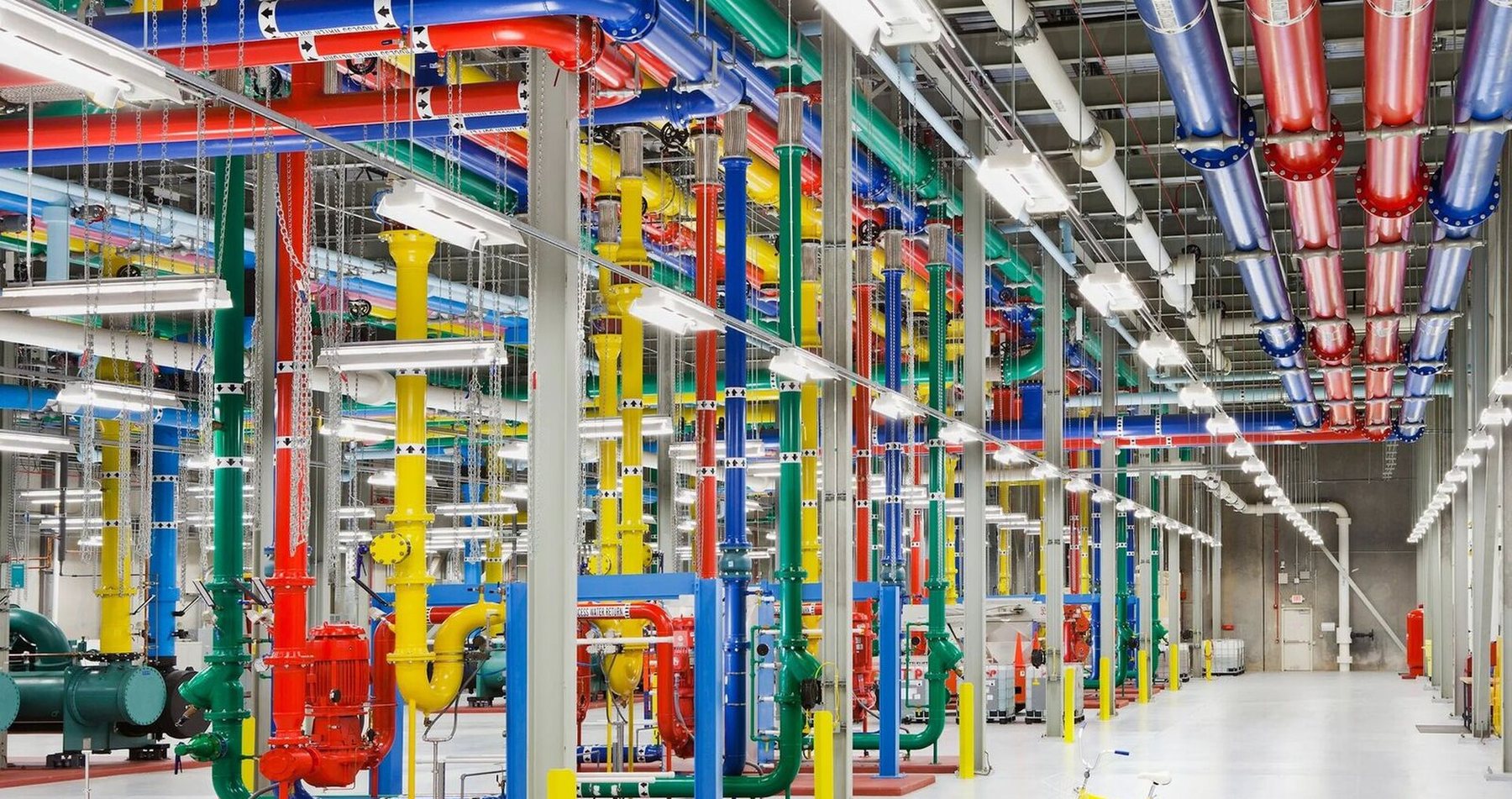
Inside the central cooling plant
Color-coded pipes carry chilled water to the halls and warm water back to the cooling towers.
Heat rejection: towers, dry coolers, adiabatic
- Era
- Every cooling chain ends here
- Typical Density
- Sized to the full facility heat load
- Leading Vendors
- Baltimore Aircoil (BAC), Evapco, SPX Cooling (Marley), Gunther, Alfa Laval, LU-VE, Modine, Chart
Heat leaves the building through towers that evaporate water (lowest energy, most water), dry coolers that use only fans and air (almost no water), or hybrid adiabatic coolers that spray water only on the hottest days.
Strengths
- Evaporative towers use the least energy
- Dry coolers remove most water use
- Warmer liquid loops make dry cooling practical
Considerations
- Water supply and permitting, especially in California
- Plume, water treatment, freeze protection
- Dry coolers need large fan fields
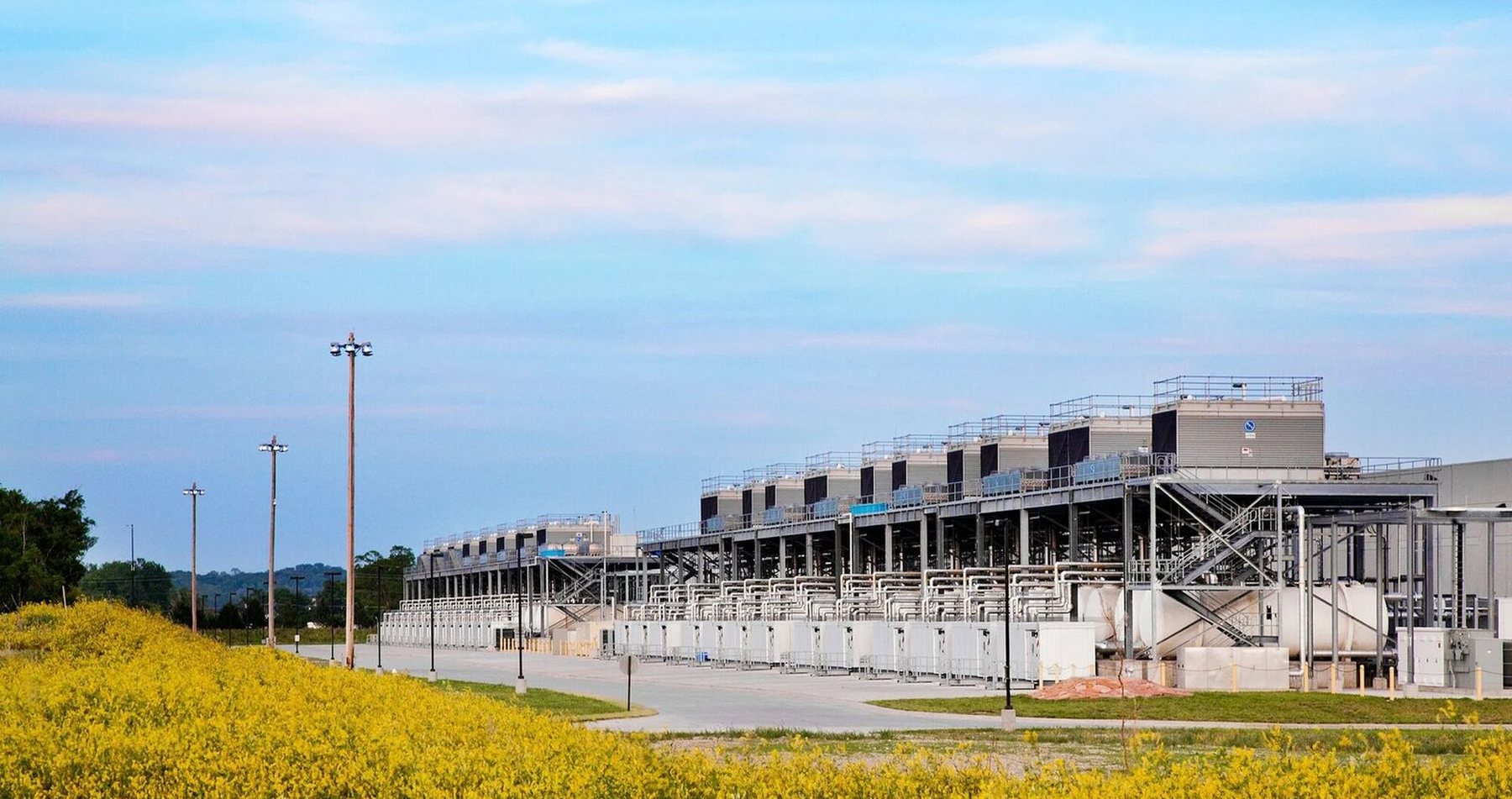
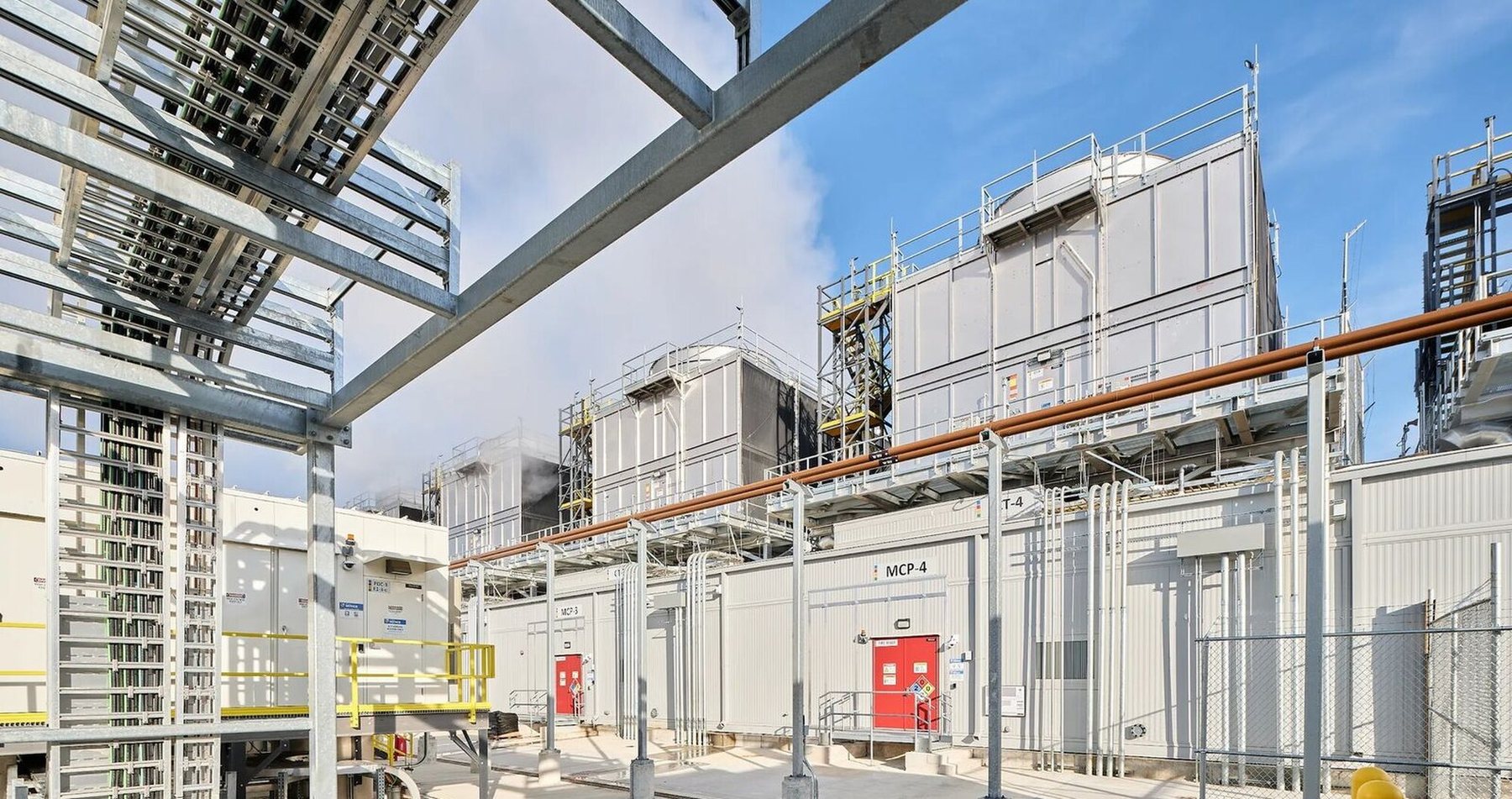
Cooling towers
Towers reject heat to the atmosphere by evaporating a small share of the water.
Dry coolers
Fan-cooled radiators that reject heat without using water.
Free cooling and economizers
- Era
- 2010s hyperscale standard
- Typical Density
- Facility scale; works with air or liquid halls
- Leading Vendors
- Munters (Nortek Data Center Cooling), Stulz, Aaon, Vertiv, Schneider Electric
When outside air or water is cool enough, the compressors switch off. Filtered outside air comes straight in (direct), or a heat exchanger moves heat to outside air, lake or seawater (indirect).
Strengths
- Biggest saving in cool and dry climates
- Behind the 1.1 to 1.2 PUE of leading hyperscalers
- Cuts compressor hours sharply
Considerations
- Depends on climate and air quality
- Humidity and filtration add complexity
- Less useful in hot, humid markets
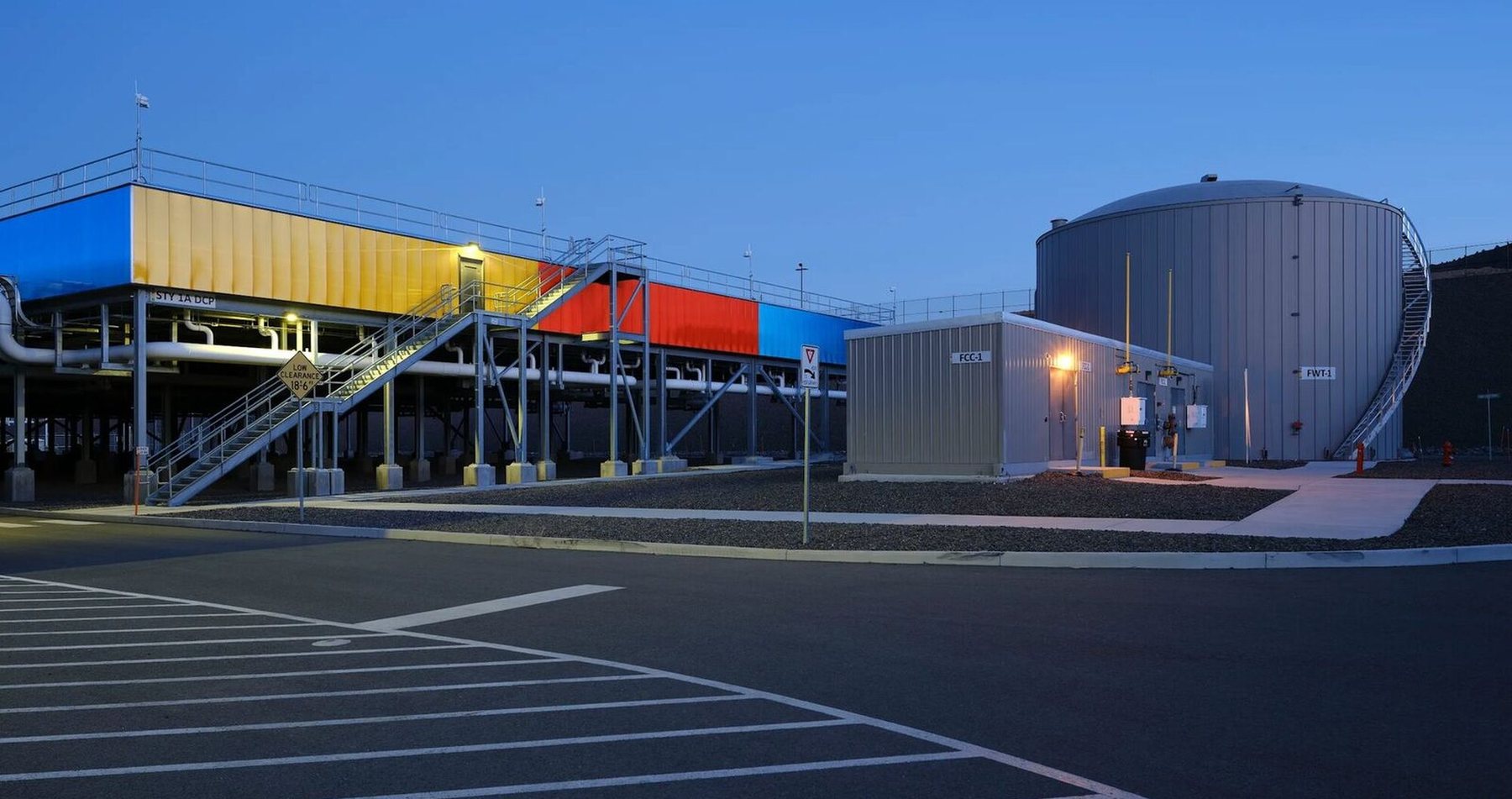
Modular cooling plants
Factory-built cooling units installed outside the building in repeating blocks.
Rear-door heat exchangers
- Era
- Bridge to liquid
- Typical Density
- About 20 to 50 kW per rack
- Leading Vendors
- Vertiv (Liebert DCD), Motivair by Schneider Electric, nVent, Coolcentric
A water-cooled radiator replaces the rear door of the rack. Exhaust air is cooled on its way out, passively or with assist fans. No change to the servers.
Strengths
- Adds density without redesigning the hall
- Room stays neutral in temperature
- Natural first step before direct-to-chip
Considerations
- Needs water piped to the rack
- Leak management and maintenance access
- Ceiling on density
Direct-to-chip liquid cooling and CDUs
- Era
- The AI standard, 2023 on
- Typical Density
- About 50 to 150+ kW per rack (a current AI rack draws ~120 kW)
- Leading Vendors
- Vertiv, CoolIT (Ecolab), Motivair (Schneider), Boyd (Eaton), nVent, Johnson Controls (Silent-Aire), LiquidStack, ZutaCore, Aaon
Cold plates sit on GPUs and CPUs. Coolant carries heat through rack manifolds to a coolant distribution unit (CDU), which hands it to the building water loop. Single-phase dominates; two-phase is emerging. Air removes the remainder.
Strengths
- The practical path for current AI chips
- Runs on warm water: less chilling, more dry cooling
- More compute per square foot
Considerations
- CDU redundancy and water-quality discipline
- Quick-disconnect reliability, new skills
- Chillers still needed for peaks and hot days
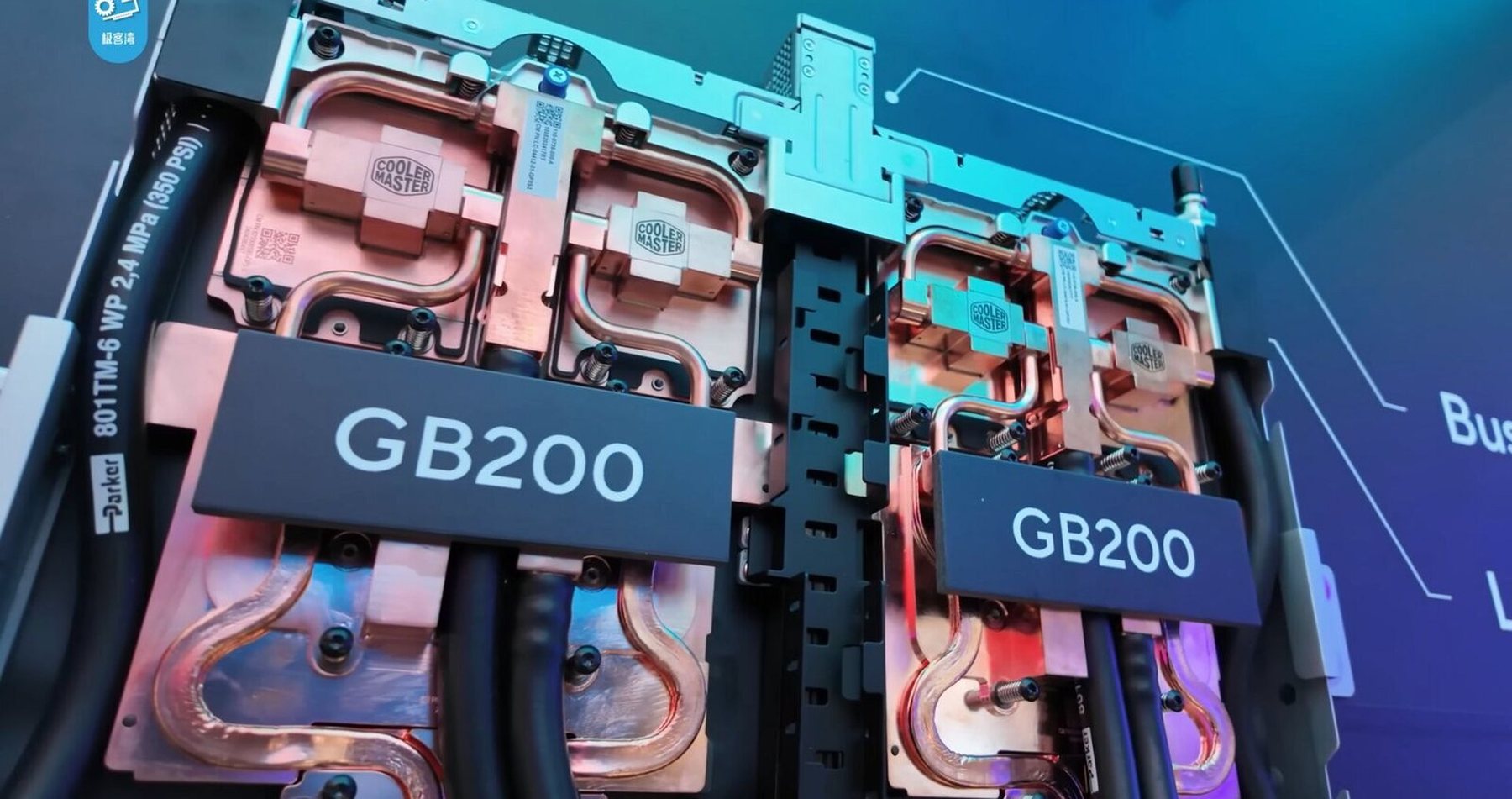
Liquid cooling at the chip
Copper cold plates sit directly on top of the GPU and CPU packages.
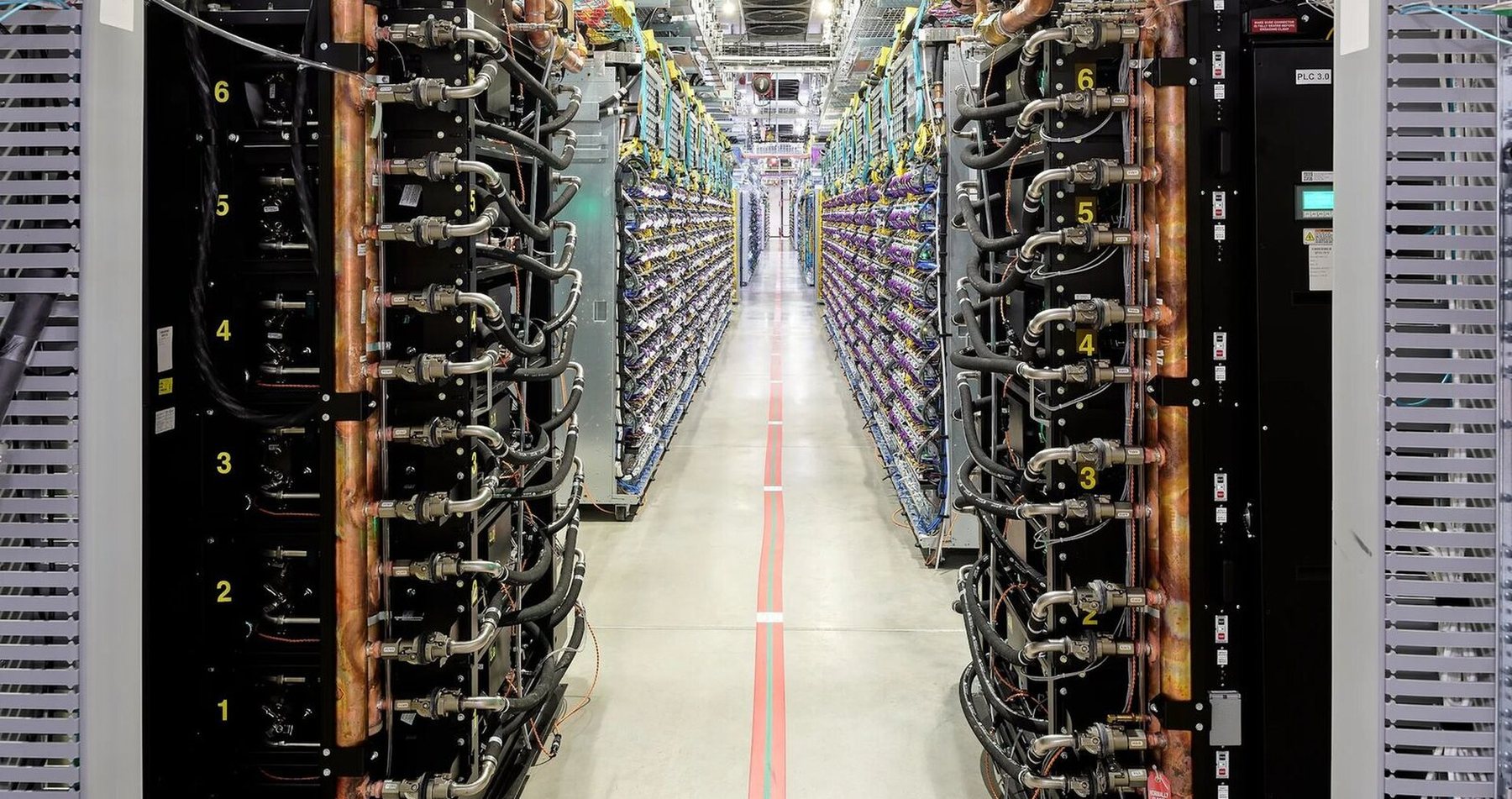
Coolant distribution units (CDUs)
Units in the hall that feed clean coolant to the racks and exchange heat with facility water.
Immersion cooling
- Era
- Niche, very high density
- Typical Density
- 100+ kW per rack equivalent
- Leading Vendors
- Green Revolution Cooling (GRC), Submer, LiquidStack, Asperitas, Iceotope
Servers sit in dielectric fluid, in single-phase tanks or two-phase boiling baths. A heat exchanger moves the heat to a water loop. Server fans disappear.
Strengths
- Highest density and very quiet
- Removes server fans
- Strong fit for edge and specialty compute
Considerations
- Server vendor warranty and support
- Fluid cost and regulatory questions
- Different maintenance and floor loading
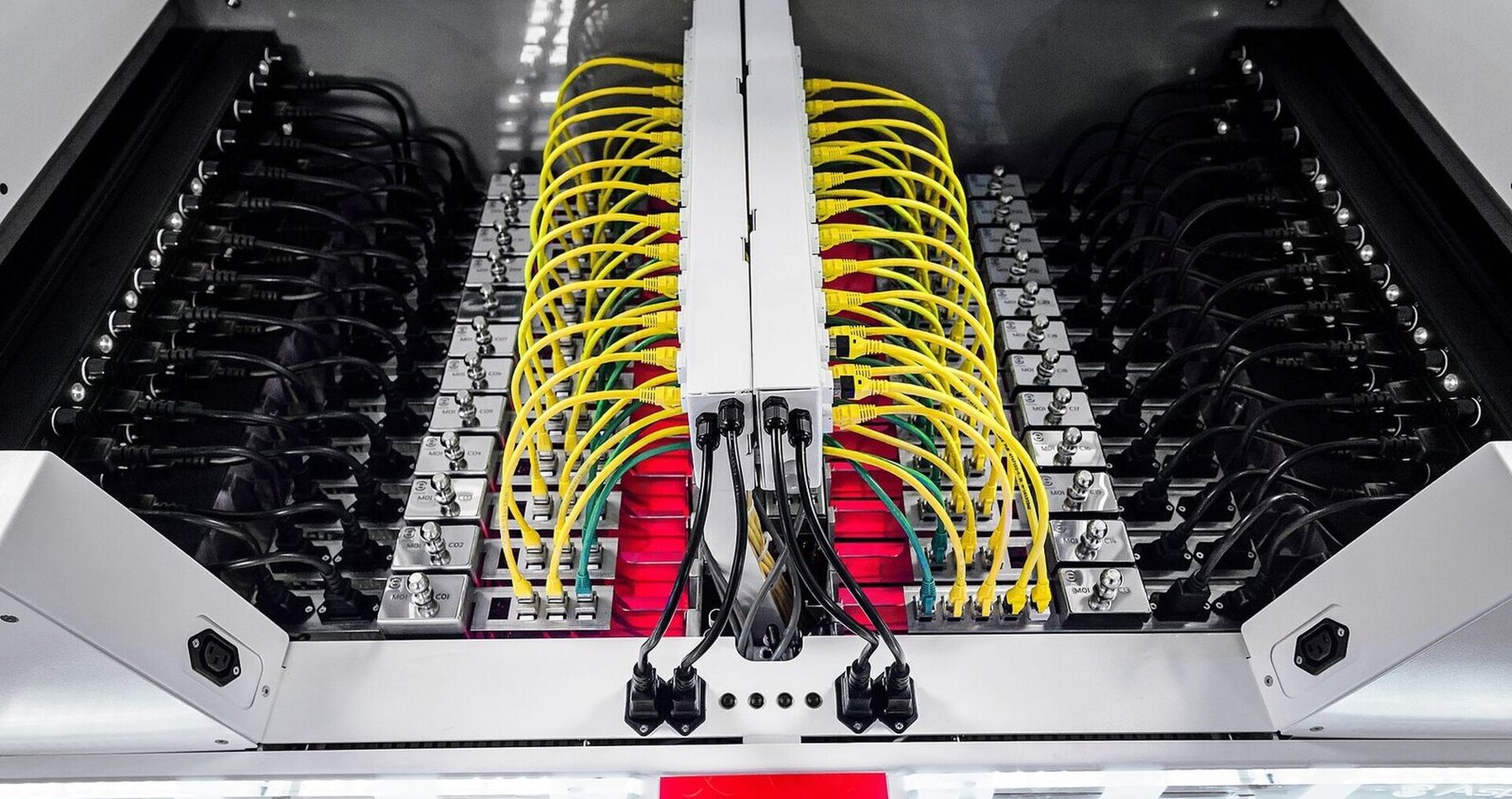
Immersion cooling
Servers submerged in a tank of non-conductive fluid that absorbs heat directly.
Thermal energy storage
- Era
- The flexibility layer
- Typical Density
- Sized in ton-hours; a 10 MW facility needs ~13,000
- Leading Vendors
- Trane (CALMAC), Baltimore Aircoil, Evapco, Fafco, newer ice-capsule entrants, chilled-water tank builders
Make cold when power is cheap or plentiful, store it, release it when power is dear or constrained. Forms include chilled-water tanks, ice (ice-on-coil or encapsulated) and phase-change materials. It sits on the chilled-water side and serves air-cooled and liquid-cooled halls.
Strengths
- Moves cooling electricity out of peak hours
- Ride-through cooling during outages
- Can defer grid upgrades, downsize chiller redundancy
Considerations
- Space for tanks or modules
- Ice needs colder chiller operation than water
- Warm liquid loops have favored water storage so far
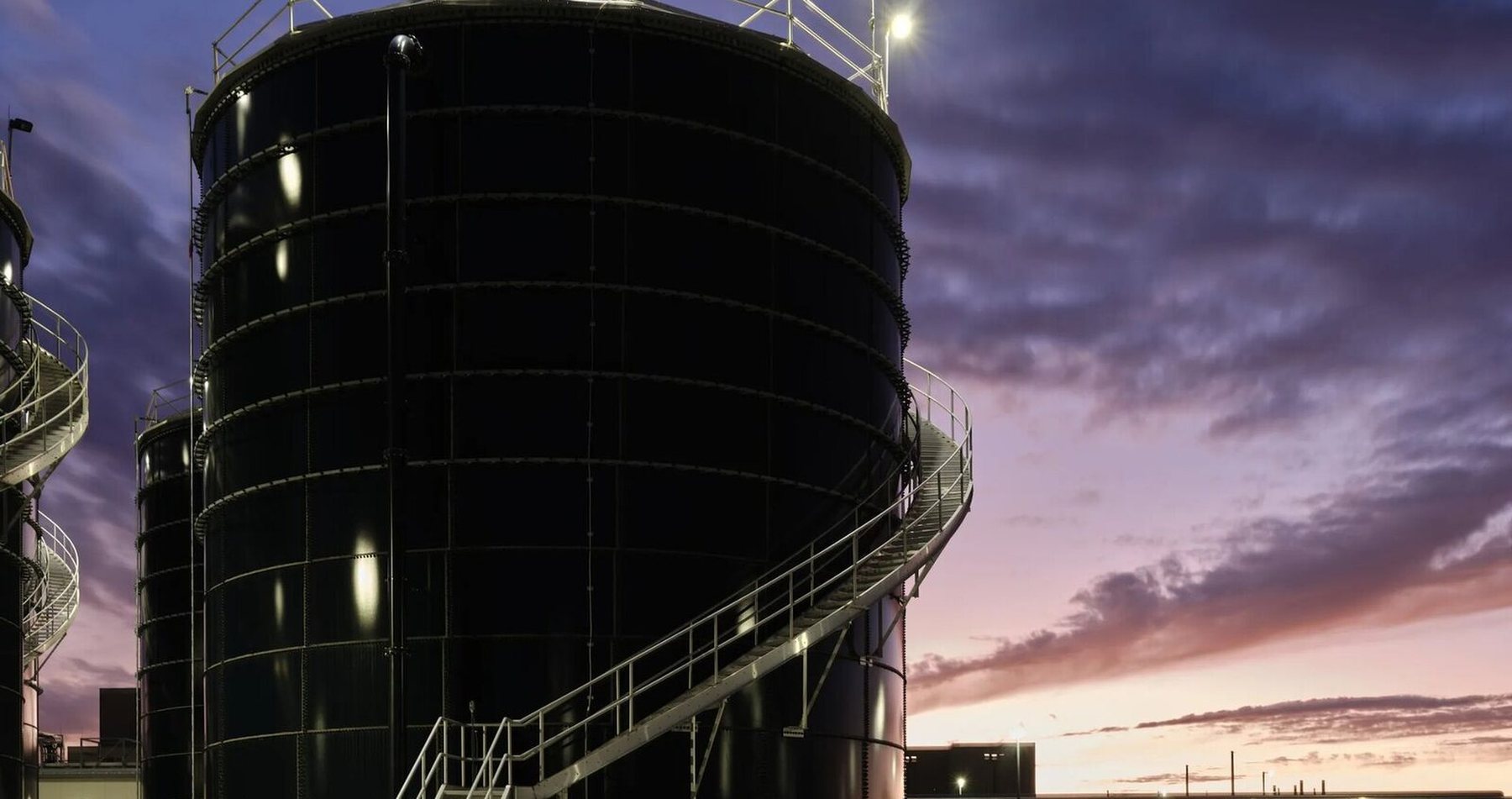
Thermal storage tank
A large insulated tank of chilled water held in reserve.
Nine approaches side by side
No single method wins. Real facilities stack several.
| Approach | Rack density | Energy efficiency | Water use | Maturity | Pairs with storage |
|---|---|---|---|---|---|
| Room air (CRAC / CRAH) | Up to ~15 kW | Moderate | Low to moderate | Mature | Yes, chilled-water versions |
| Containment and in-row | ~15 to 30 kW | Good | Low to moderate | Mature | Yes |
| Chilled-water plant | Campus scale | Good at scale | Depends on towers | Mature | Native fit |
| Free cooling / economizer | Facility scale | Best in cool climates | Low to high | Mature | Yes |
| Rear-door heat exchanger | ~20 to 50 kW | Good | Low | Mature | Yes |
| Direct-to-chip liquid | ~50 to 150+ kW | Very good, warm water | Low with dry coolers | Scaling fast | Yes, facility loop |
| Immersion | 100+ kW | Very good | Low | Niche | Possible |
| Thermal energy storage | Sized in ton-hours | Shifts load | Neutral | New in data centers | Is the storage layer |
Most new AI halls combine them: liquid takes the bulk of the heat at the chip, air handles the rest, and one chilled-water and heat-rejection plant serves both. Storage connects there.
A $13 to 22 billion market growing 10 to 17% a year
The cooling market is pulled upward by AI density and pushed into consolidation.
Market size, 2026 (analyst estimates, USD billions)
Liquid cooling revenue (USD billions)
| Market | |
|---|---|
| Cooling, narrow scope | 13.2 |
| HVAC, mid scope | 15.6 |
| Cooling, broad scope | 21.8 |
| Liquid | |
|---|---|
| 2024 (approx.) | 1.5 |
| 2025 | 3 |
| 2029 (forecast) | 7 |
1 in 5
data centers use liquid cooling today
Estimates differ by what each firm counts. All point the same way: 10 to 17% annual growth through 2033 to 2035.
Selling cooling to data centers
Who decides, owners versus operators, the sales cycle, the major vendors and what a new entrant needs.
No one person buys cooling: a chain of seven roles does
The money comes from the owner, the standard from engineering, and the veto from operations.
1
Owner or developer
Funds the build and approves capital. Wants return and speed.
2
Owner's engineer
Sets the facility standard. Wants uptime and repeatability.
3
MEP design firm
Writes the spec and names the equipment. Wants proven gear.
4
GC or EPC
Buys what is specified and holds the schedule.
OEMs and reps
5
Supply, install and warrant. Want to stay in the spec.
Commissioning agent
6
Proves it performs before go-live.
Operations team
7
Runs it for 15 to 20 years. Wants simple, serviceable systems.
The rule of the market: if a product is not in the MEP firm's drawings, it is rarely in the deal. Influence the standard and the spec early, then win operations' approval.
Owner or operator? Both: the sale needs the owner's money, the engineer's pen and the operator's trust
In hyperscale and colocation the owner and operator are usually the same company. The split matters in leased and investor-owned models.
| Segment | Owner and operator | Who sets the cooling design | How they buy |
|---|---|---|---|
| Hyperscaler self-build | Owns and operates | Central engineering; global design | Approved vendor lists, frame agreements |
| Colocation and wholesale | Owns and operates; tenants lease | Operator engineering; large tenants can dictate | Project by project from approved designs |
| Build-to-suit developer | Developer builds; tenant runs IT | Often the tenant's specification | Design-build with named equipment |
| Investor-owned platforms | Funds own the platforms | Operator engineering; capital committee approves | Capex and value-creation programs |
| AI cloud (neocloud) | Leases or builds fast | Speed to capacity comes first | Quick pilots, flexible specs, financing |
| Enterprise and edge | Own and operate small rooms | IT and facilities teams | Integrators and local contractors |
From first meeting to repeat orders takes 18 to 36 months
Indicative durations for a new technology entering the data center cooling chain.
1
Access
- 1 to 3 months
- Reach the right engineers. Typically 8 to 15 touches to land one meeting.
2
Technical validation
- 3 to 6 months
- Thermal and load modeling; integration review with chillers, CDUs, controls.
3
Design inclusion
- 3 to 9 months
- Get into the basis of design and MEP drawings, tied to project design phases.
4
Vendor approval
- 2 to 4 months
- Audits, insurance, safety, financial review and contract terms.
5
Pilot or first site
- 6 to 12 months
- Install, commission, measure and publish results.
6
Standardize
- 12 months and beyond
- Repeat orders and inclusion in the owner's standard design.
Winning vendors treat this as a market to own over five to ten years. Trust is earned on delivery against critical deadlines, not on the lowest bid.
What buyers weigh, in order
Buyers weigh uptime and response speed more than price.
- Uptime and reliability
- No single point of failure
Critical
- Bankability of the vendor
- Balance sheet, warranty, service reach
Critical
- Capacity unlocked
- More sellable MW from the same connection
High
- Safety and insurability
- Fire risk, fluids, insurer acceptance
High
- Supply chain and lead time
- Domestic content, manufacturing capacity
Medium
- Speed to power and opening
- Days of delay cost more than equipment
Critical
- Total cost of ownership
- Capex, energy, maintenance, financing
High
- Footprint and siting
- Pad space, roof loads, permits
High
- Controls and integration
- Works with BMS, DCIM, chiller plant
High
- Water and sustainability
- Local water limits, carbon goals
Medium
A concentrated field that is buying its way into liquid
Large incumbents sell the whole thermal chain. Reference designs and service networks are their moat.
| Vendor | Position | How they sell |
|---|---|---|
| Vertiv | Share leader in DC HVAC (~18%); leads liquid cooling | Integrated power and cooling; large service network; backlog above $15B |
| Schneider Electric | Top-five in HVAC; Motivair for liquid | Reference designs with chip makers, EcoStruxure software, prefab modules |
| Trane Technologies | Top-five; leading chillers; owns CALMAC storage | Chilled-water plant, controls and service from one vendor; bought Stellar Energy in 2026 |
| Johnson Controls | Top-five; York chillers, Silent-Aire | Chillers, modular cooling, CDUs; consulting-engineer coverage |
| Carrier and Daikin | Top-five (Carrier); major chiller makers | Large chiller and air-handling installed base |
| Eaton (Boyd Thermal) | Entered liquid by acquisition, 2026 | Electrical portfolio plus cold plates and CDUs |
| Ecolab (CoolIT) | Direct liquid cooling specialist | Cold plates and CDUs with water-chemistry service |
| Others | Stulz, Munters, Aaon, Modine, nVent, LiquidStack | Win with customization and hyperscaler partnerships |
Five vendors hold close to 60% of data center HVAC
Concentration helps a new entrant that can partner with the leaders and hurts one that must displace them.
Share of 2025 data center HVAC revenue (%)
What this means
- Five names control more than half the market, and every one sells chillers.
- Chillers are where many new technologies connect, so incumbents are both channel and competitor.
- Liquid cooling is less settled: ~40 CDU vendors, consolidation under way.
- Public share data is strongest at category level; shares by cooling type are not reliably published.
| Share | |
|---|---|
| Vertiv | 18.1 |
| Carrier, JCI, Schneider, Trane (combined) | 40.5 |
| All other vendors | 41.4 |
The top five vendors held 58.6% of the market; the four others average about 10% each.
What a new entrant needs to be heard
The product has to be good. The path to market has to be just as deliberate.
Barriers to expect
- Critical-infrastructure buyers are risk-averse and slow to qualify new suppliers
- A small vendor must show a balance sheet, warranty and service reach
- Incumbents bundle storage, controls and service into the chiller contract
- Reference designs from large vendors set what engineers specify
- Pilots must run on live sites that cannot afford disruption
- Warm liquid loops change the case for some storage types
How a new entrant earns a place
- Lead with speed to power: utilities offer faster, flexible connections to loads that curtail at peak
- Be included in designs: work through MEP firms, EPCs and chiller OEMs
- Offer financing or as-a-service terms so capex committees do not stall the deal
- Win one flagship site with published, measured results
- Qualify for utility and capacity programs
- Prove integration with liquid loops, CDUs and major controls platforms
Who we sell to
The top U.S. operators, segments and positioning, where to start, and the effort required.
Twenty-five companies hold most of the 17 GW of active U.S. capacity
Hyperscalers and colocation providers are near parity in capacity. Both matter.
| MW | |
|---|---|
| Amazon Web Services | 2300 |
| Meta | 1500 |
| Microsoft Azure | 1200 |
| Equinix | 995 |
| QTS | 811 |
| Digital Realty | 686 |
| CyrusOne | 674 |
| Aligned | 548 |
| DataBank | 544 |
| Google Cloud | 508 |
| Oracle | 470 |
| Switch | 445 |
| STACK Infrastructure | 410 |
| CoreSite | 331 |
| NTT Global Data Centers | 322 |
| Vantage Data Centers | 314 |
Reading the chart
- Active IT capacity in MW, 2025
- Hyperscalers: AWS, Meta, Microsoft, Google, Oracle
- Colocation and wholesale: Equinix, QTS, Digital Realty, CyrusOne and others
- Next tier (180 to 260 MW): CloudHQ, Hut 8, Iron Mountain, Cipher Mining, Centersquare, Flexential, CoreWeave, Sabey, TierPoint
Six audiences, six different pitches
Company profiles only. We approach each through its engineering, development or capital leadership.
| Segment | Who | What they value | How to position and enter |
|---|---|---|---|
| Hyperscalers | AWS, Microsoft, Google, Meta, Oracle | Capacity per grid connection; speed of energization | Pilot via engineering, reached through MEP firms, EPCs, OEMs |
| Colocation and wholesale | Equinix, Digital Realty, QTS, CyrusOne, Aligned, STACK, Vantage, NTT, CoreSite, DataBank | More sellable MW, faster delivery, lower cost, resilience | Operator engineering and development teams, project by project |
| AI cloud / neoclouds | CoreWeave, Hut 8, Cipher Mining and similar | Time to power; financing that conserves cash | Direct to leadership with a rapid pilot offer |
| Infrastructure funds and REITs | Owners of QTS, CyrusOne, Aligned, DataBank | Asset value, yield, growth without new utility capacity | Portfolio-level programs through Atomgigs and Mavengigs |
| Design and build channel | MEP firms, EPCs, GCs, chiller OEMs | Proven gear, schedule certainty | Education, reference designs, partnership terms |
| Utilities and grid operators | PG&E, Southern California Edison and peers | Verified, dispatchable load reduction at peak | Programs and tariffs that make flexibility pay |
Where grid waits are longest, flexibility is worth the most
A cooling load that can shift is a way to connect sooner. That is the opening for storage and other flexible technologies.
Why California first
- Utilities ration firm capacity and reward flexibility
- PG&E runs Flex Connect and T-Flex; Southern California Edison runs a load-control pilot
- Capacity credits reward load that can shift
- Close to Atomgigs's base
Then the other constrained hubs
- Northern Virginia, Dallas-Fort Worth, Phoenix, Chicago, Atlanta
- Each market has its own utility programs, so entry is utility by utility
- Operators in several hubs let one pilot seed a multi-site rollout
How the sale unfolds, account by account
One enterprise-grade sale is a program of work, not a campaign.
1
Map
- Weeks 1 to 6
- Rank target accounts by grid constraint, cooling architecture and pipeline.
2
Open
- Weeks 4 to 16
- Warm introductions through engineering, development and capital teams.
3
Qualify
- Months 3 to 6
- Confirm a live project, decision path and budget owner.
4
Validate
- Months 4 to 9
- Engineering review: site load, controls and chiller integration.
5
Pilot
- Months 8 to 18
- Contract, financing, install and measure at a live site.
6
Scale
- Month 12 on
- Move from one site to a multi-site standard.
What Atomgigs does
Builds the market map; opens doors and runs first meetings with the vendor's engineers; prepares the technical brief, ROI model and pilot proposal; keeps the pipeline disciplined.
What the vendor brings
Application engineering for each site, performance data and reference sites, commercial and financing terms, and an executive sponsor.
What the work takes: time, meetings and documents
Indicative planning ranges for market development of this kind.
| Unit of work | Time | Meetings | Documents |
|---|---|---|---|
| Per target account, to a first technical meeting | 20 to 40 hours | 8 to 15 touches | Account brief, intro note, one-page overview |
| Per qualified opportunity, through validation | 80 to 150 hours | 10 to 15 meetings | Technical brief, ROI model, integration notes |
| Per pilot, proposal to signature | 100 to 200 hours | 8 to 12 meetings | Pilot proposal, commercial terms, financing outline, vendor forms |
| Program level, first year | ~1,500 to 2,000 hours | Weekly cadence | Market map, target list, positioning kit, pipeline reports |
Year-one picture
- 8 to 12 target accounts actively engaged
- 3 to 5 technical evaluations underway
- 1 or 2 pilot discussions at term-sheet stage
Why the effort is front-loaded
Most of the work happens months before any contract: education, relationships and technical validation. A steady base of resources has to be in place from week one for later stages to land on time.
About Atomgigs and notes
About Atomgigs, equipment and automation, Mavengigs and Monty Pandey, and notes.
We bring humans and machines together.
Atomgigs is not just robots. It is every kind of physical AI, put to work on your build and kept running.
Atomgigs brings humans and machines together to scale up a build and stay to operate it: robots, drones, IoT devices, digital twins and complex machinery, run as one crew with machines taking more of the load as they prove themselves.
- Atoms
- The physical world: sites, machines and materials.
- Gigs
- Jobs done. Defined work, delivered in focused engagements.
- Atomgigs
- Physical AI, delivered as jobs done.
Project owners
Work built and running now, with more robots over time.
Manufacturers and OEMs
A route from the factory to the field and a paying customer.
Investors
Eyes and expertise on your physical AI bets.
- Manufacturers and OEMs make the machines. Project owners need the build done and the site operating.
- Atomgigs connects the two, and everyone with capital at stake.
Not just the robots.
Atomgigs coordinates the equipment, automation and digital twins your build needs, and operates them.
Equipment coordinated
We coordinate the implementation of large, complex systems, working with original equipment manufacturers (OEMs), distributors and end users.
- Data center power: transformers, switchgear, generators, UPS
- Cooling: chillers and liquid cooling
- Large-scale automation products, such as transducers and control systems
- Specifications, submittals and factory acceptance tests
- Heavy-haul delivery, rigging, pads and laydown
- Installation, utility interconnection and commissioning
- One team coordinating OEMs, distributors and the end user
Automation and IoT
Everything automation, from a single sensor to a full system.
- IoT sensors for power, temperature, flow, leaks and vibration
- Controllers, gateways and edge devices
- Building management, power monitoring and SCADA integration
- Open protocols, so many vendors work together
- Full automation systems, integrated and commissioned
- Network and cybersecurity design for site devices
- Feeds the site's digital twin
A live model of the site
A digital twin is a living digital copy of a site and everything installed on it.
- PLAN
- Model a data center or other project before breaking ground: layout, power, cooling, equipment fit and sequence of work.
- BUILD
- Update the model with as-built data and equipment submittals, then hand it to the owner.
- OPERATE
- Map the site and track each installed product
- Support operations and maintenance
- Keep service history, warranties and work orders
- Plan servicing and spares; add live sensor data
Mavengigs: The Scale Up Guys
Consulting, Capital and Ventures
Mavengigs Consulting
Mavengigs Capital
Mavengigs Ventures
- Strategic M&A, transformation and optimization
- Focused on the part of M&A that begins after everyone shakes hands
- Built for PE-backed and Fortune 500 teams
- An independent sponsor platform
- Family office strategy and management
- Funding and mentorship for founders we back
- Panmedical: digital health in India, run as CEO
- Atomgigs, Mavens Life and Mavens Health
Monty Pandey: Founder, CEO and driving force behind Atomgigs
Selected transactions, buy side and sell side
Core Expertise: 30+ years of management consulting in integration, divestiture, PMO and IMO. $20B M&A deal value, $100M business impact.
- 2018-present: Mavengigs: Consulting, Capital and Ventures
- 2004-2018: Founded Panvisage, CEO for 22 years
- 1998-2004: Oracle, led 14 enterprise programs
- 1994-96: Rolled out nationwide cell networks
- 1992-94: Car and truck design (CAD, CAM, CIM)
- 1989-91: B.E. Electrical and Electronics; designed robots (AGVs)
- Data Centers: Equinix
- E&C Companies: WSP, Jacobs, Halliburton, Fluor Daniel, Brown & Root
- Managed buildout of a manufacturing plant and a distribution center
GE Appliances / Haier
$5.6B
Readied for sale
Jacobs / CH2M
$3.3B
Integration
ITW Signode / Carlyle
$3.2B
Carve-out, then sale
AMLI / Morgan Stanley
$2.1B
Take-private
Fortune Brands / ACCO
$2B
Divestiture, integration
Equinix / Packet
$335M
Integration
Why this work fits Atomgigs
We open doors, prepare the ground, and stay with the sale.
Technology-maker advisory
- We advise manufacturers on positioning, who to sell to and how to enter large projects
- Our model is built on long, complex, relationship-led sales to project owners
- We work from the buyer's side: what owners, engineers and operators need to say yes
Data center and construction access
- Deep roots in engineering and construction, including work with leading E&C firms and data center operators
- A growing library of data center research behind every conversation, including the Atomgigs Data Center Primer
- A network of infrastructure investors through Mavengigs
Notes
Product names, trademarks, images and photographs shown in this document belong to their respective owners and are used for illustration only. Atomgigs does not claim ownership of any third-party product, system, technology, design or photograph.
Atomgigs is an independent advisor. It helps technology vendors reach data center owners and operators and helps buyers find the right solutions. Descriptions of vendor technologies reflect public information and vendor statements. Market figures are estimates drawn from public sources and vary by scope and definition.
Let us build this market together
Atomgigs, a Mavengigs Venture. atomgigs.com, [email protected], +1-310-694-4750, Los Angeles, California.